
A net that sags by August isn’t a net problem. Nine times out of ten, it’s a twine problem. Infinity Thread Industries has been fielding calls from net manufacturers and farm suppliers for years, and the pattern repeats: someone orders agriculture twine for net making based on price per kilogram, the mesh holds up fine through the dry season, and then the first real monsoon or the first strong crop-load wind takes the whole structure down.
The short version: agriculture twine for net making needs three things locked in before you order, not after. UV stabilization so it doesn’t go brittle in the sun. A tensile strength rated for the actual wind and crop load the net will carry. And denier that’s consistent spool to spool, because uneven denier means uneven mesh, and uneven mesh tears at exactly the point where it’s weakest. Get those three specs right and the net lasts seasons. Get them wrong, and you’re re-tying a field mid-harvest.
This guide walks through what to actually check on a spec sheet, what a workable denier range looks like for different net types, and the buying mistakes that show up most often in our order enquiries.
What Makes Twine Suitable for Net & Trellis Work
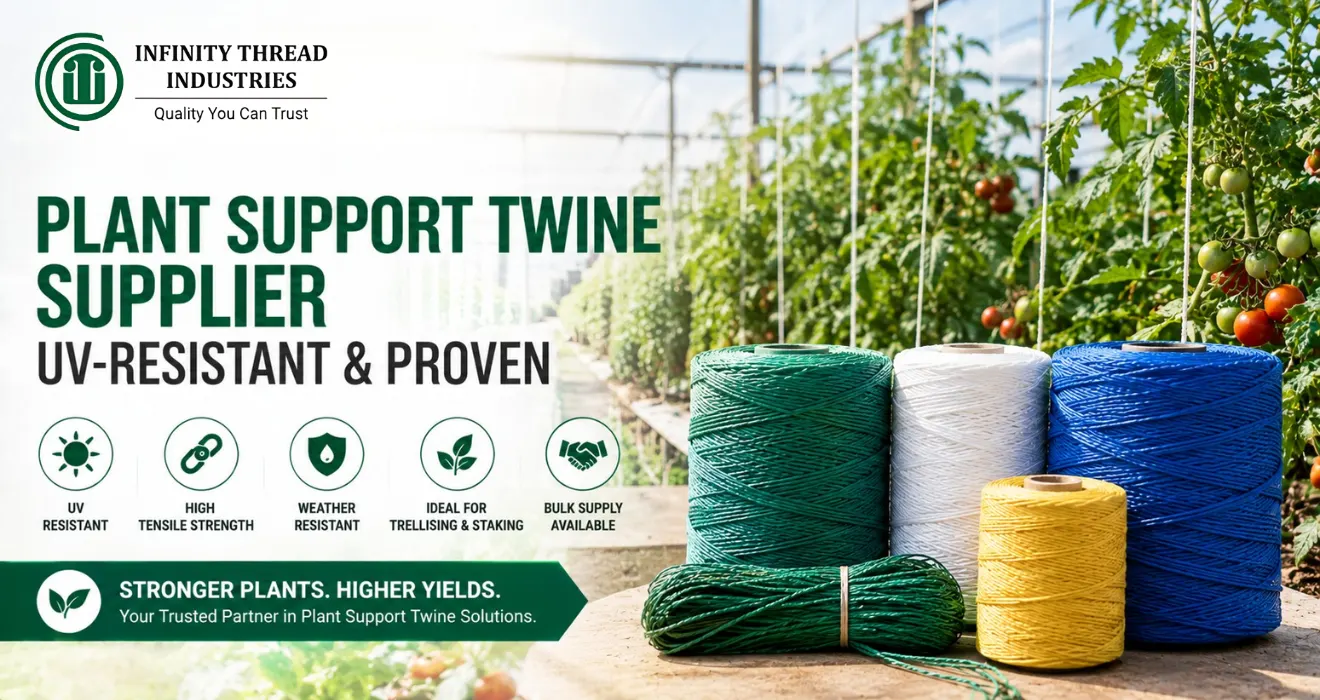
Not every twine that’s technically strong enough to hold is suitable for net making. A cotton or jute string can hold a tomato vine for a season. It won’t hold a crop-support net stretched across three acres through a Gujarat summer. The twine used to weave or knot crop-support and trellis nets has to do three jobs at once: resist UV breakdown, carry tensile load without stretching out of shape, and stay dimensionally consistent so the mesh doesn’t warp.
Trellis twine specifically takes repeated point-loading. Every place a vine or a clip grips the line, that’s a stress point. If the twine’s tensile rating is borderline, those points fail first, usually right when the plant is heaviest with fruit. This is exactly why picking agriculture twine for net making isn’t the same exercise as picking twine for simple bundling or tying.
Tensile strength requirements by crop type
There’s no single tensile number that works across every application, and any supplier who quotes one flat figure without asking about your crop is guessing. Lightweight trellis work, cucumber and bitter gourd vines, thin bean supports, can run on a lower breaking strength because the load per tie point stays small. Heavier structures like tomato cages, grape trellising, or shade-net panels that catch wind like a sail need a meaningfully higher rating.
As a rough field guide: light vine crops sit comfortably on twine rated in the 15 to 25 kg breaking-strength range. Medium structures like staked tomato rows or bean trellises need 25 to 40 kg. Full crop-support nets and windbreak panels, where wind load adds to crop weight, should not go below 40 kg breaking strength, and higher in cyclone-prone coastal belts. Whatever the number, ask your supplier to confirm it against your net’s actual mesh size, not a generic catalogue figure.
UV resistance: how long should it last outdoors
This is where a lot of buyers get burned, sometimes literally, because the failure isn’t gradual. According to agricultural netting supplier AgriShade’s buying guide, an inadequately UV-stabilized net doesn’t slowly weaken. HDPE with UV stabilizers resists degradation and maintains tensile strength in high-wind conditions, while polypropylene alternatives are cheaper upfront but become brittle faster. Untreated or under-treated material holds fine for months, then fails all at once under normal wind load.
India’s Bureau of Indian Standards addresses this directly for agricultural netting. BIS certification under IS 16008 covers both tape-type and monofilament netting and sets minimum quality benchmarks for UV resistance, tensile strength, and shade accuracy. If a supplier can’t point to a UV-treatment grade or a rated outdoor life, that’s the first red flag, not the price. Any agriculture twine for net making that skips this spec is a liability dressed up as a bargain.
Denier and Ply: Reading a Net Weaving Twine Spec Sheet
Denier tells you the weight of the yarn per 9,000 metres, and it’s the number that decides how the finished mesh behaves. Buyers who skip past denier and go straight to price usually end up with a net that’s either too flimsy for the crop load or unnecessarily heavy and expensive for a light application. Reading a spec sheet properly is the single fastest way to tell a well-made agriculture twine for net making apart from a generic bundling twine sold under the same label.
Ply matters just as much. A single-ply strand at a given denier behaves differently under repeated flex than the same total weight split across two or three plies twisted together. Multi-ply construction generally holds knots better and resists fraying at the weave points, which matters more in net making than in straight-line tying.
How denier affects mesh tightness
Lower-denier twine weaves into a finer, tighter mesh, useful for insect nets and lightweight shade applications where airflow and light transmission both matter. Higher-denier twine gives you a coarser mesh with more raw strength per strand, better suited to crop-support nets carrying real weight or windbreak panels that need to survive gusts without stretching out.
The mesh size a net manufacturer targets and the denier of the twine feeding the weaving machine have to be matched. Push too fine a denier into a mesh designed for heavier gauge, and the knots slip under tension. Push too heavy a denier into a fine mesh pattern, and the machine jams or the finished net turns unnecessarily stiff. Good net weaving twine gets tested against the actual weaving machine settings before it ships, not just against a generic denier tolerance.
Example spec comparison table: 100D vs 210D vs 420D
| Denier | Typical Use | Mesh Weight | Approx. Outdoor Life (UV-stabilized) |
|---|---|---|---|
| 100D | Insect nets, lightweight shade cloth, fine trellis ties | Light | 1 to 2 seasons |
| 210D | Crop-support nets, greenhouse trellising, medium shade nets | Medium | 2 to 3 seasons |
| 420D | Windbreak panels, heavy crop-support structures, coastal installations | Heavy | 3 to 5 seasons |
These are typical ranges, not fixed rules. Wind exposure, crop weight, and installation height all shift where a given job actually falls on this table.
📞 Get a Free Sample or Technical Consultation
What Actually Happened With One of Our Net Manufacturer Clients
In 2023, a mid-sized net manufacturer in Gujarat came to us after a batch of finished crop-support nets started failing within four months of installation. Their previous twine supplier had quoted a denier that looked right on paper. What they hadn’t disclosed was a UV-treatment grade rated for roughly 18 months of outdoor exposure, sold into a market where farmers expected three seasons minimum.
We ran their spec against actual field conditions: mesh size, expected wind exposure across the installation region, and crop type. The fix wasn’t a dramatically different product. It was stepping up from a 100D to a 210D polyester twine with a longer-rated UV treatment, at roughly 12% higher input cost. Their return rate on that product line dropped from double digits to close to zero over the following two seasons.
The lesson stuck with us: the cheapest twine that meets a mesh-size spec on paper is rarely the cheapest twine once returns and reinstallation get factored in. It’s also why we now walk every new net-manufacturing client through the same tensile-and-UV checklist before quoting agriculture twine for net making, instead of quoting off a denier number alone.
Common Mistakes Farmers & Net Manufacturers Make When Buying Net-Making Twine
Most of the buying mistakes we see aren’t about ignorance. They’re about optimizing for the wrong variable at the point of order, and it happens with agriculture twine for net making almost as often as with any other bulk industrial input.
Buying by price instead of tensile rating
Twine priced 15 to 20% cheaper per kilogram almost always means either a lower tensile rating, a lighter UV treatment, or both. For a one-season decorative tie, that trade might be fine. For a crop-support net going up for multiple seasons, it usually isn’t. Ask for the breaking-strength figure in writing, not a general “strong enough” assurance.
Ignoring monsoon or UV exposure duration
Buyers often size the twine for the crop it’s supporting today and forget the net stays up through monsoon, through the following dry season, sometimes longer. Moisture cycling combined with UV exposure degrades untreated or poorly treated material faster than either factor alone. Match the twine’s rated outdoor life to how long the structure will actually stay deployed, not just the current growing cycle. This one factor alone accounts for most of the premature-failure complaints we hear about net-making twine that “should have lasted longer.”
Want the technical range for your specific mesh size before you place an order? We put together a spec sheet covering breaking strength, denier, and UV-treatment grades across our agriculture twine range, and our team is happy to walk through it against your net design directly.
Where the Numbers Come From: Our Production Capacity
Infinity Thread Industries manufactures from a 15,300 sq. ft. facility in Surat, Gujarat, with a monthly production capacity of 80,000 kg across our polyester and nylon thread and twine lines. We’ve been producing industrial thread and agriculture twine since 2007. That volume matters for net manufacturers specifically, because a mid-season denier or color mismatch between production batches shows up as visible inconsistency in the finished net. Consistent large-batch supply is one of the few things you genuinely can’t retrofit after a run has already gone into weaving, and it’s the main reason repeat buyers of our agriculture twine for net making keep coming back to the same spec order after order.
Frequently Asked Questions
Is agriculture twine strong enough for netting?
Yes, but only when the tensile strength and denier are matched to the mesh size and expected wind or crop load. Good agriculture twine for net making holds up fine; twine bought for general tying and repurposed for netting is where problems start.
What’s the difference between agriculture twine and dedicated net material?
Agriculture twine is the raw input. It gets woven or knotted into net form on a weaving or braiding machine, which is why suppliers often describe it as twine for net making rather than a separate net product. The twine itself needs UV stabilization built in during manufacturing, because the finished net won’t get a separate UV treatment afterward in most production runs.
How long does UV-treated twine last outdoors?
It depends heavily on the treatment grade and the region’s UV index, but a properly UV-stabilized agriculture twine typically holds up for one full growing season at minimum, and premium-grade treatments can run three to five years in less extreme climates.
What denier should I choose for a lightweight crop net?
Lower denier, generally in the 100D to 150D range, works well for lightweight crops like beans, cucumbers, and light shade applications. Heavier crops and structures that need to survive real wind load call for 210D and above.
Can I get custom denier or ply twine for net manufacturing?
Yes. Custom denier, ply count, and finish are all available on bulk orders. Most net manufacturers we work with settle on one or two spec variants once they’ve tested against their actual mesh design.
Is polyester or nylon better for outdoor net weaving twine?
Honestly, it depends on the job. Nylon flexes more and handles repeated knotting and reknotting better, which fishing-style nets benefit from. Polyester holds its shape under sustained load and resists UV and moisture slightly better over time, which tends to favor stationary crop-support and trellis applications.
What’s the minimum order quantity for bulk net-making twine?
MOQ varies by denier, ply, and color, so there isn’t one fixed number. Contact our team directly with your mesh spec and volume and we’ll confirm MOQ against current production scheduling.
Do you supply directly to net manufacturers, or only to farmers?
Both. We run B2B bulk supply for net manufacturers and industrial buyers, and we also offer smaller, farmer-focused packs for direct field use.
A mismatched spec is cheap to avoid and expensive to fix once a net is already in the ground. Check the tensile rating, confirm the UV-treatment grade, and match the denier to your mesh before you commit to a bulk order of agriculture twine for net making, not after the first failure shows up in the field.
Request a Bulk Twine Quote Tell us what you’re building and we’ll send back the right spec.
- Name
- Phone
- Quantity Needed
- Application
We covered denier selection in more depth in our guide to agriculture twine for Indian farmers, and you can browse the full range on our agriculture twine product page. For where our threads and twines get used across other industries, see our application areas overview. Ready to talk specs or get a quote for your net or trellis order? Reach our team here.

Founder of Digi Segment and HV Digital Marketing
SEO Strategist & Digital Marketing Expert
Hardik Vaghani is a digital marketing professional and SEO strategist based in Surat, Gujarat, India. He is the founder of Digi Segment, a content and insights platform covering SEO, digital marketing, AI tools, and online growth strategies, and the founder of HV Digital Marketing, a results-focused digital marketing agency helping local and service-based businesses rank on Google and generate consistent leads.
With hands-on experience in Search Engine Optimisation, Technical SEO, Google Ads, Meta Ads, and Content Strategy, Hardik has helped businesses across industries including e-commerce, real estate, healthcare, home improvement, and solar companies improve their organic visibility, local search rankings, and lead generation through ethical, white-hat strategies.
He specialises in Core Web Vitals optimisation, on-page SEO, keyword research aligned with search intent, and building scalable content frameworks that rank. At Digi Segment, Hardik shares practical, experience-backed insights, case studies, and step-by-step guides to help marketers, entrepreneurs, and small businesses grow online.
When he is not optimising websites, Hardik is building digital tools, writing SEO-focused content, and working with his agency clients to turn Google visibility into measurable business growth.
Expertise: SEO | Technical SEO | Google Ads | Meta Ads | Content Strategy | Core Web Vitals | WordPress | Digital Marketing | Lead Generation | Local SEO