
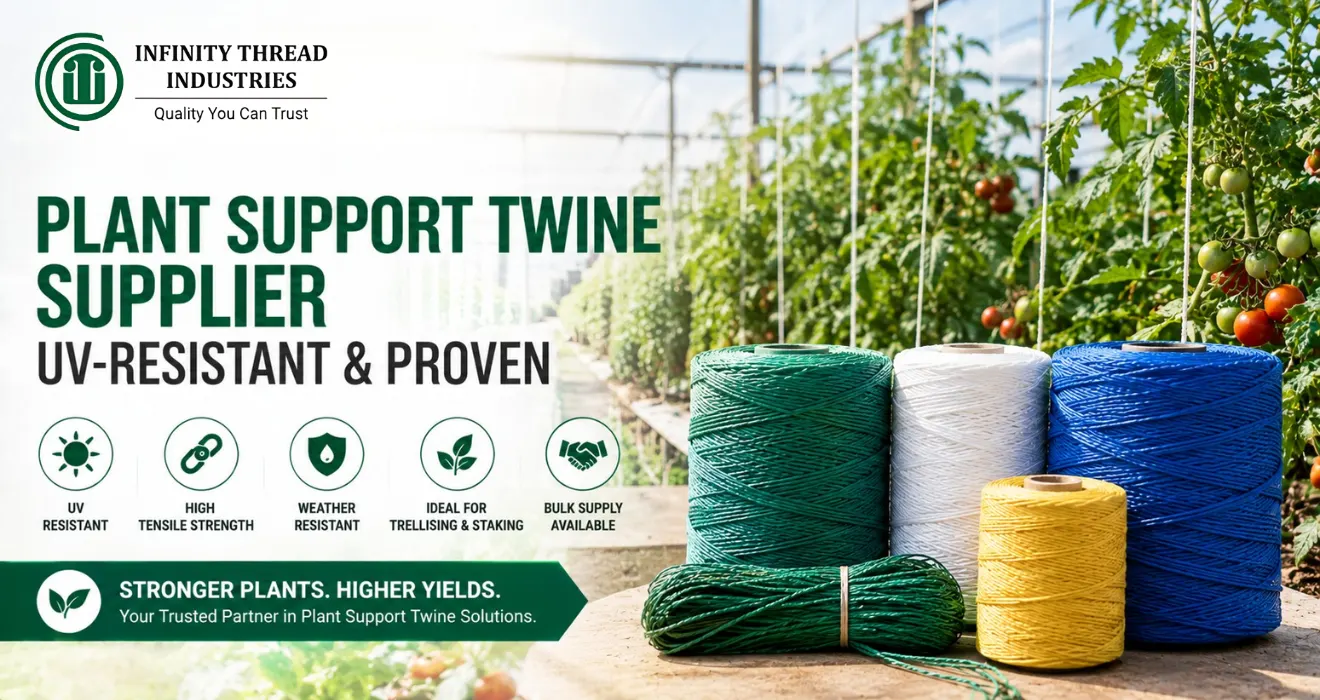
A trellis line snapped in July. Not in a storm, not under some freak load, just an ordinary afternoon three months into the growing season. The tomato crop it was holding went down with it. That’s the call most nurseries make to a plant support twine supplier only after the damage is already done, not before.
If you run a nursery, a horticulture farm, or you’re buying twine on behalf of one, you already know this isn’t really about twine. It’s about whether the twine you bought holds for an entire crop cycle without you having to think about it again. Infinity Thread Industries has worked as a plant support twine supplier out of Surat since 2007, and the number one call we get mid-season isn’t “we need more twine.” It’s “why did the twine we already bought fail.”
The Short Version
Nurseries and horticulture farms need twine that survives months of direct sun without going brittle under the weight of climbing or trellised crops. Polyester and UV-stabilized polypropylene are the two materials that hold up, and thickness has to be matched to the actual crop, not guessed at. Before you place a bulk order with any plant support twine supplier, confirm the UV rating, the tensile strength, and how the twine performs on your specific trellis system, not a generic one.
Why Twine Fails Mid-Season (And Why Buyers Don’t Notice Until It’s Too Late)
Here’s the problem most buyers only learn the hard way: twine that looks fine on the roll can fail three months into outdoor use, and there’s no way to tell just by touching it in the packaging.
Sun exposure is the real enemy, not weight. Plant support twine can hold a heavy crop for weeks and still snap later, once UV exposure has already broken down the polymer chains inside it. By the time you notice the fibres going stiff or chalky, the damage is done. The load hasn’t changed. The twine has.
Buyers usually find out one of two ways. Either their plant support twine supplier tells them upfront, or they find out when a full row of staked capsicum goes down in August. Nurseries ordering twine at scale don’t get a second chance mid-crop cycle. There’s no quick re-tying across five acres of trellised produce.
What “UV-Resistant” Actually Means When You’re Choosing a Twine Supplier
“UV-resistant” gets printed on a lot of packaging, and it means very different things depending on which twine supplier is saying it. A peer-reviewed materials study tracking polypropylene under sustained ultraviolet exposure found tensile strength dropping by roughly 59% after 625 days of continuous exposure, with the sharpest decline happening between 225 and 375 days. That’s the exact window most single-season and multi-season nursery crops sit in the field.
Unstabilized polypropylene degrades even faster. Without UV additives, it can lose a significant share of its mechanical strength within months outdoors, not years. That’s why the additive package matters more than the base material when you’re comparing plant support twine suppliers. Ask what stabilizer is actually in the resin, not just whether the twine is labelled UV-resistant.
What B2B Buyers Should Check Before Ordering Plant Support Twine in Bulk
There are seven things worth confirming before you commit to a bulk purchase order with a plant support twine supplier. Skip any one of these and you’re buying on trust alone.
Material: Polyester vs Polypropylene
Polyester generally holds tensile strength longer under UV exposure and resists stretching under sustained load, which matters for heavier trellised crops like cucumbers or gourds. Polypropylene is lighter and cheaper per kilogram, and works well for lighter staking and tying jobs where the twine isn’t carrying serious weight for months at a stretch. We’ve written a full breakdown in our polyester twine vs polypropylene twine comparison if you want the material science side of this.
Twine Thickness and Tensile Strength
Thickness isn’t a style choice, it’s an engineering one. A twine rated for light bundling will not hold a fully loaded tomato or capsicum trellis through to harvest. A good plant support twine supplier will ask about the crop’s weight at full maturity, not at planting stage, before recommending a thickness.
UV Rating
Ask for the specific UV stabilization used, not just a yes/no answer. Carbon black, HALS additives, and UV absorbers all perform differently, and a supplier who can name theirs is usually one who’s tested it.
Application: Trellis, Stake, or Tie
| Use Case | Recommended Twine Type |
|---|---|
| Trellising | Higher tensile strength, UV-stabilized twine |
| Staking | Mid-thickness twine matched to plant weight |
| Bundling / tying | Lighter twine, confirmed with your supplier |
Quantity and Recurring Supply
Nurseries ordering for a single season have different needs than farms placing recurring monthly orders. A plant support twine supplier with real production capacity, not a trading middleman, should be able to support both without lead-time surprises.
Packaging for Field Conditions
Twine that ships in poor packaging can pick up moisture or dust before it even reaches the field. Confirm packaging suited to your storage conditions, especially for humid coastal regions.
Customization: Colour, Denier, Construction
Some operations use colour-coded twine to separate crop rows or crop years. Denier and construction (twisted vs bonded) affect how the twine grips and holds knots under load.
Matching Twine to Crop Type: A Practical Breakdown
This is the section most buying guides skip, and it’s the one that actually prevents mid-season failures.
Climbing Crops (Cucumbers, Gourds, Beans)
These crops put continuous, increasing load on twine as the plant grows heavier through the season. Higher tensile strength plant support twine, UV-stabilized, is non-negotiable here. Undersizing this is the single most common mistake we see from first-time bulk buyers.
Trellised Fruiting Crops (Tomatoes, Capsicum)
Weight comes in bursts as fruit sets and ripens, not gradually. Mid-to-high tensile strength twine with good UV stability handles the load spikes without stretching out of shape.
Ornamentals and Nursery Saplings
Lighter twine works here, but UV resistance still matters if saplings are staked outdoors for months before sale. A twine that looks fine in April can be brittle by August if it wasn’t UV-stabilized to begin with.
A Quick Example: Net-Trained Crops
Net-based crop training, common in cucumber and gourd nurseries, needs plant support twine that holds a knot cleanly under repeated tension as the net is adjusted through the season. We cover this specific case in our guide to agriculture twine for net making, since it’s different enough from straight trellising to need its own thickness and construction recommendation.
📞 Get a Free Sample or Technical Consultation
What We See When Nurseries Come to Us
Back in 2022, a horticulture farm near Vadodara placed a small trial order with us for capsicum trellising, using twine they’d sourced from a different supplier for the rest of the plot. By week fourteen, the sections tied with the other supplier’s twine were sagging badly. The sections using our UV-stabilized polyester twine were still holding full weight without any visible wear.
What had actually happened wasn’t a manufacturing defect on their original supplier’s end. It was a mismatch between the twine’s UV rating and Gujarat’s sun exposure over a full growing season. We didn’t know that until they sent us photos of both sections side by side, which is honestly the clearest before-and-after we’ve seen from a customer.
Bhadresh Devani, who runs operations at Infinity Thread Industries, put it simply when the farm called back to switch their full order over to us: most complaints about “weak twine” aren’t about the twine breaking under weight at all. They’re about twine that was never rated for the sun exposure it was going to get. Since then, we ask every new nursery client one question before quoting: how many months will this plant support twine actually sit outdoors under direct sun.
Real Numbers Behind the Demand for Better Agriculture Twine
India’s protected cultivation sector isn’t small, and it’s growing in a way that puts pressure on every twine supplier to actually deliver on durability claims. Under the government’s Mission for Integrated Development of Horticulture, protected cultivation area has expanded by 2.51 lakh hectares since 2014-15, backed by over ₹2,963 crore in investment. That’s a lot of new greenhouse and nursery infrastructure that all needs support materials rated for extended outdoor exposure.
More area under cultivation means more buyers sourcing twine at scale, and more of them getting burned by twine that wasn’t built for the job. We supply Plant Support Twine from a 15,300 sq. ft. facility with a monthly production capacity of 80,000 kg, specifically because recurring bulk buyers need a supplier who won’t run short mid-season.
How to Source Plant Support Twine Without Guessing
- Confirm your crop type and expected plant weight at full maturity.
- Share your trellis or staking system with your twine supplier, not just “we need twine.”
- Ask for the UV stabilizer type, not just a UV-resistant label.
- Request a sample roll and test it under your own field conditions before committing to bulk.
- Confirm packaging, MOQ, and lead time in writing before the order ships.
The result is plant support twine that survives the season it’s actually bought for, instead of one that looks fine in the warehouse and fails in the field.
Comparing Twine Options for Nursery and Horticulture Use
| Twine Type | Best For | UV Stability | Relative Cost | Typical Lifespan Outdoors |
|---|---|---|---|---|
| Standard Polypropylene | Light bundling, short-term ties | Low | Low | Under 12 months |
| UV-Stabilized Polypropylene | Staking, mid-duration crops | Moderate to High | Moderate | 1-2 seasons |
| UV-Stabilized Polyester | Trellising, heavy climbing crops | High | Moderate to High | 2+ seasons |
Frequently Asked Questions
What is the best plant support twine supplier for nursery and horticulture use?
Look for a supplier that manufactures its own twine rather than trading it, can confirm the specific UV stabilizer used, and supports both sample orders and recurring bulk supply. Infinity Thread Industries supplies UV-stabilized polyester and polypropylene twine for exactly this use case.
How do I know if plant support twine is actually UV-resistant?
Ask your twine supplier to name the stabilizer, carbon black or a HALS additive, rather than accepting a plain “yes.” A supplier who can’t answer that question probably hasn’t tested it against extended outdoor exposure.
Is polyester or polypropylene twine better for trellising?
Polyester generally holds tensile strength longer under sustained UV exposure and heavier loads. Polypropylene works fine for lighter staking and tying, but it’s usually the wrong choice for full-season trellis support on heavy climbing crops.
How long does agriculture twine last outdoors before it needs replacing?
It depends entirely on the UV rating. Non-stabilized twine can weaken significantly within a year outdoors, while properly UV-stabilized plant support twine can hold through two or more growing seasons.
What’s the MOQ for bulk plant support twine orders?
This varies by thickness, material and construction. Share your crop type, trellis system, and expected monthly volume with your supplier so they can quote an accurate MOQ instead of a generic one.
Can twine thickness really be customized for different crops?
Yes, and it should be. A single “one size fits all” thickness across cucumbers, tomatoes, and ornamentals usually means it’s undersized for at least one of them.
Does UV-resistant twine cost significantly more than standard twine?
Not by much relative to what a mid-season failure costs. The price difference is usually small compared to the labour and crop loss involved in re-tying or losing a trellised section outdoors.
Do plant support twine suppliers offer sample rolls before a full bulk order?
Most legitimate manufacturers do, and it’s worth insisting on one. Testing a sample under your own field conditions for a few weeks tells you more than any spec sheet will.
Ready to Source Plant Support Twine That Actually Holds?
Plant support twine is only as reliable as the supplier who rated it for your conditions in the first place. If you’re placing a bulk order and want a plant support twine supplier who can confirm UV rating, tensile strength, and lead time before you commit, get in touch with our team. If you’re comparing options first, our wholesale agriculture twine supplier guide is a good next read.

Founder of Digi Segment and HV Digital Marketing
SEO Strategist & Digital Marketing Expert
Hardik Vaghani is a digital marketing professional and SEO strategist based in Surat, Gujarat, India. He is the founder of Digi Segment, a content and insights platform covering SEO, digital marketing, AI tools, and online growth strategies, and the founder of HV Digital Marketing, a results-focused digital marketing agency helping local and service-based businesses rank on Google and generate consistent leads.
With hands-on experience in Search Engine Optimisation, Technical SEO, Google Ads, Meta Ads, and Content Strategy, Hardik has helped businesses across industries including e-commerce, real estate, healthcare, home improvement, and solar companies improve their organic visibility, local search rankings, and lead generation through ethical, white-hat strategies.
He specialises in Core Web Vitals optimisation, on-page SEO, keyword research aligned with search intent, and building scalable content frameworks that rank. At Digi Segment, Hardik shares practical, experience-backed insights, case studies, and step-by-step guides to help marketers, entrepreneurs, and small businesses grow online.
When he is not optimising websites, Hardik is building digital tools, writing SEO-focused content, and working with his agency clients to turn Google visibility into measurable business growth.
Expertise: SEO | Technical SEO | Google Ads | Meta Ads | Content Strategy | Core Web Vitals | WordPress | Digital Marketing | Lead Generation | Local SEO