
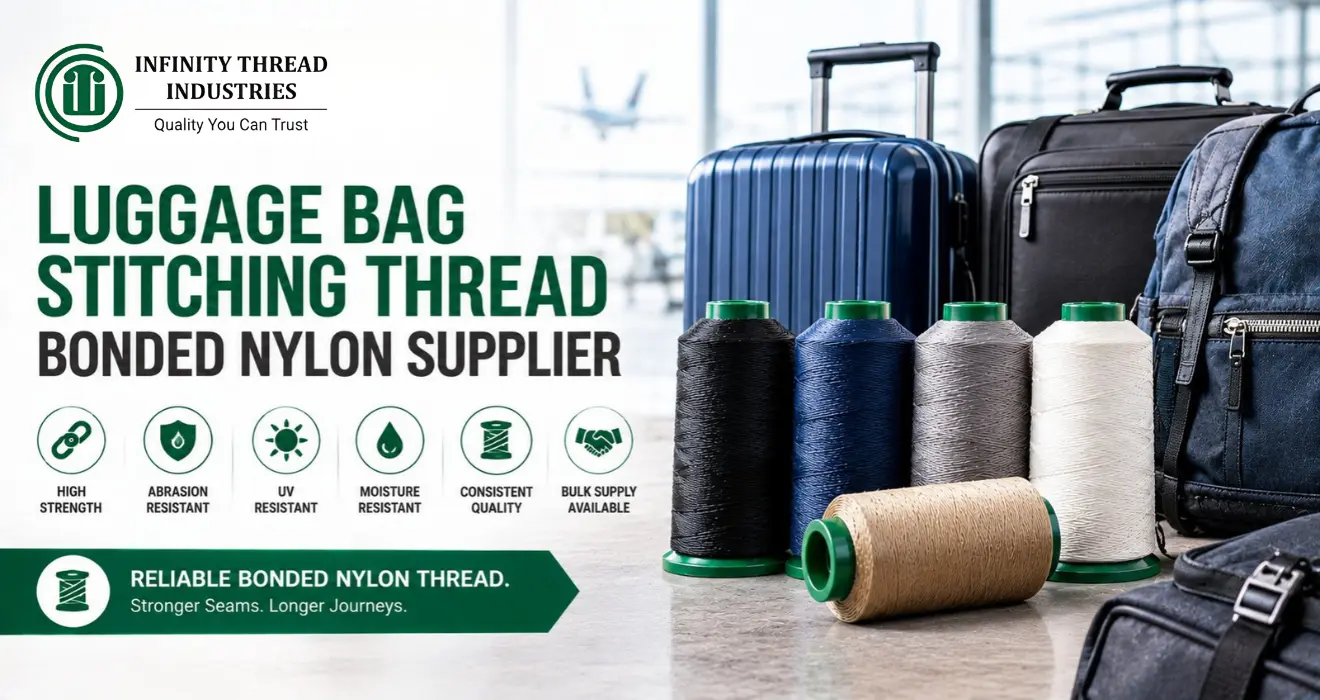
Luggage Bag Stitching Thread: Heavy-Duty Bonded Nylon for Travel Bag Manufacturing
A suitcase strap gives way at the airport carousel, and somebody films it. By evening the clip is online. By next week it’s been traced back to a decision made on a factory floor months earlier.
That decision is often just a spool of thread. Luggage bag stitching thread takes more punishment than almost anything else in a travel bag, and the straps, handles and zipper anchors take the worst of it.
Infinity Thread Industries is a family-owned thread manufacturer in Surat, Gujarat. We’ve been at it since 2007 and run a 15,300 sq. ft. facility with a monthly capacity of 80,000 kg. This guide covers what to check before you order luggage stitching thread in bulk, and where our High Strength Industrial Threads fit into luggage and backpack production.
Here’s the Short Answer
Luggage and backpack seams get pulled, dragged and scraped on every trip. The right luggage bag stitching thread is a high-tenacity bonded nylon that resists fraying and stretch. Choose the denier by stress point: straps, handles and zipper attachments need a heavier thread than body or lining seams.
And ask your supplier for abrasion data, not just a tensile figure.
The Problem: One Weak Seam Undoes the Whole Bag
You’ve sourced good fabric. The webbing is fine, the zippers carry a respected brand, the design passed every review. Then returns start arriving from the same three places: the shoulder strap anchor, the top handle, the zipper end. Each one points back to bag stitching thread that was sized for the wrong job.
The fabric rarely tears. The stitching holding it to the strap does.
Here’s some context on how rough the journey is. SITA’s Baggage IT Insights 2025 report counted 33.4 million mishandled checked bags in 2024, or 6.3 per 1,000 passengers. Of those, 18% were damaged or pilfered. Not every damaged bag is a stitching failure, and I won’t pretend otherwise. But a bag that goes through that system needs seams that hold, and that starts with the right backpack stitching thread and suitcase thread at the load points.
The rate was higher still in 2022, when SITA reported 7.6 mishandled bags per 1,000 passengers. Handling conditions swing from year to year. Your luggage thread choice is the one variable you control.
Why Luggage Bag Stitching Thread Fails at the Straps First
Body seams hold a bag’s shape. Straps hold its weight. That difference decides everything about which bag stitching thread goes where.
Load Concentrates on a Few Stitches
Lift a packed carry-on by its top handle and the whole load passes through one small stitched patch. Every lift repeats the stress. A thread that’s fine for a lining seam can fatigue here within a season of regular use, which is why general-purpose thread for luggage handles rarely lasts.
Abrasion Comes From Every Surface a Bag Meets
Luggage gets dragged across floors, conveyor belts and overhead bins. Thread at those contact points needs abrasion resistance data, not just tensile strength figures. A thread can test well in a pull test and still fuzz and fray after a month of scraping.
Why Bonded Nylon Is the Usual Answer
Bonded nylon thread has a surface treatment that locks the plies together into one smooth strand. That’s why it resists untwisting and fraying during high-speed stitching and in daily use. It’s also high in tenacity, which is the property that matters most in luggage stitching thread on load-bearing seams.
So is it the only option? No. Polyester has its place, especially for outdoor bags that sit in strong sun. Our own comparison of polyester vs nylon thread walks through the trade-offs.
But for straps and handles on luggage, I’d choose bonded nylon every time. That’s an opinion, and it comes from watching where bags actually fail.
Matching Bag Stitching Thread to Each Stress Point
Thread size is usually quoted in denier or Tex. Tex is simply the weight in grams of 1,000 metres of thread, so a higher number means a thicker thread, as this Tex thread size guide explains.
Thicker isn’t automatically better, though. Each component wants its own balance of strength and flexibility from your travel bag stitching thread.
Denier by Component
Straps and Handles
These carry the highest load, so they get the heaviest denier of bonded nylon luggage stitching thread in your range. Flexibility matters less here than raw strength.
Body Seams and Lining
Go mid-denier. A finer thread sews cleaner and flexes with the fabric, and these seams aren’t taking the same pull.
Zipper Attachment Points
Match the denier to the zipper tape. I’m deliberately not giving a number, because it depends on the tape, the fabric stack and your machine. Send us the zipper spec and we’ll confirm.
| Bag component | Recommended thread | What drives the choice |
|---|---|---|
| Straps and handles | Heaviest denier bonded nylon | Highest repeated load |
| Body seams | Mid-denier bonded nylon | Flexibility and clean finish |
| Zipper attachment | Denier matched to zipper tape (confirm with our team) | Tape thickness and stitch density |
Colour Matching Across Batches
For branded luggage lines, visible stitching is part of the design. Thread colour has to stay consistent from one production batch to the next, so ask any backpack stitching thread supplier how they control it. And confirm colour-batch matching before placing a large order, and keep a master colour card on file.
Machine and Needle Fit
Heavier thread needs a bigger needle and a machine set up for it. Get this wrong and you’ll see skipped stitches and puckering, even with perfect thread. Run a sample on your own line before you commit to volume.
Working with leather trim on handles or corners? Our guide to bonded nylon thread for leather goods covers combination materials, and thread for leather bags and wallets goes deeper on ply and strength.
What to Check Before You Order Thread for Luggage in Bulk
Most ordering mistakes happen because the brief was vague. “Strong nylon thread” can mean ten different products, and buying luggage bag stitching thread in bulk leaves little room for a wrong guess.
A Five-Step Way to Brief Your Supplier
- List every bag component you stitch, from straps and handles to body, lining and zipper ends.
- Note the expected load on each, using the heaviest realistic use case.
- Share your machine type and needle size.
- Send a colour card or a physical fabric swatch.
- State your monthly volume and whether supply will be one-time or recurring.
The result is a specification a supplier can quote and sample against, instead of guessing.
The Buyer Checklist
Before you contact any luggage stitching thread supplier or suitcase thread manufacturer, have these ready:
- Application and bag type
- Product type and material
- Thread size, denier or TKT
- Required quantity
- Colour requirements
- Machine type
- Customization needs
- Packaging preference
- Delivery location
What Drives the Price
We quote per requirement, so I can’t give a flat per-kg rate for luggage thread here. A fair quote depends on:
- Material and thread size or denier
- Construction, such as bonded or twisted
- Order quantity
- Colour and dyeing requirements
- Customization requests
- Packaging type
- Delivery location
Be wary of any quote that skips these questions. If a supplier doesn’t ask about your machine and your components, the price probably isn’t tied to your actual need.
Where Infinity Thread Industries Fits
Our High Strength Industrial Threads work as luggage bag stitching thread where strap and handle durability matter most. Exact denier, construction and colour availability get confirmed based on your component. Customization and packaging are discussed per order.
| Specification | Details |
|---|---|
| Material | Bonded nylon (confirm grade with our team) |
| Thread size / denier | Contact us for details |
| Construction | Contact us for details |
| Colour | Available on request, standard and custom shades |
| Application | Luggage, backpacks and travel bags: straps, body, zipper attachment |
| Packaging | Contact us for details |
| MOQ | Contact us for details |
| Customization | Denier or thickness, colour, packaging |
Quality and Capacity
Our facility produces up to 80,000 kg a month, which matters when you’re running recurring orders. Consistent raw material sourcing and batch-level quality checks are what keep specifications from drifting between shipments. Our About Us page lists the ISO 9001:2015 certification, along with our well-lubricated, knotless and AZO-free threads.
Beyond luggage thread, we also supply woven sack and FIBC jumbo bag thread, polyester and nylon twine, sewing thread, mattress threads, fishing twine and agriculture twine. Bag makers who source several lines can keep one supplier.
What I’d Tell a Bag Maker Before the First Order
I can’t share a client’s numbers, so here’s a hypothetical built from the pattern bag makers describe to us. Treat the figures as illustration only.
Say a backpack unit in Surat uses one mid-denier bag stitching thread for the entire bag. It keeps inventory simple. Everything looks fine at final QC.
Then, a few months after shipping, shoulder strap anchors start opening up.
The first fix is to add more stitch rows. It doesn’t work. More needle holes weaken the webbing, and the failures continue.
The real change is simpler. They move strap and handle seams to a heavier bonded nylon and keep the lighter thread on the body. In this example, strap-related returns drop from roughly 3 in 100 bags to under 1.
One thread for the whole bag is false economy. I’d stand behind that.
But I’ll admit a limit. Heavier isn’t always the answer. Go too heavy for your needle and machine and you’ll trade seam failures for skipped stitches. That’s why we always ask about your machine before recommending a denier.
FAQs
Q: What thread is used for luggage and backpack stitching?
A: High-tenacity bonded nylon is the common choice, especially at stress points like straps and handles.
Q: Does strap stitching need a different thread than body seams?
A: Usually, yes. Straps and other load-bearing points typically need a heavier denier than body seams, where flexibility and finish matter more.
Q: What is the MOQ for bulk luggage thread orders?
A: It depends on your specification. Contact us with your requirement and we’ll confirm the MOQ for it, rather than quoting a number that may not fit your order.
Q: Can thread colour be matched to bag fabric?
A: Yes. Colour matching can be discussed with our team, and for large orders you should confirm colour-batch consistency up front.
Q: Do you support recurring monthly supply for bag manufacturers?
A: Yes. With a production capacity of 80,000 kg a month, we can arrange recurring and contract-based supply, for both domestic and export buyers. Share your volumes with our sales team.
Q: Can I get a sample before a bulk order?
A: Sample requests are generally accommodated. It’s the sensible first step, and we’d encourage you to test on your own machine.
Q: What is the lead time?
A: Lead time depends on specification and order volume. Contact our team for a current estimate.
Q: Why is my machine skipping stitches with heavy bonded nylon thread?
A: Most often it’s a mismatch between thread size, needle and tension. Heavier thread needs a larger needle and a machine set up for it. Tell us your machine and needle size and we’ll help narrow it down.
Get a Quote for Your Luggage Stitching Thread Requirement
Luggage is judged on how well it survives daily handling. Thread choice at the stress points is what separates a durable product from a warranty claim.
Matching denier and tenacity to each component, straps, body and zipper attachment, protects your bags and your brand.
Share your bag component, expected load and monthly volume with our team, and we’ll recommend the right denier for each stress point. Reach us through the Contact Us page.

Founder of Digi Segment and HV Digital Marketing
SEO Strategist & Digital Marketing Expert
Hardik Vaghani is a digital marketing professional and SEO strategist based in Surat, Gujarat, India. He is the founder of Digi Segment, a content and insights platform covering SEO, digital marketing, AI tools, and online growth strategies, and the founder of HV Digital Marketing, a results-focused digital marketing agency helping local and service-based businesses rank on Google and generate consistent leads.
With hands-on experience in Search Engine Optimisation, Technical SEO, Google Ads, Meta Ads, and Content Strategy, Hardik has helped businesses across industries including e-commerce, real estate, healthcare, home improvement, and solar companies improve their organic visibility, local search rankings, and lead generation through ethical, white-hat strategies.
He specialises in Core Web Vitals optimisation, on-page SEO, keyword research aligned with search intent, and building scalable content frameworks that rank. At Digi Segment, Hardik shares practical, experience-backed insights, case studies, and step-by-step guides to help marketers, entrepreneurs, and small businesses grow online.
When he is not optimising websites, Hardik is building digital tools, writing SEO-focused content, and working with his agency clients to turn Google visibility into measurable business growth.
Expertise: SEO | Technical SEO | Google Ads | Meta Ads | Content Strategy | Core Web Vitals | WordPress | Digital Marketing | Lead Generation | Local SEO