
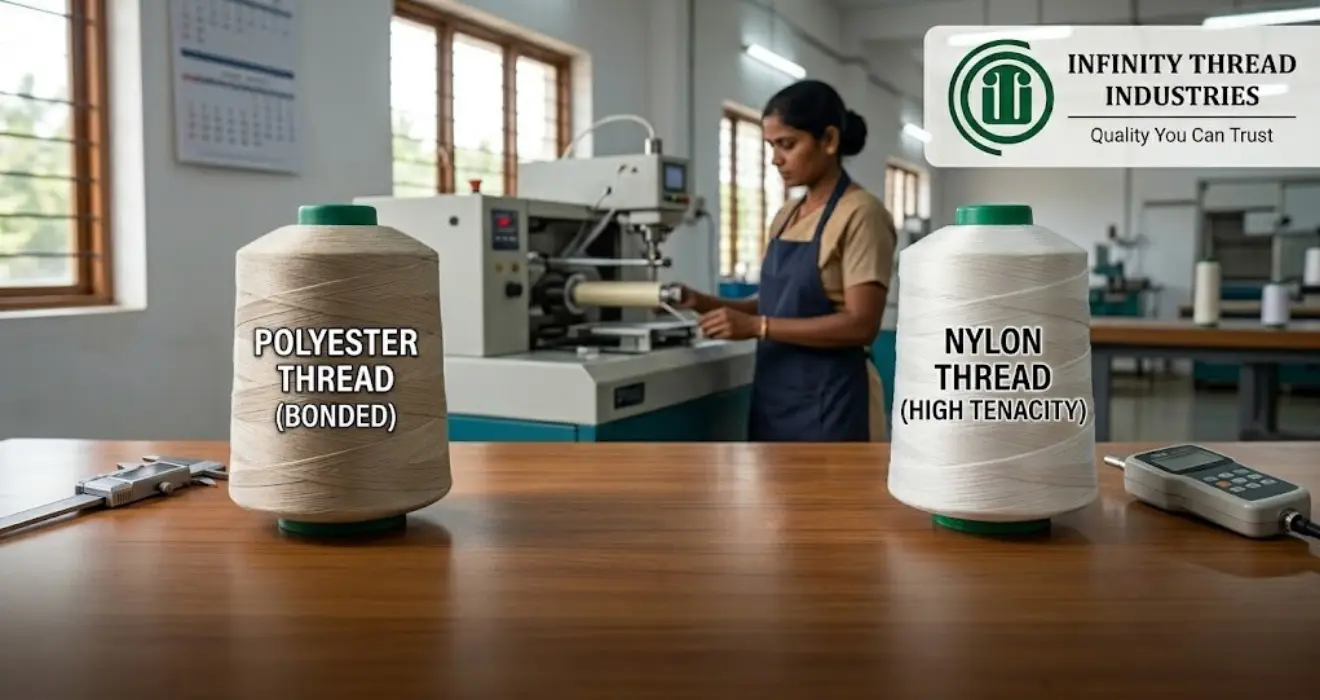
Here’s a question we get almost every week at Infinity Thread Industries: “Which is better — polyester vs nylon thread?”
And every time, the honest answer is: it depends entirely on what you’re stitching and where.
The wrong thread choice doesn’t just reduce seam strength. It creates field failures. A FIBC bag that tears under load at a client’s warehouse. A fishing net that weakens after three months in salt water. An agricultural cover that loses tensile strength six weeks into the season. We’ve seen the consequences of mismatched thread selection, and they’re always avoidable.
This guide breaks down exactly where polyester wins, where nylon wins, and which one your specific application actually needs.
Understanding Thread Fiber Chemistry
Polyester and nylon are both synthetic polymers, but they respond to the physical world very differently.
Polyester (polyethylene terephthalate, or PET) is a semi-crystalline polymer. That structure is what gives it dimensional stability. It doesn’t stretch much under load, it doesn’t absorb moisture, and UV radiation breaks it down slowly. For industrial thread applications, that translates to consistent seam tension and long shelf life.
Nylon (polyamide) is a different story. It’s more amorphous in structure, which gives it that characteristic stretch and recovery. Nylon will absorb moisture — anywhere from 2.8% to 8% of its weight depending on the grade — and that moisture changes its mechanical properties. What you get in return is exceptional abrasion resistance and elasticity that polyester simply can’t match.
According to a 2023 study published by the Textile Research Journal, high-tenacity nylon threads show elongation-at-break values of 18–28%, compared to 10–15% for equivalent denier polyester. That difference matters the moment your application involves repeated flexing, shock loading, or underwater movement.
But here’s where most buyers get confused: tensile strength data from manufacturers is measured in dry lab conditions. Once nylon absorbs moisture, its tensile strength can drop by up to 15%. Polyester loses almost nothing — its moisture absorption is below 0.4%. In a humid warehouse, a rainy field, or a marine environment, that gap gets meaningful fast.
Side-by-Side Technical Comparison Table
Property | Polyester Thread | Nylon Thread |
Tensile Strength (dry) | High | Slightly higher |
Moisture Absorption | < 0.4% | 2.8–8% |
UV Resistance | Excellent | Moderate (degrades faster) |
Elongation at Break | 10–15% | 18–28% |
Abrasion Resistance | Good | Excellent |
Dimensional Stability | Excellent | Moderate |
Chemical Resistance | Good | Good |
Heat Resistance | Higher (~250°C) | Moderate (~180°C) |
Cost (relative) | Lower | Higher |
Best For | Packaging, FIBC, agriculture | Fishing, marine, elastic applications |
When to Use Polyester Thread
Use polyester when the seam needs to hold its shape and strength over time in real-world conditions.
UV exposure is your clearest signal. Polyester retains about 70–80% of its tensile strength after 500 hours of UV exposure testing. Nylon without UV stabilizers can drop below 50% in the same window. If your bags, covers, or sacks spend weeks in the sun between manufacturing and end use, that gap matters.
Moisture and humidity are the second factor. Sacks stored in wet docks, agricultural products exposed to rain, or packaging in coastal warehouses — polyester holds its dimensional stability in all of these. The thread doesn’t swell, soften, or relax its tension against the seam.
High-load consistency is the third. In FIBC bags carrying 500–2000 kg, you need thread that performs the same on day one as it does after six months of stacking. Polyester’s lower elongation means the seam doesn’t “give” under sustained load, which is exactly what you need.
Our polyester & nylon twine range covers deniers from 840D to 3000D for industrial and packaging use — including the high-tenacity grades that FIBC bag stitching requires.
When to Use Nylon Thread
Nylon earns its place in applications where the thread needs to move.
Fishing and marine applications are the clearest use case. Nets flex with every wave, every current, every haul. A thread that can’t stretch and recover will fail at the knot points — and it will fail quickly. Nylon’s elongation of 18–28% means it absorbs that mechanical shock without concentrated stress at any single point.
Abrasion is nylon’s other advantage. Where thread rubs against hard surfaces, grit, or rough materials repeatedly, nylon outlasts polyester. Gear straps, heavy bag handles, canvas stitching — anywhere friction is the main wear mechanism.
Low-temperature flexibility is worth noting too. Nylon stays pliable in cold environments where some polyester grades can become slightly brittle. Not a major factor in most Indian industrial contexts, but relevant for cold storage or export logistics in northern climates.
The caveat: if you’re using nylon outdoors or in the sun, look specifically for UV-stabilized grades. Standard nylon without UV protection loses strength faster than most buyers realise. We cover this in more detail in our fishing twine product range.
Cost Comparison: Polyester vs Nylon
Bluntly put: polyester is cheaper. Not by a trivial margin, either.
In 2025 Indian industrial thread markets, nylon typically runs 25–40% higher per kg than equivalent denier polyester, depending on the grade and quantity. For large-volume buyers — packaging plants processing hundreds of tonnes of bags a month — that difference adds up to a real budget line.
But cost-per-kg is the wrong metric if you’re comparing thread performance over time. A nylon fishing twine that survives 18 months in salt water is cheaper per use than a polyester twine that degrades at 9 months. For packaging applications, the calculation flips.
My Take: At Infinity Thread Industries, we’ve seen buyers switch from nylon to polyester for bag-closing applications and cut thread costs by 30% with zero reduction in seam performance. We’ve also seen the reverse — buyers using cheap polyester on fishing nets and replacing gear twice a season. Get the chemistry right first. Then talk price.
Which Thread Is Best for Specific Applications?
Woven Sacks & FIBC Bags
Verdict: Polyester, high-tenacity grade, 840D–3000D.
FIBC bags carry extreme loads. The thread is not decorative — it’s structural. Polyester’s combination of UV stability, moisture resistance, and dimensional consistency under sustained load makes it the industry standard here. Most reputable FIBC manufacturers globally have moved to high-tenacity polyester as their default specification.
Read our detailed breakdown in the woven sack stitching thread guide for denier selection and stitch density recommendations.
Agriculture & Farming
Verdict: Polyester, for most applications.
Bundling crops, securing shade nets, baling — almost all agricultural uses involve extended UV exposure and moisture cycling. Polyester handles both. The exception is applications requiring knotting flexibility or stretch, where a lighter nylon twine works better.
See our agriculture twine range for the specific grades used in Indian farming applications.
Fishing Industry
Verdict: Nylon, UV-stabilized.
No contest. Nets that flex thousands of times per deployment need nylon’s elasticity. Pair it with UV stabilization and you get the combination the fishing industry has relied on for decades. According to the Central Institute of Fisheries Technology (CIFT), India, nylon multifilament nets account for over 70% of commercial fishing net construction in Indian coastal fisheries due to their durability under marine conditions.
For our marine-grade options, see the fishing twine product page.
Mattress Manufacturing
Verdict: Polyester.
Mattress stitching needs consistent thread tension across thousands of stitches per unit, plus resistance to body heat and occasional moisture. Polyester’s stability and higher heat resistance (up to ~250°C) make it the right choice. Most Indian mattress manufacturers we supply specify bonded polyester thread in the 20/3 to 40/3 count range.
Garment & Sewing
Verdict: Depends on the fabric and use case.
For general garment sewing, spun polyester is the industry standard — consistent, colour-stable, cost-effective. Nylon shows up in performance wear, stretch fabrics, and applications where the seam needs to move with the fabric. Denim and workwear almost always use polyester. Sportswear and lingerie often use nylon.
Infinity Thread Industries – Supplying Both Polyester & Nylon
Infinity Thread Industries has been manufacturing industrial threads from our 15,300 sq. ft. facility in Surat, Gujarat since 2007. We produce both polyester and nylon threads across a full denier range — from light sewing threads to heavy-duty FIBC bag thread — at a monthly capacity of 80,000 kg.
Our threads are knotless, well-lubricated, AZO-free, and ISO 9001:2015 certified. We supply packaging plants, fishing industries, agricultural suppliers, mattress manufacturers, and garment units across India.
We don’t push one fiber over the other. The right recommendation depends on your application, denier requirement, and production conditions — and we’ve helped enough buyers make that call to give you a straight answer rather than a sales pitch.
If you want to test both before committing to a volume order, we’re happy to send samples. Reach out directly at info@infinitythreadindustries.in — specify your denier range and end use, and we’ll send the relevant options.
Frequently Asked Questions
Nylon has slightly higher tensile strength and better elasticity in dry lab conditions, making it the better choice for applications that need stretch — fishing nets and marine use, primarily. Polyester offers better UV resistance and dimensional stability in real-world conditions. For most outdoor packaging and agriculture applications, polyester delivers stronger in-use performance because its strength isn't compromised by moisture absorption.
Polyester is generally the better choice for outdoor use. It retains strength much longer under prolonged sun exposure — around 70–80% after 500 hours of UV testing, compared to nylon without UV stabilizers, which can drop below 50%. If you're working with nylon outdoors, specify a UV-stabilized grade explicitly. Standard nylon degrades faster than most buyers expect when left in direct sunlight.
Yes, and it's worth taking seriously. Nylon absorbs between 2.8% and 8% of its weight in moisture depending on grade, which can reduce its tensile strength by up to 15%. Polyester absorbs less than 0.4% moisture. For applications in humid warehouses, rainy outdoor environments, or coastal settings, polyester's dimensional stability is a genuine advantage — not just a spec-sheet number.
High-tenacity polyester thread in the 840D to 3000D range is the industry standard for FIBC jumbo bag stitching. It delivers consistent tensile strength under heavy load, doesn't absorb moisture, and holds up to UV exposure during extended storage. Most serious FIBC manufacturers won't use nylon for primary bag-closing thread — the moisture sensitivity creates too much variability in field performance.
Yes. Contact Infinity Thread Industries at info@infinitythreadindustries.in and specify your required denier range and end application. We'll send you samples of both fiber types so you can run your own tests before committing to a volume order.

Founder of Digi Segment and HV Digital Marketing
SEO Strategist & Digital Marketing Expert
Hardik Vaghani is a digital marketing professional and SEO strategist based in Surat, Gujarat, India. He is the founder of Digi Segment, a content and insights platform covering SEO, digital marketing, AI tools, and online growth strategies, and the founder of HV Digital Marketing, a results-focused digital marketing agency helping local and service-based businesses rank on Google and generate consistent leads.
With hands-on experience in Search Engine Optimisation, Technical SEO, Google Ads, Meta Ads, and Content Strategy, Hardik has helped businesses across industries including e-commerce, real estate, healthcare, home improvement, and solar companies improve their organic visibility, local search rankings, and lead generation through ethical, white-hat strategies.
He specialises in Core Web Vitals optimisation, on-page SEO, keyword research aligned with search intent, and building scalable content frameworks that rank. At Digi Segment, Hardik shares practical, experience-backed insights, case studies, and step-by-step guides to help marketers, entrepreneurs, and small businesses grow online.
When he is not optimising websites, Hardik is building digital tools, writing SEO-focused content, and working with his agency clients to turn Google visibility into measurable business growth.
Expertise: SEO | Technical SEO | Google Ads | Meta Ads | Content Strategy | Core Web Vitals | WordPress | Digital Marketing | Lead Generation | Local SEO