
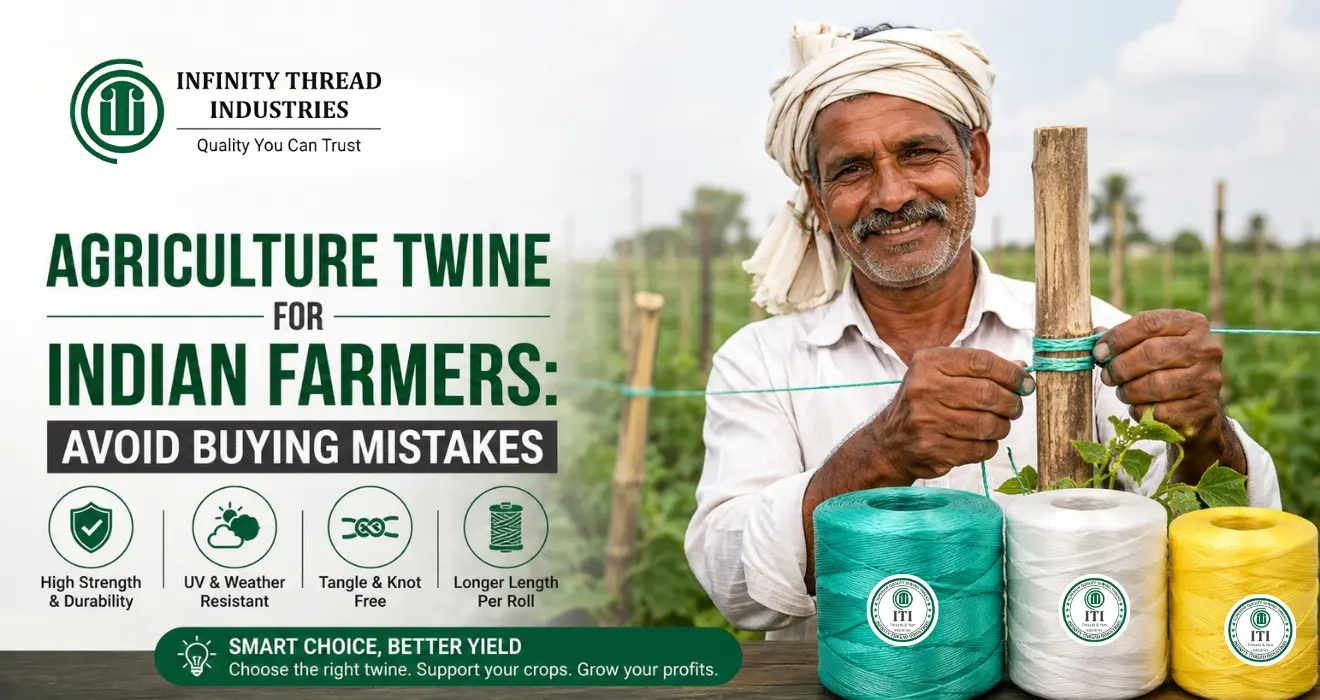
A roll of twine snapped halfway through tying a row of tomato stakes in Nashik last August. The farmer lost almost 40 kanis of crop to wind damage that same week. Nobody blames the twine first. They blame the weather, the wind, bad luck. But talk to enough farmers and a pattern shows up fast: the cheapest roll on the shelf is rarely the one that survives the season.
This isn’t a small detail. And it’s not one farmers are taught to think about.
The Underestimated Role of Twine in Modern Indian Agriculture
Nobody talks about twine the way they talk about seeds or fertilizer. There’s no scheme for it, no subsidy line item, no agronomist showing up to test it. It just sits in a corner of the local krishi store, sold by weight, often without a clear spec sheet.
But twine is load-bearing infrastructure. It holds up tomato vines heavy with fruit. It bales wheat straw under machine tension. It ties trellised grapevines through monsoon winds. When it fails, the failure isn’t cosmetic it’s a collapsed plant, a burst bale, a morning spent re-tying instead of harvesting.
According to the Indian Council of Agricultural Research, staking and trellising can improve yield in vegetable crops like tomato and cucumber by supporting better light exposure and reducing fruit rot from ground contact. That benefit disappears the moment the twine holding the structure together gives way.
So why does this keep happening? Because most twine sold in rural markets isn’t labelled with denier, tenacity, or UV rating. Farmers are buying blind, going on price and feel, not specification.
Signs You Are Using Low-Quality Agriculture Twine (And What It Costs You)
Here’s what poor twine actually looks like in the field, not in a lab report.
It frays at the knot first. Not in the middle of the strand right where you tied it, because that’s where stress concentrates. A twine that can’t hold a simple clove hitch under tension is going to fail exactly when you need it most.
It turns brittle within weeks under direct sun. PP twine without UV treatment can lose a meaningful share of its strength after a single month of strong sun exposure, depending on intensity and exposure hours. By the time the crop needs support the most mid-season, full fruit load the twine has already weakened.
It stretches under load and loosens. This one’s sneaky. The plant looks supported on day one. By week three, the twine has crept, the support has slackened, and the stem is bending under its own weight.
What does this cost, practically? Replanting labour. Re-tying labour, which is the same job done twice. Fruit loss from ground contact and rot. And in baling operations, twine failure means a burst bale mid-transport that’s lost product, not just lost time.
I’ve seen agri-input dealers in Gujarat quote farmers prices per kilo with zero mention of denier or breaking strength. That’s the equivalent of buying cement by colour. It tells you nothing about whether it’ll hold.
Polypropylene vs Polyester Agriculture Twine Which Is Right for Indian Conditions?
This is the question that actually matters before you buy anything.
Polypropylene (PP) twine is lighter, cheaper, and works fine for single-season use light staking, short-duration crops, low-budget operations. It’s the twine most commonly sold in local markets. The catch: PP degrades faster under UV exposure unless it’s specifically stabilised, and it has lower knot retention than polyester.
Polyester twine costs more upfront but holds tensile strength longer, resists UV degradation better when properly treated, and performs more consistently in knot strength. For multi-season use orchards, vineyards, greenhouse structures that stay up year-round polyester is the harder-working option.
Here’s where it gets specific. Indian agriculture spans wildly different climates humid coastal belts, dry interior heat, monsoon-heavy regions. A PP twine that survives fine in a Himachal apple orchard at 2,000 metres can fail in three weeks under direct Gujarat summer sun. Same product, different outcome, because UV intensity and duration aren’t the same.
My honest take: for anything that needs to last more than one growing cycle trellising, orchard support, perennial crops polyester is worth the extra cost. For single-season bundling or short-term staking, PP works and saves money. Don’t pay for polyester durability you don’t need. But don’t use PP where the job demands polyester, either.
Key Properties to Look for in Agriculture Twine
Four things determine whether a twine performs or fails. Denier, tenacity, UV resistance, and knot strength.
Denier is the weight-per-length measure essentially how thick and substantial the strand is. Infinity Thread Industries manufactures agriculture twine from 800 Denier up to 3000 Denier, which covers everything from light vegetable tying to heavy-duty bundling. Higher denier generally means more raw strength, but it’s not the only factor.
Tenacity measures how much force the fibre withstands relative to its weight this is what actually predicts whether the twine snaps under load, independent of how thick it looks. Two twines can look identical and have very different tenacity depending on the fibre quality and manufacturing process.
UV Resistance Why It Is Non-Negotiable in Indian Climate
Most of India sits in a UV exposure zone that’s harsher than what twine specs from temperate countries are designed for. Untreated twine left outdoors through an Indian summer will show visible fading and brittleness well before the season ends.
UV-stabilised twine is chemically treated during manufacturing to slow this breakdown. It’s not optional for anything that stays in the field longer than a few weeks greenhouse tie-downs, orchard trellising, vineyard support. If the product listing doesn’t mention UV treatment, assume it doesn’t have any.
Knot Strength and Why It Matters More Than Breaking Strength
Breaking strength numbers on a spec sheet are measured on a straight, untied strand. Almost nobody uses twine that way. The moment you tie a knot, you introduce a stress point and that’s where real-world failure happens.
A twine can have impressive straight-line breaking strength and still fail fast at the knot if the fibre is too smooth or too stiff to hold tension. This is why a quick field test tie the knot you’ll actually use, hang a weight, see what happens tells you more than any number on a packet.
How Infinity Thread Industries’ Agriculture Twine Helps Farmers Across India
Infinity Thread Industries has been manufacturing thread and twine out of Surat, Gujarat, since the family business started in 2007 first as an embroidery thread store, then expanding into heavy twisting, twine, and industrial stitching threads as the company grew under Nilesh Devani and Bhadresh Devani. Today the facility runs a 15,300 sq. ft. production unit with a monthly capacity of 80,000 kg, certified ISO 9001:2015.
For agriculture specifically, the range covers 800D to 3000D twine in both twisted and braided construction twisted for general-purpose tying, braided for higher abrasion resistance where it’s needed, like baling and trellising. Every batch is tested for tensile strength, knot performance, and weather resistance before it leaves the facility.
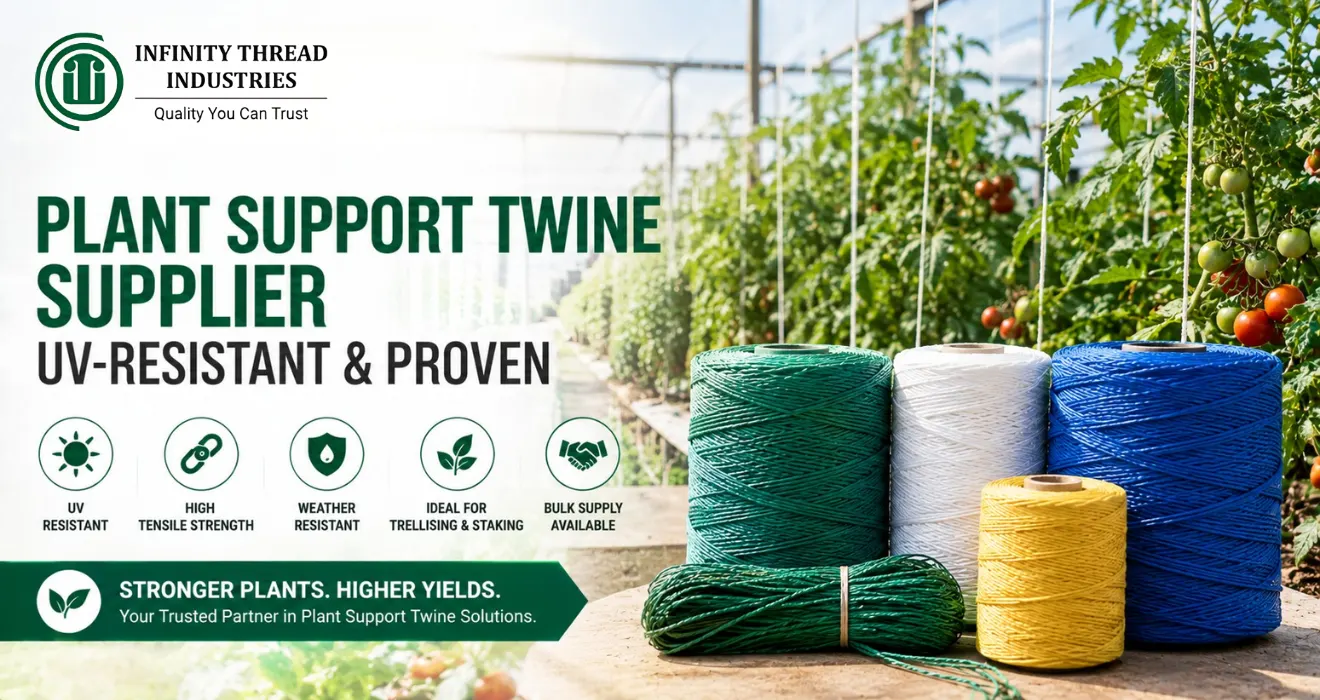
We supply UV-stabilised, moisture-resistant twine built specifically for outdoor seasons vineyard tying, greenhouse support, orchard trellising alongside baler twine in 1.5mm to 4mm diameter for round and square bale binding. Custom colors and lengths are available where farms need visibility marking or specific spool sizing for their equipment.
Where to Buy Premium Agriculture Twine in Bulk?
If you’re sourcing for a single plot, local dealers work fine. If you’re buying for a co-operative, a contract farming operation, or repeat seasonal use, going direct to a manufacturer changes the economics better pricing per kg, consistent denier batch to batch, and someone who can answer a tenacity question instead of just quoting a price.
Infinity Thread Industries supplies agriculture twine in bulk directly from its Surat manufacturing unit, with MOQ terms that scale to order size. Reach out before assuming a quantity is too small or too large bulk pricing structures vary by product and specification.
Get a Free Sample and See the Difference Yourself
Don’t take a spec sheet’s word for it. Tie the knot. Hang the weight. Leave it in the sun for a week and see what happens.
Infinity Thread Industries offers free samples so farmers and dealers can test agriculture twine under their own field conditions before committing to a bulk order. Call +91-76007 10883 or email info@infinitythreadindustries.in to request one.
How to Choose the Right Agriculture Twine for Your Farm
- Identify the application plant support, baling, trellising, or bundling.
- Check the crop type and the weight it needs to support.
- Choose the right material polyester for multi-season durability, PP for cost-effective single-season use.
- Verify UV resistance rating. This is essential for Indian summers.
- Test knot strength before bulk use. A twine that slips under load is dangerous, not just inconvenient.
- Order a sample from Infinity Thread Industries before placing a bulk order.
The result: twine that matches your crop, your climate, and your season instead of a guess based on price per kilo.
Frequently Asked Questions
What is the best twine for tomato and vegetable plant support in India?
UV-stabilised polyester twine with 3–5 kg breaking strength is ideal for vegetable support in Indian climate. Infinity Thread Industries supplies agriculture twine specifically designed for tropical conditions.
How long does agriculture twine last in outdoor conditions?
Our polyester agriculture twine lasts 1–3 seasons depending on UV exposure and usage. PP twine typically lasts one full growing season. Ask us for the right grade for your region.
Can agriculture twine be used for baling hay and wheat?
Yes. For baling, you need higher tenacity twine typically 8–12 kg breaking strength. We supply baling twine in standard and custom specifications.
Is there a minimum order quantity for agriculture twine?
Yes, we have MOQ policies depending on the product. Contact us at +91-76007 10883 to discuss bulk pricing and MOQ details.
Does UV exposure weaken agriculture twine over time?
Regular twine degrades significantly under UV. Our UV-stabilised agriculture twine is specifically treated to resist solar degradation, making it far more durable in Indian outdoor conditions.
📞 Get a Free Sample or Technical Consultation

Founder of Digi Segment and HV Digital Marketing
SEO Strategist & Digital Marketing Expert
Hardik Vaghani is a digital marketing professional and SEO strategist based in Surat, Gujarat, India. He is the founder of Digi Segment, a content and insights platform covering SEO, digital marketing, AI tools, and online growth strategies, and the founder of HV Digital Marketing, a results-focused digital marketing agency helping local and service-based businesses rank on Google and generate consistent leads.
With hands-on experience in Search Engine Optimisation, Technical SEO, Google Ads, Meta Ads, and Content Strategy, Hardik has helped businesses across industries including e-commerce, real estate, healthcare, home improvement, and solar companies improve their organic visibility, local search rankings, and lead generation through ethical, white-hat strategies.
He specialises in Core Web Vitals optimisation, on-page SEO, keyword research aligned with search intent, and building scalable content frameworks that rank. At Digi Segment, Hardik shares practical, experience-backed insights, case studies, and step-by-step guides to help marketers, entrepreneurs, and small businesses grow online.
When he is not optimising websites, Hardik is building digital tools, writing SEO-focused content, and working with his agency clients to turn Google visibility into measurable business growth.
Expertise: SEO | Technical SEO | Google Ads | Meta Ads | Content Strategy | Core Web Vitals | WordPress | Digital Marketing | Lead Generation | Local SEO