
What Actually Holds a Pair of Jeans Together
A denim unit in Gujarat called us last year with a strange complaint. Their topstitching kept snapping mid-run, and their existing supplier just kept saying “try a different needle.” Nobody was asking about the thread itself. That’s usually where the real problem lives.
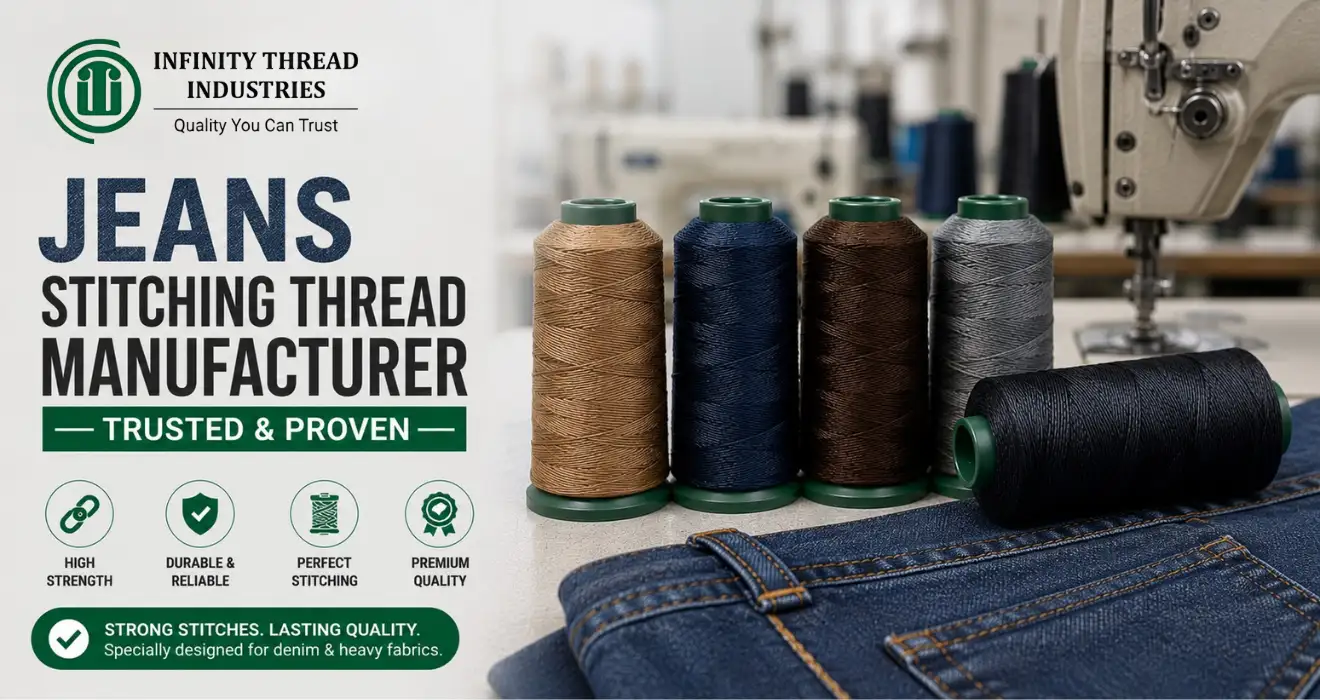
If you’re searching for a jeans stitching thread manufacturer right now, you’ve probably hit the same wall. Denim looks simple from the outside. Sew it together, add the orange topstitch, done. But the thread doing that job is under more stress than almost any other seam in garment manufacturing, and most buyers only think about it after something’s already gone wrong.
I’m Nilesh Devani, and along with my brother Bhadresh, I run Infinity Thread Industries, a jeans stitching thread manufacturer out of Surat, Gujarat. Our family has been in the thread business since 2007, and denim-grade stitching thread is one of the categories we get asked about most.
The Short Version
A jeans stitching thread manufacturer supplies thread engineered specifically for denim’s thickness, tension, and wash cycles, usually corespun or high tenacity polyester in Tex 60 to Tex 105. The right one matters more than the fabric weight for how long the seam actually survives.
That’s it in three sentences. The rest of this comes down to why a jeans stitching thread manufacturer picks one construction over another, and how to check their work before you place a bulk order.
Why the Right Denim Stitching Thread Supplier Matters More Than the Denim Itself
Here’s the thing nobody tells first-time buyers. Denim fabric can be excellent and the garment can still fail at the seam. Why? Because jeans go through repeated stress that most other clothing never sees. Sitting, squatting, machine washing at high heat, industrial dryers. The seam takes the hit every single time, not the fabric.
A weak thread shows up fast. Waistband seams pop after two washes. Topstitching frays and goes dull within a month. Belt loops tear off in the store before the customer even buys the jeans. None of that is a fabric problem. It’s a thread problem, and it traces straight back to whoever manufactured the thread in the first place.
This is exactly why sourcing from an established denim stitching thread manufacturer matters so much more than most buyers assume during the sampling stage.
What “Denim-Grade” Actually Means
Not every polyester thread on the market is built for jeans. Denim-grade thread needs three things a regular garment thread doesn’t:
- High abrasion resistance denim is a rough, dense weave, and the thread rubs against it constantly during high-speed sewing.
- Heat tolerance needle friction on heavy denim runs hot, and a cheap thread will glaze over and snap.
- Wash and shrink stability stone-washing, enzyme washing, and repeated home laundering all attack the thread’s structure over time.
A good industrial thread manufacturer tests for all three before a spool ever ships, and honestly, any jeans stitching thread manufacturer that skips this testing stage is asking for a defect complaint six weeks down the line.
Corespun Thread vs. High Tenacity Polyester for Denim
This is the question we get asked constantly, and honestly, there isn’t one universal right answer.
Corespun thread has a continuous filament polyester core wrapped in cotton or spun polyester. The core typically makes up around 60% of the thread’s construction, which gives it a more uniform, higher-tenacity result than plain spun polyester. Denim experts at Denim & Jeans note that corespun is the standard choice among quality denim manufacturers for topstitching and stress seams, precisely because that core resists cutting and heat damage better than 100% spun constructions.
High tenacity (HT) polyester thread is 100% polyester filament, thicker and coarser, built purely for raw strength. It costs less per kilo than corespun in most cases and works fine on mid-weight denim. But on premium, heavy-ounce denim, it can look flatter and less “authentic” than a corespun thread with a cotton feel.
My honest take? For export-quality jeans where the customer will feel the seam, go corespun. For workwear denim or budget domestic lines where cost per garment matters more than hand-feel, HT polyester is the smarter buy. Most guides won’t tell you that trade-off plainly. They just push whichever product they happen to stock. A straight-talking jeans stitching thread manufacturer will tell you which one fits your fabric weight, not just which one they have more of in the warehouse.
Tex Sizing: The Number That Actually Decides Your Order
Every serious jeans stitching thread manufacturer will ask you one question before quoting: what Tex size do you need? It’s the single question that separates a manufacturer who understands denim from one who just resells generic spools under a new label.
Tex measures linear density, essentially how thick the thread is. For denim specifically:
- Tex 40–60 chino pants, twill trousers, lighter denim construction seams
- Tex 60–105 the classic jeans topstitch look, used for waistbands, seat seams, and visible stitching
- Tex 105+ bold, heavy-duty topstitching on premium or statement denim
Get this number wrong and you’ll either see thin, weak-looking stitches on heavy denim or, on the flip side, a thread so thick it jams the needle and skips stitches. As a denim stitching thread manufacturer, we walk every new client through Tex selection before we even talk pricing, because guessing here costs far more in rework than it saves in sampling time.
📞 Get a Free Sample or Technical Consultation
How to Choose a Jeans Stitching Thread Manufacturer
If you’re evaluating a jeans stitching thread manufacturer right now, here’s the actual process, not the marketing version.
- Ask for a lubrication and lint report. A well-lubricated thread runs cooler through the needle and breaks less on high-speed machines.
- Request wash-cycle samples, not just dry samples. Thread that looks perfect on the roll can weaken badly after three industrial washes.
- Check color fastness against your specific wash program. Stone-wash and enzyme-wash chemicals treat dye very differently.
- Confirm certification. ISO 9001:2015 and AZO-free dyeing aren’t just paperwork; they’re what lets you sell into export markets without a compliance headache later.
- Test on your own machines before committing to bulk. A thread that runs beautifully on the supplier’s demo line can behave completely differently on your factory floor. The result should be a thread that survives your actual production conditions, not just a lab test.
From My Experience: The Ahmedabad Denim Unit
As a jeans stitching thread manufacturer based in Surat, we see this exact scenario often. Take a mid-sized denim unit near Ahmedabad we started supplying in 2023. They were running Tex 40 spun polyester on heavy 14-ounce denim, because it was what their old vendor kept sending regardless of fabric weight. Their stitch-cut rate on waistband seams was somewhere around 8 to 9 defective units per thousand pairs. That’s not a small number when you’re running volume.
We moved them to a Tex 80 corespun thread matched properly to their fabric weight, adjusted needle size alongside it, and reworked their tension settings over about two weeks of trial runs. Their defect rate dropped to under 2 per thousand within the first full production month. Nothing exotic happened. It was simply the right thread doing the right job for once.
I’ll admit we don’t always get the Tex size right on the first sample. Sometimes it takes two or three rounds of adjustment before a client’s specific machine speed and fabric combination clicks into place. That’s normal, and any honest manufacturer will tell you the same instead of pretending the first spool is always perfect.
The Numbers Behind Why This Category Keeps Growing
According to Fibre2Fashion, India’s denim market is projected to touch $9.15 billion by 2026, up from $6.15 billion in FY2023, with Gujarat leading national production. That’s not a small, niche category. It’s a fast-growing one, and it means demand for a reliable jeans stitching thread manufacturer is only going to climb alongside it, not shrink.
More denim volume also means more factories cutting corners on thread quality to hit price targets. That’s where a lot of the seam failures we get asked to troubleshoot actually come from, and it’s exactly why choosing an established stitching thread manufacturer over the cheapest quote matters more each year, not less.
Corespun vs. HT Polyester vs. Cotton-Wrapped: Quick Comparison
| Thread Type | Best For | Feel | Wash Durability | Typical Tex Range |
|---|---|---|---|---|
| Corespun (poly core) | Export-quality, premium denim | Cotton-like, soft | Excellent | Tex 60–105 |
| High Tenacity Polyester | Workwear, budget denim | Slightly glossy | Very good | Tex 60–120 |
| Cotton-Wrapped Core | Vintage-wash, fashion denim | Authentic, matte | Good (wash-down look) | Tex 40–80 |
Frequently Asked Questions
Q: What is a jeans stitching thread manufacturer?
A: It’s a company that produces thread engineered specifically for denim’s thickness, tension, and wash requirements, usually in corespun or high tenacity polyester construction, rather than generic all-purpose garment thread.
Q: How do I choose the right stitching thread for jeans?
A: Start with your fabric weight and desired stitch look, then match Tex size accordingly. Heavier denim and bold topstitching need Tex 80–105; lighter chino-style denim works fine with Tex 40–60. After that, test wash durability, not just the dry sample.
Q: What does jeans stitching thread cost in bulk?
A: It varies by Tex size, fiber type, and order volume, but corespun generally runs higher than plain spun polyester because of the manufacturing process involved. Get a quote against your actual annual volume rather than a small sample order; per-kilo pricing usually drops noticeably at scale.
Q: Is corespun thread better than 100% spun polyester for denim?
A: For visible topstitching and stress seams, yes, mostly. The filament core gives it more uniform tenacity and better resistance to needle heat. For hidden construction seams on lighter denim, spun polyester often works just fine and costs less.
Q: Does high tenacity thread actually stop stitch breakage on jeans?
A: In most cases, yes, especially when the breakage was caused by an undersized or low-quality thread to begin with. It won’t fix a genuinely wrong Tex size or a bad tension setting on the machine, though.
Q: Corespun vs. high tenacity thread, which one wins for topstitching?
A: Corespun for premium and export denim where hand-feel and authentic look matter. High tenacity polyester for workwear and budget lines where raw strength and lower cost matter more than the visual finish.
Q: Why does my denim thread keep breaking or melting on the machine?
A: Usually needle heat from high-speed sewing on heavy denim, wrong Tex-to-needle-size matching, or a thread with poor lubrication. Check lubrication first. It’s the cheapest fix and solves it more often than people expect.
Q: Which Tex size thread should I use for jeans in 2026?
A: Tex 60 to Tex 105 covers the vast majority of denim topstitching being produced right now, with Tex 80 sitting as the most common middle ground for standard 5-pocket jeans.
Where to Go From Here
If you’re evaluating suppliers, we’ve also written about how to choose the best industrial thread manufacturer in India and broken down polyester vs. nylon thread for industrial use in more depth. Our sewing thread and high strength industrial thread ranges both carry denim-grade Tex options in corespun and HT polyester construction.
Nilesh and Bhadresh at Infinity Thread Industries work as a jeans stitching thread manufacturer for denim units across Gujarat, on exactly this kind of thread selection. If your stitch-cut rate is higher than it should be, or you’re just tired of guessing at Tex sizes, reach out and we’ll walk through it with you.

Founder of Digi Segment and HV Digital Marketing
SEO Strategist & Digital Marketing Expert
Hardik Vaghani is a digital marketing professional and SEO strategist based in Surat, Gujarat, India. He is the founder of Digi Segment, a content and insights platform covering SEO, digital marketing, AI tools, and online growth strategies, and the founder of HV Digital Marketing, a results-focused digital marketing agency helping local and service-based businesses rank on Google and generate consistent leads.
With hands-on experience in Search Engine Optimisation, Technical SEO, Google Ads, Meta Ads, and Content Strategy, Hardik has helped businesses across industries including e-commerce, real estate, healthcare, home improvement, and solar companies improve their organic visibility, local search rankings, and lead generation through ethical, white-hat strategies.
He specialises in Core Web Vitals optimisation, on-page SEO, keyword research aligned with search intent, and building scalable content frameworks that rank. At Digi Segment, Hardik shares practical, experience-backed insights, case studies, and step-by-step guides to help marketers, entrepreneurs, and small businesses grow online.
When he is not optimising websites, Hardik is building digital tools, writing SEO-focused content, and working with his agency clients to turn Google visibility into measurable business growth.
Expertise: SEO | Technical SEO | Google Ads | Meta Ads | Content Strategy | Core Web Vitals | WordPress | Digital Marketing | Lead Generation | Local SEO