
FIBC Jumbo Bag Safety Why Thread Strength Testing Must Be Non-Negotiable
A 1,000 kg FIBC jumbo bag suspended from a crane isn’t carrying 1,000 kg. It’s carrying 1,000 kg of trust trust that the seam holding the bottom panel to the body won’t give way mid-lift, mid-transport, or mid-stack three bags high in a warehouse.
That trust comes down to a few millimetres of stitching thread. Not the woven polypropylene fabric everyone focuses on. The thread.
We’re going to be direct about why this matters: Infinity Thread Industries manufactures the high-tenacity polyester threads that go into woven sack and FIBC stitching, and we get the “can we skip testing this batch” question more often than we’d like. The honest answer is no and here’s the reasoning, not just the rule.
What Happens When a Jumbo Bag Seam Fails? (The Scary Reality)
A seam failure on an FIBC isn’t a torn corner of a paper sack. These bags routinely carry 500 kg to 2,000 kg of grain, chemicals, minerals, or construction material, lifted by crane or forklift, often stacked, often handled multiple times between filling and final discharge.
When a seam gives way under that kind of load, the failure mode is sudden, not gradual. A bottom-panel seam splitting mid-lift drops the full load onto a forklift operator, onto a warehouse floor, onto whatever or whoever happens to be underneath. A side-seam failure during stacking can collapse an entire pallet of bags. None of this is theoretical; it’s exactly the failure scenario the entire FIBC testing framework exists to prevent.
And here’s the part that should worry every manufacturer cutting corners on thread quality: seam failure is consistently one of the most common root causes investigators find in FIBC incident reports, more often than fabric tearing or lifting-loop detachment. The bag’s woven fabric can be rated for the load. If the thread holding it together isn’t, the fabric rating doesn’t matter.
Understanding Safe Working Load (SWL) and How Thread Plays a Role
Safe Working Load is the maximum weight a bag is rated to carry under normal operating conditions. It’s the number printed on the bag, the number the warehouse crew trusts without thinking twice about it.
But SWL on its own doesn’t tell you whether a bag is safe. The number that matters alongside it is the Safety Factor (SF) the ratio between the bag’s tested breaking strength and its declared SWL. Under ISO 21898, single-trip FIBCs are tested to a 5:1 safety factor, meaning the bag must withstand five times its rated load before failure. Multi-trip, reusable bags require a 6:1 safety factor, because repeated filling, handling, and discharge cycles add cumulative stress that a single-use bag never experiences.
Here’s where thread becomes the limiting factor rather than the fabric. A woven polypropylene fabric can easily be specified to handle 5x or 6x the rated SWL. The stitching thread holding the panels together has to handle that exact same multiple at every seam, every stitch, every time. If the thread’s tenacity and breaking strength weren’t specified to match the bag’s safety factor in the first place, the bag was never actually a 5:1 or 6:1 bag. It just looked like one on the spec sheet.
The 4 Thread Tests Every FIBC Manufacturer Must Conduct
To be precise about what these actually are: under ISO 21898 and the UN Recommendations for dangerous goods packaging, these are bag-level qualification tests they evaluate the FIBC as a complete system. But in every one of them, the stitched seam is where failure shows up first if the thread isn’t rated correctly. That’s why we frame them here as the tests that matter most for verifying thread performance, even though the bag as a whole is what’s technically under test.
| Test | What It Checks | Why Thread Is the Deciding Factor |
|---|---|---|
| Seam Strength Test | Stitch-level pull strength | Directly tests thread tenacity and stitches-per-inch |
| Cyclic Top Lift Test | Repeated lifting at multiples of SWL | Seams take cumulative stress before fabric does |
| Topple Test | Bag stability when tipped while filled | Side-seam integrity under sudden load shift |
| Drop Test | Impact resistance from a rated drop height | Seam shock-resistance under sudden impact load |
Seam Strength Test
This is the most direct thread test of the four. A sample seam is pull-tested, typically at a load equal to 1.5 times the bag’s rated SWL, to confirm the stitching itself not the fabric around it can hold that tension without the thread breaking or the stitches pulling through the fabric.
A seam strength test failure almost always traces back to one of two things: thread tenacity that doesn’t match the denier and load requirement, or a stitch density (stitches per inch) that’s too low for the seam type.
Cyclic Top Lift Test
The filled bag is lifted and lowered repeatedly 30 cycles at 2x SWL for a 5:1 single-trip bag, or 70 cycles at 4x SWL for a 6:1 multi-trip bag followed by a final cycle at the full safety-factor load. The bag must show no seam separation, no loop detachment, and no fabric tearing across the entire cycle count.
This is widely considered the single most important FIBC qualification test, because it simulates real handling conditions rather than a one-time static pull. Thread that performs fine on a single pull-test can still fail here if it doesn’t hold up under repeated cyclic stress.
Topple Test
The filled bag is tipped onto its side from a standing position to confirm it doesn’t burst, split, or lose structural integrity from the sudden, uneven load shift this creates across the seams. It’s a more realistic failure scenario than it sounds bags get knocked over during transport and handling far more often than anyone plans for.
Side seams take the brunt of this test, and a thread that’s marginal on tenacity tends to show its weakness here before it would in a straight vertical lift.
Drop Test
The filled bag is dropped from a specified height to simulate the kind of impact that happens during loading, transport, or an accidental fall off a pallet. The seams absorb a sudden shock load very different from the sustained tension of a lift test, and thread with poor elongation characteristics can fail here even when its straight-line breaking strength looks adequate on paper.
What Thread Specifications Should Your FIBC Supplier Guarantee?
Here’s the checklist we’d want if we were the ones buying thread instead of manufacturing it.
| Specification | What to Ask For | Why It Matters |
|---|---|---|
| Tenacity | 8–10 g/d for loads of 500–2,000 kg | Determines raw breaking strength per filament |
| Breaking strength | Minimum 50N per stitch | Direct measure of seam pull-strength |
| Denier range | 840D to 1200D, matched to load rating | Heavier loads need higher denier thread, not just heavier fabric |
| UV stability | Stabilized finish for outdoor storage | Untreated thread degrades faster than the fabric around it |
| Batch test reports | Tenacity, elongation, breaking strength per batch | Lets you verify quality without running your own lab tests |
If a supplier can’t produce documentation for these on request, that’s a signal worth paying attention to not because every undocumented thread is bad, but because you have no way of knowing if it isn’t.
How Infinity Thread Industries Ensures Safety-Grade Threads for Jumbo Bags
We manufacture our woven sack and FIBC stitching threads from 100% high-tenacity polyester in a multi-filament twisted construction, across an 840D to 1200D denier range, specifically because different bag weight ratings demand different thread strengths a single “one size fits all” thread doesn’t hold up across that range of safe working loads.
Every batch leaving our Surat, Gujarat facility is tested for tensile strength, elongation, and friction resistance before it ships. That’s not a marketing line it’s the same testing discipline that ISO 21898 expects to be designed into the bag from the thread up, not bolted on afterward.
Our honest take, having supplied this market for years: the manufacturers who never have a seam-failure complaint are the ones who treat thread specification as seriously as fabric specification from day one. The ones who call us after an incident are almost always the ones who were sourcing thread on price alone.
Request a Thread Test Report Before Your Next Bulk Order
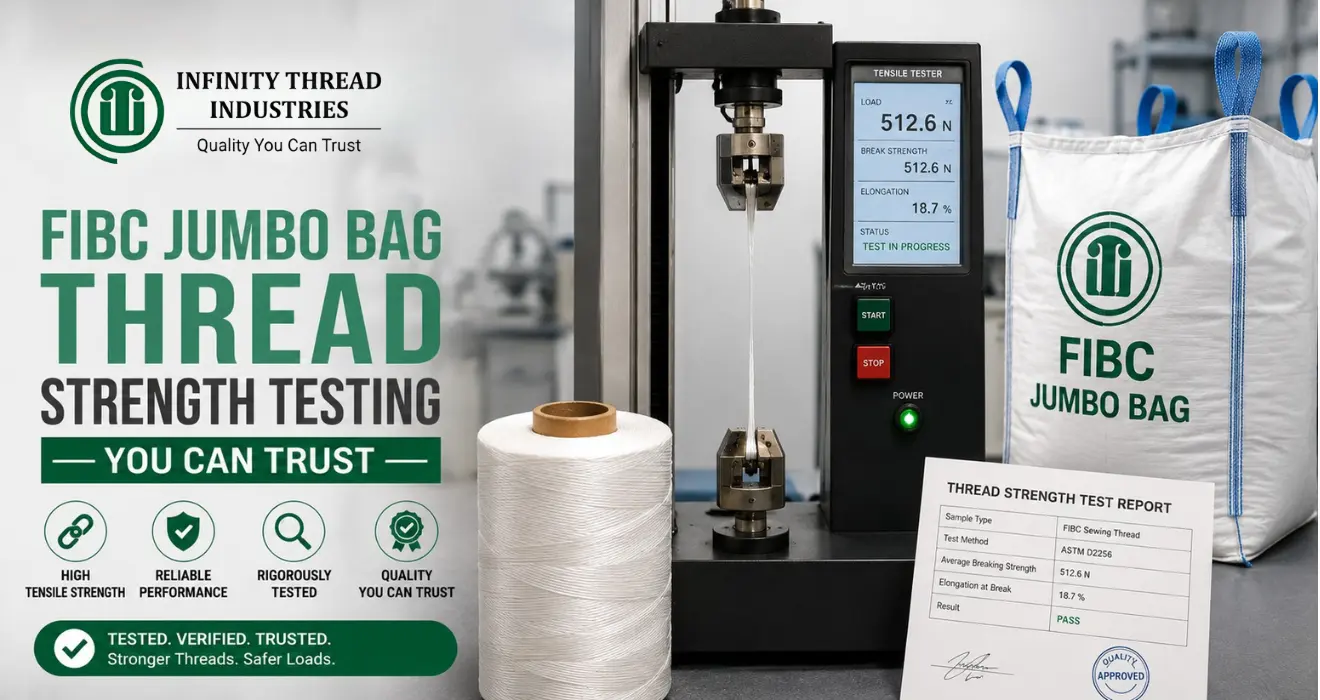
Don’t take a denier number on a packing slip as proof of performance. Ask for the batch test report before you commit to a bulk order tenacity, elongation, and breaking strength data, specific to the batch you’re buying, not a generic spec sheet from a catalogue.
Infinity Thread Industries provides batch-wise test reports with every order, so you can verify thread quality against your bag’s required safety factor without running additional testing on your end.
How to Verify Thread Quality Before Using It in FIBC Manufacturing
- Request a technical datasheet from your supplier check tenacity (g/d) and breaking strength (N) against your bag’s rated SWL.
- Conduct a sample stitch seam test pull-test at 1.5x the bag’s safe working load before committing to production.
- Verify UV stability if the finished bags will be stored or transported outdoors for any length of time.
- Check moisture absorption. Excess absorption weakens thread strength over time, even if it tested fine on day one.
- Run a batch production test before scaling to full production runs on a new thread batch.
- Source from Infinity Thread Industries we provide test reports with every batch, so this verification step doesn’t add cost or delay to your process.
FAQs
Q: What is the standard thread tenacity required for FIBC jumbo bags?
A: FIBC bags used for loads of 500–2,000 kg require thread tenacity of 8–10 g/d with breaking strength of minimum 50N per stitch. Our high-tenacity threads exceed these standards.
Q: How often should FIBC manufacturers test their stitching thread?
A: Thread quality should be tested with every new batch received from the supplier. We provide batch-wise test reports so you can verify quality without additional testing costs.
Q: Does Infinity Thread Industries provide ISO-certified threads for FIBC use?
A: Yes. Our threads comply with relevant IS and international quality standards. Contact us for our quality certification documentation.
Q: What causes FIBC seams to fail under load?
A: Common causes include wrong thread denier for the load rating, too few stitches per inch, thread degradation due to UV or moisture exposure, and machine tension calibration errors.
Q: Can we get safety factor documentation with our thread order?
A: Absolutely. We provide complete technical documentation including breaking strength, elongation, and tenacity data for every product. Request it when placing your order.
📞 Get a Free Sample or Technical Consultation

Founder of Digi Segment and HV Digital Marketing
SEO Strategist & Digital Marketing Expert
Hardik Vaghani is a digital marketing professional and SEO strategist based in Surat, Gujarat, India. He is the founder of Digi Segment, a content and insights platform covering SEO, digital marketing, AI tools, and online growth strategies, and the founder of HV Digital Marketing, a results-focused digital marketing agency helping local and service-based businesses rank on Google and generate consistent leads.
With hands-on experience in Search Engine Optimisation, Technical SEO, Google Ads, Meta Ads, and Content Strategy, Hardik has helped businesses across industries including e-commerce, real estate, healthcare, home improvement, and solar companies improve their organic visibility, local search rankings, and lead generation through ethical, white-hat strategies.
He specialises in Core Web Vitals optimisation, on-page SEO, keyword research aligned with search intent, and building scalable content frameworks that rank. At Digi Segment, Hardik shares practical, experience-backed insights, case studies, and step-by-step guides to help marketers, entrepreneurs, and small businesses grow online.
When he is not optimising websites, Hardik is building digital tools, writing SEO-focused content, and working with his agency clients to turn Google visibility into measurable business growth.
Expertise: SEO | Technical SEO | Google Ads | Meta Ads | Content Strategy | Core Web Vitals | WordPress | Digital Marketing | Lead Generation | Local SEO