
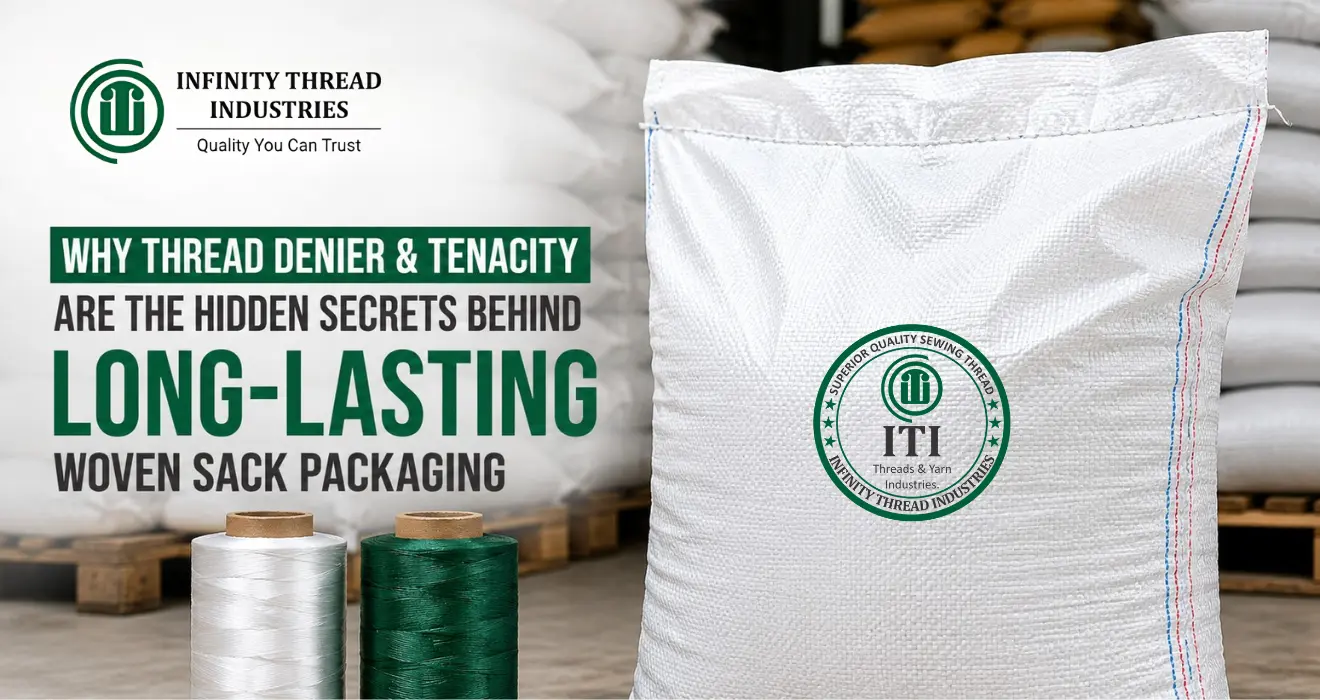
Thread Denier & Tenacity The Hidden Secrets Behind Long-Lasting Woven Sack Packaging
A 50 kg cement bag splits at the seam during loading. The thread looks fine. The sack looks fine. But somewhere between the specification sheet and the stitching line, the wrong denier got ordered and now the manufacturer is explaining a spillage to an angry buyer.
At Infinity Thread Industries, a Surat-based thread manufacturer operating since 2007, this is one of the most common problems we help packaging companies fix. The reason it keeps happening? Most buyers choose thread by price and colour. Very few look at denier and tenacity the two numbers that actually decide whether a woven sack survives in the real world.
This post explains both concepts in plain language, shows you exactly how to match thread specs to your bag requirements, and shares a real case from our factory floor.
How Wrong Thread Specs Cost Packaging Companies Lakhs Every Year
Here’s the thing most thread suppliers won’t tell you: the problem usually isn’t thread quality. It’s thread selection.
A packaging company in the cement or fertiliser business will run 50,000+ bags through a stitching line every week. If even 2% fail at the seam during transport or handling, that’s 1,000 burst bags. At ₹25–40 per bag, plus product loss, plus the cost of re-packing the maths turns ugly fast.
The usual culprits we see when clients call us with seam failures:
- Thread denier too low for the bag’s filled weight
- Tenacity under-specified the thread stretches instead of holding
- Stitch count too low, which puts more stress on each individual stitch
- Thread diameter mismatch causing needle friction and heat damage
None of these problems show up on a visual inspection. They only show up when the bag is being loaded into a truck at 6am in 40-degree heat.
What Is Thread Denier and Why Should Manufacturers Care?
Denier is a unit of measurement. One denier = the weight in grams of 9,000 metres of a single fibre.
So a 1500 denier thread means: 9,000 metres of that thread weighs 1,500 grams. A 2000 denier thread is heavier per metre which means it’s thicker. Thicker thread generally creates more volume in the seam, which distributes stress across a wider area.
But here’s where most buyers get confused: higher denier alone doesn’t guarantee more strength. That’s tenacity’s job.
Practically speaking, for woven sack packaging, denier determines three things:
- Needle compatibility too thick and you break needles or create friction holes
- Machine speed higher denier threads run better at lower speeds
- Seam appearance relevant for branded consumer packaging
According to the Bureau of Indian Standards (BIS IS 11579), woven sack stitching threads for PP and HDPE bags must meet minimum denier and tenacity thresholds depending on application class. Most Indian manufacturers are working in the 1200D–2500D range for standard bag-closing applications.
Understanding Tenacity The Strength That Holds Everything Together
Tenacity is the measurement of a thread’s breaking strength relative to its linear density. It’s expressed in grams per denier (g/d).
If denier tells you how thick the thread is, tenacity tells you how much it can handle before it gives way. And in packaging, this distinction matters enormously.
A thread with 2000 denier but 5 g/d tenacity will fail under the same load that a 1500 denier thread with 8 g/d tenacity handles without breaking a sweat.
Why does this happen? Because a low-tenacity thread has air and filler mixed into its fibre structure. It looks the same. It feels similar. But under load, those fibres elongate instead of holding and elongation in a sealed seam leads to the stitching pulling away from the fabric.
Infinity Thread Industries manufactures our woven sack range with tenacity ratings from 6.5 g/d for light packaging applications up to 9.5 g/d for FIBC and jumbo bag closures. The specific number depends on your load class and stitch pattern.
Denier vs Tenacity Quick Comparison
| Attribute | Denier | Tenacity |
| What it measures | Thread thickness / linear density | Breaking strength per unit weight |
| Unit | Grams per 9,000 m | Grams per denier (g/d) |
| Affects | Machine compatibility, seam volume, stitch density | Load-bearing capacity, elongation at break |
| Typical range (woven sack) | 1200D – 2500D | 6.0 – 9.5 g/d |
| Higher always better? | No must match needle and machine | Generally yes for heavy-load bags |
Denier vs Tenacity Which One to Prioritise for Woven Sack Stitching?
Short answer: tenacity, always.
Denier gets you into the right range for your machine. Tenacity is what keeps the bag sealed under stress. If you have to choose where to spend on thread quality, spend it on higher tenacity not just higher denier.
That said, the two work together. Here’s the practical framework we share with clients:
- Light bags (up to 25 kg, grain, rice, spices): 1200D–1500D thread, minimum 6.5 g/d tenacity
- Standard bags (25–50 kg, cement, fertiliser, chemicals): 1500D–2000D thread, 7–9 g/d tenacity
- Heavy bags (50+ kg, construction aggregates): 2000D–2500D thread, 8.5–9.5 g/d tenacity
- FIBC / jumbo bags (500–2000 kg): custom spec call us before ordering
There’s one more variable that buyers often miss: stitch count per inch (SPI). A high-tenacity thread paired with too-low SPI still fails. Aim for a minimum of 4 SPI for bags under 50 kg, and 5–6 SPI for heavier applications.
How Infinity Thread Industries Ensures the Right Denier for Your Application
We’ve been manufacturing threads in Surat since 2007. The business started when Vitthalbhai G. Devani opened a textile supply store in Ghanshyam Nagar, and it’s grown through three generations of hands-on manufacturing experience.
When a new client comes to us with a woven sack application, we don’t just ask ‘how many kg do you need.’ We run through a structured qualification:
- What is the filled bag weight?
- What is the base fabric GSM and tape width?
- What stitching machine are you running and at what speed?
- What is your current SPI setting?
- What failure mode are you experiencing, if any?
Only after those answers do we recommend a specification. Our manufacturing facility at Laskana, Surat covers 15,300 sq. ft. and runs 80,000 kg per month so we’re not guessing from a catalogue. We’re running the same production conditions our clients are specifying into.
Every thread batch goes through tenacity testing before dispatch. We maintain ISO 9001:2015 certification across our quality processes.
How Our Woven Sack Thread Saved a Cement Bag Manufacturer
A cement bag manufacturer from Rajasthan contacted us in early 2024 with a specific problem: 3–4% of their 50 kg bags were failing at the stitched end-seal during palletisation. Not during transit during palletisation. That’s an unusually early failure point.
After their team shared their current spec with us, the issue was clear immediately: they were running 1500D thread at 5.8 g/d tenacity with 3 SPI. For cement bags at 50 kg, that’s right at the edge of acceptable and their palletisation line was adding a compression load that pushed it over.
We recommended switching to 1800D thread at 8.2 g/d tenacity and increasing SPI from 3 to 5. We sent a 10 kg sample for testing on their line. Within two weeks, their QC team reported zero seam failures across 12,000 trial bags.
They’ve been running Infinity Thread’s woven sack range ever since.
Choosing the Right Thread Count for FIBC and Jumbo Bags
FIBC bags are a different category entirely. These bags carry between 500 kg and 2000 kg sometimes more for certain bulk chemical and mineral applications. The failure stakes are correspondingly higher.
For FIBC stitching, most international buyers specify UN-certified thread with tenacity above 8.5 g/d and denier in the 2000D–3000D range. The UN certification protocol (UN 13H3 for woven sacks) requires drop tests, stack tests, and seam integrity testing before a bag design gets certified.
Infinity Thread Industries supplies FIBC-grade thread specifically for these applications. If you’re manufacturing to a UN-certified design, let us know we’ll supply the thread spec that matches your certified bag construction.
One thing worth knowing: don’t assume your standard woven sack thread supplier can cover FIBC requirements. The denier and tenacity ranges are different enough that it’s worth a separate technical discussion.
How to Select the Right Thread Denier for Woven Sack Manufacturing
Here’s the process in six steps. This is what our technical team walks through for every new client application:
- Identify the maximum load your bag will carry (in kg). This is your starting anchor point for all other decisions.
- Determine the base fabric weight (GSM) of your woven sack material. Heavier fabric generally requires higher denier thread to maintain seam integrity.
- Calculate required tenacity minimum 6 g/d for bags up to 50 kg; 8–10 g/d for FIBC. Don’t accept a thread spec without this number.
- Match denier range: 1200D–1500D for light bags, 1500D–2500D for heavy-duty applications. Cross-reference against your machine’s needle size compatibility.
- Test seam strength using a standard stitch-pull test before bulk production. Pull speed should simulate the stress your bag will face during loading and palletisation.
- Contact Infinity Thread Industries with these specs we’ll supply the exact match from our current production run, or custom-manufacture to your requirements.
The result of following this process: you’ll never have to explain a burst bag to a buyer again.
Why This Gets Ignored (And What Changes When It Doesn’t)
I want to be direct about something. Most packaging manufacturers in India buy stitching thread the way they buy any commodity lowest price per kg that passes a basic snag test. And for 95% of production, that works fine.
The problems show up in the 5%. High-load bags in peak summer. Cement bags stacked six high in a humid warehouse. Fertiliser bags bouncing on a truck chassis for 400 km.
When those failures happen, people look at the thread manufacturer. But the root cause is almost always a specification that was never designed for that stress condition in the first place.
At Infinity Thread Industries, we’ve been having this exact conversation with Indian manufacturers since 2007. The ones who take the time to specify properly denier, tenacity, SPI, application conditions end up with failure rates under 0.2%. The ones who just order ‘standard woven sack thread’ keep coming back with complaints.
I know which conversation I’d rather have with a client.
Frequently Asked Questions
What denier is best for woven sack stitching?
For standard woven sacks carrying 25–50 kg, a thread in the 1500D–2000D range with tenacity above 7 g/d is the right starting point. For FIBC jumbo bags handling 500–2000 kg, the spec climbs significantly you’ll need denier in the 2000D–3000D range with tenacity at 8.5 g/d or above. Contact Infinity Thread Industries for a custom recommendation based on your specific application.
Does higher denier always mean stronger thread?
No. Tenacity strength per unit weight matters more than denier alone. A high-denier thread with low tenacity elongates under stress rather than holding the seam. Infinity Thread Industries balances both specifications for each application class, which is why our threads are tested for tenacity before every batch dispatch, not just visual inspection.
Can I get custom denier thread for my specific packaging line?
Yes. We offer custom thread specifications including denier, tenacity rating, finish (lubricated or dry), and colour matched to your machinery and packaging requirements. Call us at +91-76007 10883 or email info@infinitythreadindustries.in with your application details and current machine specs.
How does thread denier affect my stitching machine speed?
Thicker threads (higher denier) generally perform better at lower machine speeds because they generate more friction and heat at the needle. Running high-denier thread at speeds optimised for finer thread causes needle breakage and uneven seaming. Our technical team can advise on the optimal speed range for your specific denier and machine model.
Why do my stitched sacks burst at the seam even with quality thread?
Seam bursting despite quality thread usually points to one of three causes: denier mismatched to bag weight, tenacity too low for the load, or stitch count per inch (SPI) set too low. Each individual stitch carries too much stress when SPI is insufficient. Our team will audit your current specification denier, tenacity, and SPI together and recommend the correct combination for your failure pattern.
Ready to Get the Perfect Thread Specification for Your Factory?
Getting thread specification right isn’t complicated but it does require the right starting information. That’s exactly what the team at Infinity Thread Industries is here to help with.
We’re based in Surat, Gujarat, and have been manufacturing high-quality polyester and nylon threads for industrial packaging applications since 2007. Our woven sack and FIBC jumbo bag threads are used by manufacturers across India’s cement, fertiliser, chemical, and agricultural packaging sectors.
Explore our product range:
- Woven Sack & FIBC Jumbo Bag Thread
- High Strength Industrial Threads
- Polyester & Nylon Twine
- Woven Sack Stitching Thread: Buyer’s Guide for FIBC Manufacturers
📞 Get a Free Sample or Technical Consultation

Founder of Digi Segment and HV Digital Marketing
SEO Strategist & Digital Marketing Expert
Hardik Vaghani is a digital marketing professional and SEO strategist based in Surat, Gujarat, India. He is the founder of Digi Segment, a content and insights platform covering SEO, digital marketing, AI tools, and online growth strategies, and the founder of HV Digital Marketing, a results-focused digital marketing agency helping local and service-based businesses rank on Google and generate consistent leads.
With hands-on experience in Search Engine Optimisation, Technical SEO, Google Ads, Meta Ads, and Content Strategy, Hardik has helped businesses across industries including e-commerce, real estate, healthcare, home improvement, and solar companies improve their organic visibility, local search rankings, and lead generation through ethical, white-hat strategies.
He specialises in Core Web Vitals optimisation, on-page SEO, keyword research aligned with search intent, and building scalable content frameworks that rank. At Digi Segment, Hardik shares practical, experience-backed insights, case studies, and step-by-step guides to help marketers, entrepreneurs, and small businesses grow online.
When he is not optimising websites, Hardik is building digital tools, writing SEO-focused content, and working with his agency clients to turn Google visibility into measurable business growth.
Expertise: SEO | Technical SEO | Google Ads | Meta Ads | Content Strategy | Core Web Vitals | WordPress | Digital Marketing | Lead Generation | Local SEO