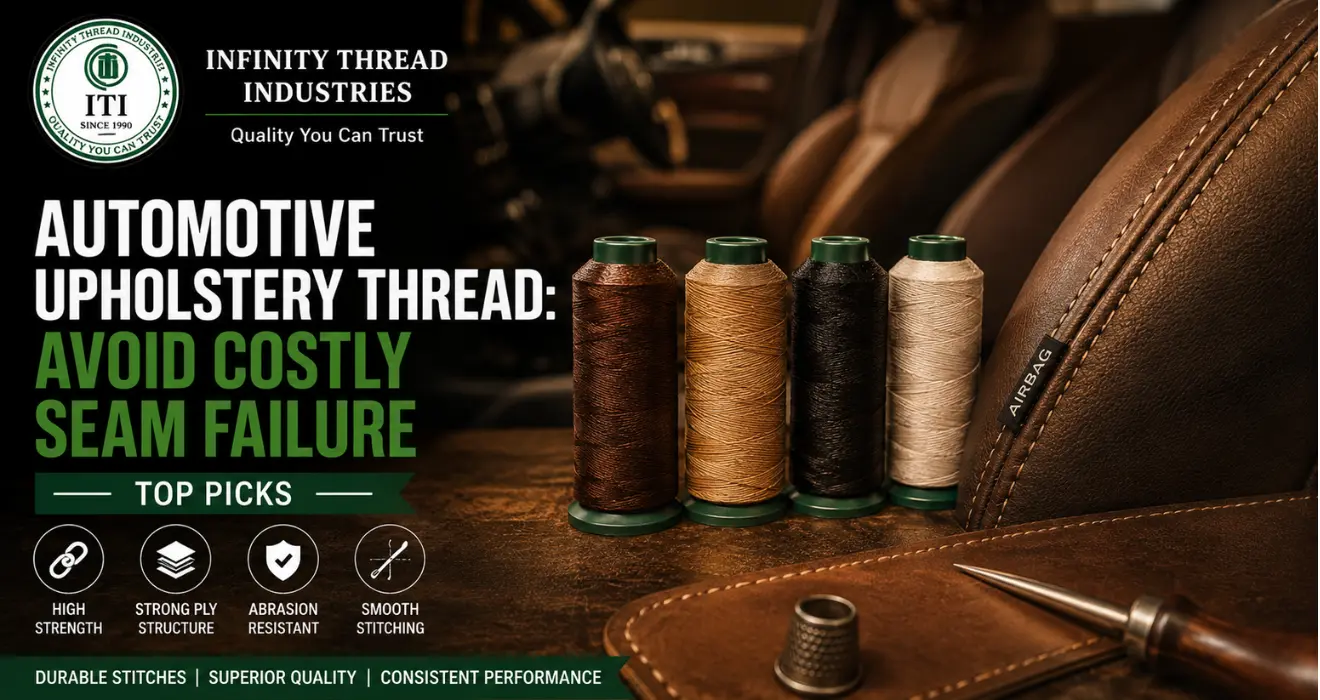

A batch of leather seat covers came back from an automotive Tier-1 supplier in 2023. Not because of the leather. Not because of the cutting. The seam thread had snapped along the bolster, right where a driver’s hip presses in and out of the seat a few thousand times a month. That one rejected batch cost more in freight and rework than the thread itself was worth for the entire order.
That’s the real story behind why a car seat cover stitching thread manufacturer matters more than most buyers realize until something goes wrong. Seat covers look simple. They’re not. A seam inside a moving vehicle deals with vibration, heat that can cross 70°C in a parked car under sun, constant flexing, and years of friction from someone getting in and out. If the thread underneath is wrong, the fabric or leather on top doesn’t matter at all.
The Short Version
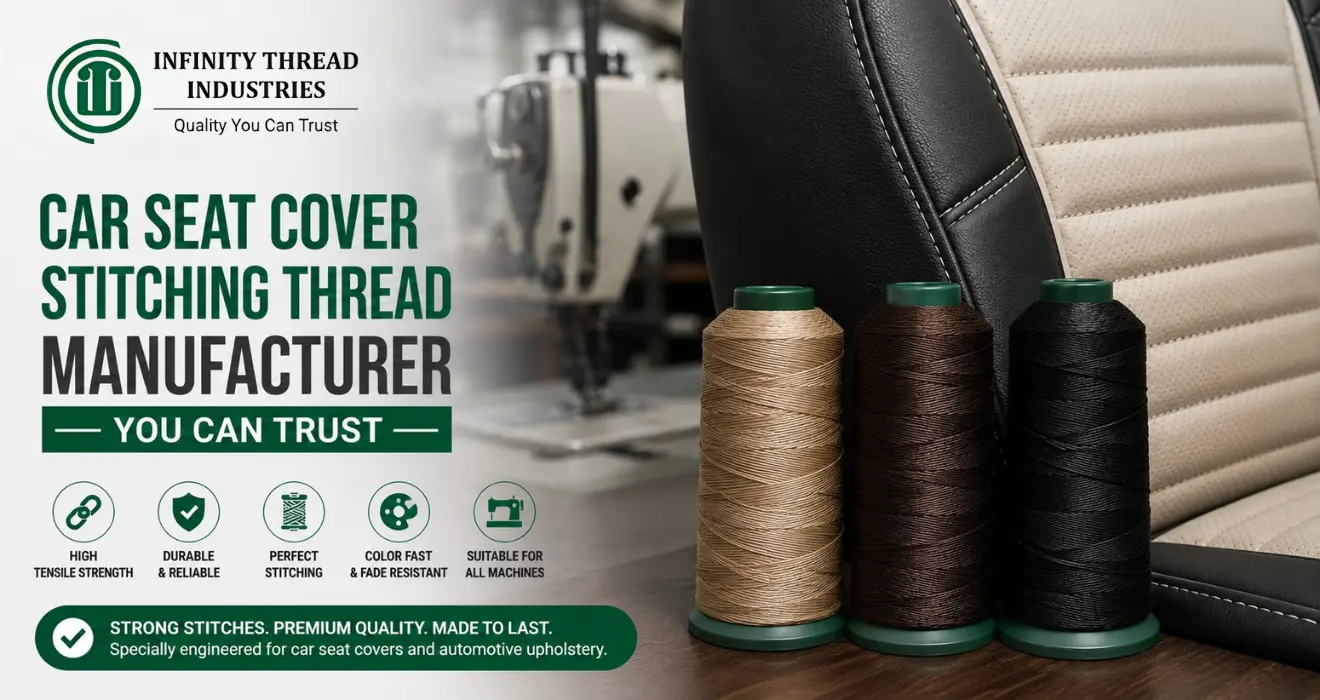
A car seat cover stitching thread manufacturer supplies bonded nylon or high-tenacity polyester thread engineered for tensile strength, abrasion resistance, and heat stability inside a vehicle cabin. Polyester holds color better under UV exposure through glass. Bonded nylon flexes and recovers well on high-speed seams. The right choice depends on the seat material, the machine speed, and whether the seam is structural or decorative.
Why Seat Cover Seams Fail Long Before the Fabric Does
Most warranty complaints on car interiors trace back to stitching, not upholstery. A seam pops at the bolster edge. Thread turns brittle and snaps after two summers of dashboard-level heat. Colors fade unevenly along visible topstitching while the seat panel underneath still looks new.
None of that is really a fabric problem. It’s a thread problem, and it usually starts with buying on price instead of specification. A cheap cone of thread might sew fine on day one. Under repeated flex fatigue and heat cycling, it won’t hold for the life of the vehicle.
This is exactly why buyers switch to a dedicated car seat cover stitching thread manufacturer instead of sourcing thread the same way they’d source thread for shirts or bags. A general-purpose cone gets tested against general-purpose conditions. A cabin isn’t general-purpose. It’s closer to a small greenhouse that also vibrates.
What a Serious Seat Cover Thread Supplier Gets Right
A serious car seat cover stitching thread manufacturer isn’t just spinning fiber and winding it onto a cone. The thread has to survive conditions most stitching never sees: sustained heat, UV bleed through tinted glass, and a seam that flexes every single time someone sits down.
That’s a longer list of demands than most buyers expect when they first go looking for a seat cover thread manufacturer. Garment thread and automotive thread aren’t interchangeable, even when they look identical on the cone. One is built for a shirt seam that mostly sits still. The other gets flexed, heated, and sat on thousands of times over a car’s lifespan.
Bonded Nylon vs High-Tenacity Polyester for Seat Covers
Bonded nylon thread is treated with a resin finish that reduces friction as the needle passes through the material at high speed. That matters on industrial sewing lines running seat covers all day, since less friction means fewer thread breaks and less downtime.
High-tenacity polyester, on the other hand, is the better call for anything facing a windshield or side window for years. It resists UV-driven color fade far better than nylon. We cover this comparison in more depth in our polyester vs nylon thread guide, since the same tradeoff shows up in bag closing and upholstery work too.
So which wins for a car seat? Honestly, it depends on the panel. Structural seams under the seat, where sunlight never reaches, can run bonded nylon. Visible topstitching on the seat back or bolster should run polyester, because that’s the part a customer actually sees fade first.
Thread Ticket Number and Denier: Getting the Sizing Right
Ticket number (or denier, depending on how your supplier measures it) decides how visible and how strong the stitch line is. Automotive seat covers typically run in the Tkt 20 to Tkt 40 range for structural seams, dropping finer for decorative topstitching where the look matters more than raw pull strength.
Get this wrong and you’ll see one of two failures. Too fine, and the seam fails under the flex fatigue of daily use. Too heavy, and the needle punches oversized holes that weaken the leather or vinyl around the stitch line, which then tears before the thread does.
Colorfastness and UV Resistance Inside a Cabin
A parked car in Ahmedabad or Surat in May regularly sits above 65°C on the dashboard. That’s not a lab condition. That’s a Tuesday. Any high-strength industrial thread going into seat covers needs UV-stabilized dye, or the topstitching will visibly lighten within a year while the seat fabric around it stays true to color. That mismatch is what actually triggers customer complaints, more than any structural failure.
How to Choose a Seat Cover Thread Manufacturer in 5 Steps
- Ask for the tensile strength test report, not just a spec sheet.
- Request a sample cone and run it on your actual machine at production speed, not a demo unit.
- Check UV and heat resistance data specific to automotive interior conditions, not general textile claims.
- Confirm minimum order quantities match your production batches, so you’re not overstocking one lot number.
- Get a written lead time commitment, because a late thread delivery stalls an entire cutting and sewing line. The result is a supplier relationship that survives more than one order cycle.
📞 Get a Free Sample or Technical Consultation
What Changed After We Retooled for Automotive Orders
We started getting automotive interior enquiries around 2022, mostly from garment units in Surat supplying seat cover panels to Tier-2 suppliers. The first few orders went out on our standard sewing thread line, the same cones we’d sell for regular garment work.
It didn’t hold up. Two clients came back within four months reporting thread breakage on high-speed automated lines running 4,000+ stitches a minute. That’s a different world from a tailoring unit doing 1,200 stitches a minute on cotton fabric.
We reworked the twist and bonding process specifically for high-speed automotive lines after that, testing tensile strength at higher RPM before a single cone left the facility. Traffic through that product line hasn’t slowed since. We still lose the odd order to buyers chasing the lowest per-kg price, and honestly, that’s fine. Chasing every order isn’t the goal. Holding the ones where quality actually gets tested is.
Word travels fast between garment units in one industrial cluster. Once two or three seat cover manufacturers in Surat started asking specifically for the reworked cones by name, we knew the retooling had paid off. That’s a better signal than any brochure claim.
The Automotive Textile Market Is Growing. So Is the Pressure on Thread Quality
This isn’t a small, niche corner of the thread business anymore. According to the India Brand Equity Foundation, India’s mobiltech textile market, a division of technical textiles for automotive use, is projected to grow from US$ 2.32 billion in FY25 to US$ 4.57 billion by FY33. That’s nearly double in eight years.
Global vehicle production tells a similar story. Global vehicle production surpassed 92 million units in 2024 according to OICA data, and each vehicle needs a complete set of seat and interior stitching. More vehicles built means more seams stitched, and more manufacturers under pressure to cut costs somewhere. Thread is often the first place buyers try to save money. It’s usually the last place they should.
Bonded Nylon vs Polyester Thread: A Quick Comparison
| Property | Bonded Nylon | High-Tenacity Polyester |
| Best for | Structural, hidden seams | Visible topstitching |
| UV / colorfastness | Moderate | Strong |
| High-speed sewing | Excellent, low friction | Good |
| Heat resistance | Good | Very good |
| Typical cost | Slightly lower | Slightly higher |
FAQs: Buying Thread for Car Seat Covers
What is car seat cover stitching thread made of?
Most automotive seat cover thread is either bonded nylon or high-tenacity polyester. Both are synthetic filament yarns twisted and finished to handle heat, flex fatigue, and repeated abrasion better than cotton or basic spun thread ever could.
How do I choose a car seat cover stitching thread manufacturer?
Start with a tensile strength test report, then run a sample cone on your own machine at real production speed. A manufacturer that hesitates to share test data or provide samples isn’t one you want holding up your seat cover line.
What is the typical cost of automotive seat cover thread?
It varies by ticket number, fiber type, and order volume, so there’s no single number that applies everywhere. Bonded nylon usually runs slightly cheaper per kg than high-tenacity polyester, though the gap narrows on large industrial orders.
What thread count is best for stitching car seat covers?
Tkt 20 to Tkt 40 covers most structural automotive seams. Finer counts work for decorative topstitching. The right pick depends on your machine, needle size, and whether the seam is load-bearing or purely visual.
Does bonded nylon thread work for leather seat covers?
Yes, and it’s a common choice for hidden or structural seams on leather. For visible leather topstitching exposed to sunlight, though, high-tenacity polyester tends to hold its color longer.
Polyester vs nylon thread for car seats, which is better?
Neither wins outright. Polyester handles UV exposure and color retention better. Nylon flexes better on high-speed lines and resists sudden shock loads. Most serious manufacturers use both, matched to where each seam sits on the seat.
Why does my seat cover thread keep breaking on the sewing machine?
Usually it’s one of three things: wrong ticket number for the needle size, thread tension set too tight for the fiber, or a lower-grade cone that wasn’t built for sustained high-speed stitching. Worth checking all three before blaming the machine.
Where can I buy industrial-grade car seat cover thread in India?
Infinity Thread Industries, based in Surat, Gujarat, supplies bonded nylon and high-tenacity polyester thread for automotive and industrial stitching, with in-house production and a monthly capacity of 80,000 kg.
Where to Go From Here
If you’re evaluating suppliers, our guide on choosing the best industrial thread manufacturer in India covers the broader vetting process beyond just automotive work. For a wider look at who’s active in this space, see our roundup of top thread manufacturers in India.
Got a seat cover production line that’s chewing through thread faster than it should? Get in touch with Infinity Thread Industries and Nilesh’s team can walk through your machine speed, seam type, and ticket number to recommend the right cone before your next production run.

Founder of Digi Segment and HV Digital Marketing
SEO Strategist & Digital Marketing Expert
Hardik Vaghani is a digital marketing professional and SEO strategist based in Surat, Gujarat, India. He is the founder of Digi Segment, a content and insights platform covering SEO, digital marketing, AI tools, and online growth strategies, and the founder of HV Digital Marketing, a results-focused digital marketing agency helping local and service-based businesses rank on Google and generate consistent leads.
With hands-on experience in Search Engine Optimisation, Technical SEO, Google Ads, Meta Ads, and Content Strategy, Hardik has helped businesses across industries including e-commerce, real estate, healthcare, home improvement, and solar companies improve their organic visibility, local search rankings, and lead generation through ethical, white-hat strategies.
He specialises in Core Web Vitals optimisation, on-page SEO, keyword research aligned with search intent, and building scalable content frameworks that rank. At Digi Segment, Hardik shares practical, experience-backed insights, case studies, and step-by-step guides to help marketers, entrepreneurs, and small businesses grow online.
When he is not optimising websites, Hardik is building digital tools, writing SEO-focused content, and working with his agency clients to turn Google visibility into measurable business growth.
Expertise: SEO | Technical SEO | Google Ads | Meta Ads | Content Strategy | Core Web Vitals | WordPress | Digital Marketing | Lead Generation | Local SEO