
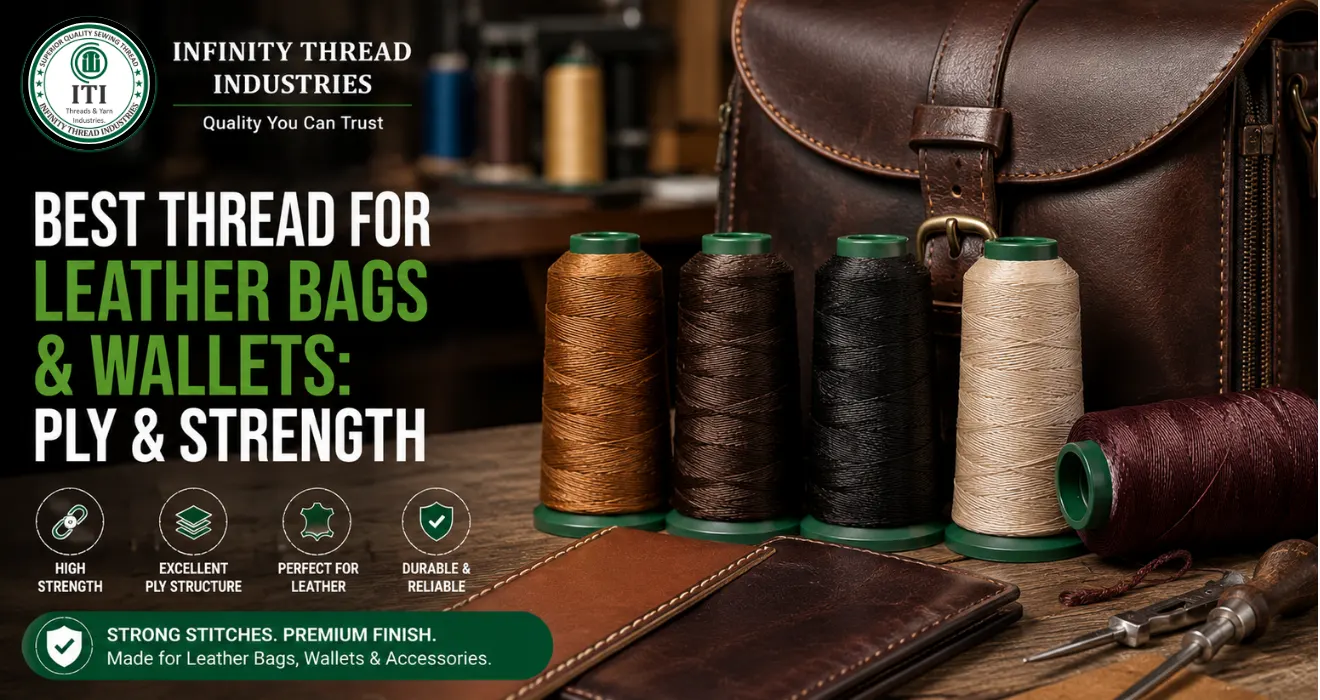
A stitch line that looks perfect on day one and splits open by month three isn’t a leather problem. It’s almost always the wrong thread for leather bags and wallets going through the machine.
That’s the call Infinity Thread Industries gets constantly from bag units, wallet manufacturers, and leather accessory brands across India. Someone switches leather suppliers, keeps the same spool on the machine, and three months later returns start piling up at the handle seam. Nobody thinks to check the thread first. They should.
Pick the right thread for leather bags and wallets and you get seams that outlast the leather itself. Pick the wrong one and you get either a snapped seam under normal use or a stitch line so bulky it ruins a fine wallet’s finish. There isn’t a single “best” spec. There’s a right spec for your specific product, and it comes down to three numbers: ply, ticket, and tensile strength.
Here’s the Short Answer
Bonded nylon or bonded polyester thread in the T-40 to T-70 ticket range is the standard choice for bags and wallets. Thinner leather goods like wallets and cardholders lean toward the finer end, T-40 to T-50. Bags, totes, and anything load-bearing move up toward T-60 to T-90. The right pick isn’t about raw strength alone. It’s about matching the thread to leather thickness, stitch visibility, and how the seam will actually get used.
Why “Just Use a Strong Thread” Doesn’t Work on Leather Goods
Ask a new leather workshop owner what thread for leather bags and wallets they need and most say “the strongest one you have.” That’s the wrong question. A wallet stitched with T-90 heavy-duty thread doesn’t look premium. It looks like a tarp repair. The stitching bulges at every fold, the needle holes stretch wider than they should, and the thin leather around the card slots starts to tear before the thread ever does.
On the other end, a bag maker who orders a fine T-40 thread because it “matches the delicate look” ends up with handle seams that fray within a season. Heavy daily-carry bags put real load on a strap seam every time someone lifts it off a hook or drops it on a car seat. Undersized thread for leather bags and wallets snaps under that kind of repeated stress, not because the leather failed, but because the spec was wrong from the start.
How Ticket Number and Ply Affect Thread for Leather Bags and Wallets
Ticket number is a commercial sizing system, and it isn’t standardised the same way across every thread brand. On bonded thread ranges like the ones most leather units order from us, a higher T-number generally means a heavier, higher-tenacity spool: T-40 sits at the fine end for delicate stitching, T-90 sits at the heavy end for load-bearing seams. Some cotton and spun-thread numbering systems run the opposite way, which is exactly why guessing a ticket number off memory or a competitor’s spec sheet is risky. Confirm the chart with your actual supplier before ordering a leather goods stitching thread in bulk.
Ply and ticket number together are what actually decide whether a spool of thread for leather bags and wallets is right for your product, not one number in isolation.
Ply is the number of individual strands twisted or bonded together to form the finished thread. More plies generally means more tensile strength and a slightly heavier visible stitch line. Two-ply bonded nylon is common on wallets and small leather goods where a fine, tight stitch matters more than raw pull strength. Three-ply and heavier constructions show up on strap seams, gussets, and anywhere a bag takes constant pulling.
Thin Leather (Wallets, Small Goods) vs Thick Leather (Bags, Belts)
Thin leather, the kind used for wallets, cardholders, and small pouches, usually runs 1 to 1.5mm. A fine bonded thread in the T-40 to T-50 range sews clean through that without punching oversized holes that weaken the material around the stitch line. Push a heavier T-90 thread through 1.2mm leather and you’re more likely to perforate the edge than reinforce it.
Thick leather for bags, belts, and structural panels runs anywhere from 2mm up to 4mm or more on some strap and handle pieces. That needs a heavier ticket range, typically T-70 to T-90, because a fine thread simply doesn’t have the bulk to resist abrasion as the leather flexes at the fold points thousands of times over a product’s life.
Bonded vs Spun Thread for Leather
Bonded thread runs individual nylon or polyester filaments through a resin coating that fuses them into one smooth strand. Spun thread twists short staple fibres together with no bonding agent. For leather goods stitching thread work specifically, bonded wins almost every time. It resists abrasion better against the rough, uneven surface leather presents, and it generates less friction heat as it passes through the needle on dense material.
Spun thread still has a place, mostly on lighter fashion leather goods where the softer hand-feel of the stitch matters more than maximum durability. But if the product will see daily handling, a bonded construction is the safer default.
Matching Bag and Wallet Thread to Your Machine Type
The right ticket number on paper can still fail on the wrong machine setup. Machine type and needle size decide how much thread the seam can actually accommodate without skipped stitches or thread shredding.
Flat-Bed vs Post-Bed Machines for Bag Stitching
Flat-bed machines handle flat panels well: the front and back of a wallet before assembly, gussets laid open, straps before they’re folded and closed. Post-bed machines are built for stitching around tubular or curved sections after a bag is partly assembled, like the sides of a structured tote or the curved seam on a rounded pouch. Trying to force post-assembly stitching through a flat-bed machine usually means fighting the geometry the whole way, and that fight shows up as inconsistent stitch tension on the finished seam.
Neither machine changes the fundamental thread for leather bags and wallets selection, but it does change how forgiving the setup is if your ticket number is slightly off from ideal. Get the bag and wallet thread spec right first, and the machine choice mostly takes care of itself.
Needle Size to Thread Ticket Compatibility
| Ticket Number | Recommended Needle Size | Typical Use |
| T-40 | 90/14 to 100/16 | Wallets, cardholders, small goods |
| T-50 | 100/16 to 110/18 | Light bags, pouches, thin straps |
| T-70 | 110/18 to 120/19 | Standard bags, medium straps |
| T-90 | 120/19 to 130/21 | Heavy bags, handles, load-bearing seams |
Mismatched needle-to-thread sizing is the single most common cause of thread breakage we hear about from new clients. The needle eye needs enough room for the thread to pass without dragging, but not so much room that the stitch loops loosely.
📞 Get a Free Sample or Technical Consultation
Color, Finish & Visual Stitch Quality for Premium Leather Goods
For visible stitching on premium leather goods, the finish matters as much as the spec sheet. A bag or wallet buyer notices stitch color contrast before they notice ticket number, even though ticket number is what determines whether that stitch survives. This is the part of choosing thread for leather bags and wallets that most spec sheets skip entirely, because it’s a design call as much as a technical one.
Waxed vs Non-Waxed Finish
Waxed thread carries a light wax coating that reduces friction as it passes through the needle and against the leather surface. It’s the better call for heavier leather, saddle-stitched goods, and anything hand-finished, since the wax also helps the thread sit flush and resist moisture pickup over time.
Non-waxed bonded thread runs cleaner on high-speed industrial machines and tends to hold dye color slightly better over years of UV exposure, which matters for lighter-colored bags that see regular sun. Neither option is universally “better.” It depends on whether the priority is machine speed or long-term finish quality on a visible seam.
| Ticket Number | Best Application | Ply Range | Typical Product |
| T-40 to T-50 | Fine, detailed stitching | 2-ply | Wallets, cardholders, small pouches |
| T-60 to T-70 | Standard everyday goods | 2 to 3-ply | Handbags, totes, crossbody bags |
| T-80 to T-90 | Load-bearing, structural | 3-ply | Handles, straps, structural gussets |
Use the table above as a starting point for your own bag and wallet thread order, then confirm against your specific leather batch. If you’re staring at a spec sheet and still unsure, the fastest fix is testing rather than guessing. Request thread samples for testing on your leather line before committing to a full production run.
What We’ve Seen Supplying Bonded Nylon to Leather Goods Units
We’ve been supplying bonded nylon thread for leather goods manufacturing since 2022, running out of our ISO 9001:2015-certified facility in Surat, Gujarat. In that time, the single most common support call isn’t “my thread broke.” It’s “my thread is fine on paper but keeps snapping on the line.”
Nine times out of ten, the actual issue traces back to ticket number chosen for the wrong leather thickness, not a defect in the spool itself. A bag unit in one case had been running T-90 thread on 1.4mm wallet-weight leather for months because a previous supplier told them “heavier is always safer.” It wasn’t. The oversized needle holes were weakening the leather around every stitch, and returns for torn card slots kept coming back. Switching to T-50 solved it in a single production run.
We don’t push the highest ticket number to make a bigger sale. Honestly, we’d rather talk a client down to the right spec and keep them as a long-term account than oversell them once and lose the relationship over a returned batch. Most of the leather bag and wallet manufacturers we work with come back for repeat orders once they’ve run one production batch on the correct spec.
Why Getting Bag and Wallet Thread Specs Right Matters More Than Ever
India’s leather and footwear exports climbed 25% to touch roughly $5.7 billion in FY 2024-25, and industry estimates put the broader leather sector on track toward $50 billion by 2030, according to the India Brand Equity Foundation. Leather bags, wallets, and small goods make up a meaningful slice of that growth, and export-grade quality checks don’t leave room for a stitch line that fails at inspection.
The industry also runs on shared standards rather than guesswork. ASTM’s practice for determining sewing thread ticket numbers exists specifically because thread manufacturers were using too many undefined, unrelated numbering systems, which made it hard for buyers to compare specs across suppliers. That’s exactly why we always recommend testing a sample against your own leather and your own machine tension rather than trusting a ticket number on a data sheet alone. One supplier’s T-70 isn’t automatically identical to another’s.
Frequently Asked Questions
What ticket number thread is best for leather wallets?
Finer ticket numbers work best here, generally T-40 to T-50 bonded nylon. Thinner leather goods need a thread that won’t punch oversized holes through delicate material.
Is bonded nylon thread better than polyester for leather bags?
Depends on the use case. For everyday thread for leather bags and wallets, bonded nylon offers better abrasion resistance and a bit more flex. Bonded polyester holds up better under UV and moisture, so outdoor or travel-heavy bags often do better with it.
Can thread color affect leather goods pricing or perception?
Yes, and more than people expect. Premium brands specify the stitch color on their bag and wallet thread down to a shade, because visible contrast stitching is a design signal buyers read as quality before they even touch the leather.
What causes thread breakage on leather stitching machines?
Mismatched needle-to-thread sizing is the top cause, followed closely by incorrect tension settings on the machine. Check the needle size chart before assuming your thread for leather bags and wallets is defective.
Do you offer custom colors for leather goods thread orders?
Yes. Custom color matching is available for leather bag and wallet thread orders, along with finish options like waxed or non-waxed coatings for bulk runs.
What’s the difference between waxed and non-waxed thread for leather?
Waxed thread reduces needle friction and works well on heavier, hand-finished leather bags. Non-waxed wallet and bag thread runs cleaner on high-speed machines and tends to hold color a little longer under sun exposure.
Can I get bulk samples before ordering thread for leather bags and wallets?
Sample requests are standard practice here, and honestly, we’d rather you test first. It costs a little more upfront and saves both sides a returned shipment later.
What thread works for both bags and wallets without switching spools?
A mid-range T-60 to T-70 bonded thread often covers both, though we’d still recommend confirming against your leather thickness and stitch type before locking in one spec for an entire product mix.
Matching Your Wallet and Bag Thread, Product by Product
There’s no single best thread for leather bags and wallets that covers every product on a line. Wallets need a finer bonded thread that won’t overwhelm thin leather. Bags and structural pieces need heavier ply and higher ticket ranges to survive daily strain. Get the ticket number, ply, and finish matched to the actual product, not a generic “strong is safe” assumption, and the seam stops being the weak point. That’s the whole difference between a spool that just fits the machine and a spool built for your leather bags and wallets specifically.
We’ve built our whole supply process around leather stitching thread manufacturer work and high strength industrial threads for exactly this reason. If you’re not sure where your product falls on the ticket number chart, don’t guess on a full production order.

Founder of Digi Segment and HV Digital Marketing
SEO Strategist & Digital Marketing Expert
Hardik Vaghani is a digital marketing professional and SEO strategist based in Surat, Gujarat, India. He is the founder of Digi Segment, a content and insights platform covering SEO, digital marketing, AI tools, and online growth strategies, and the founder of HV Digital Marketing, a results-focused digital marketing agency helping local and service-based businesses rank on Google and generate consistent leads.
With hands-on experience in Search Engine Optimisation, Technical SEO, Google Ads, Meta Ads, and Content Strategy, Hardik has helped businesses across industries including e-commerce, real estate, healthcare, home improvement, and solar companies improve their organic visibility, local search rankings, and lead generation through ethical, white-hat strategies.
He specialises in Core Web Vitals optimisation, on-page SEO, keyword research aligned with search intent, and building scalable content frameworks that rank. At Digi Segment, Hardik shares practical, experience-backed insights, case studies, and step-by-step guides to help marketers, entrepreneurs, and small businesses grow online.
When he is not optimising websites, Hardik is building digital tools, writing SEO-focused content, and working with his agency clients to turn Google visibility into measurable business growth.
Expertise: SEO | Technical SEO | Google Ads | Meta Ads | Content Strategy | Core Web Vitals | WordPress | Digital Marketing | Lead Generation | Local SEO