
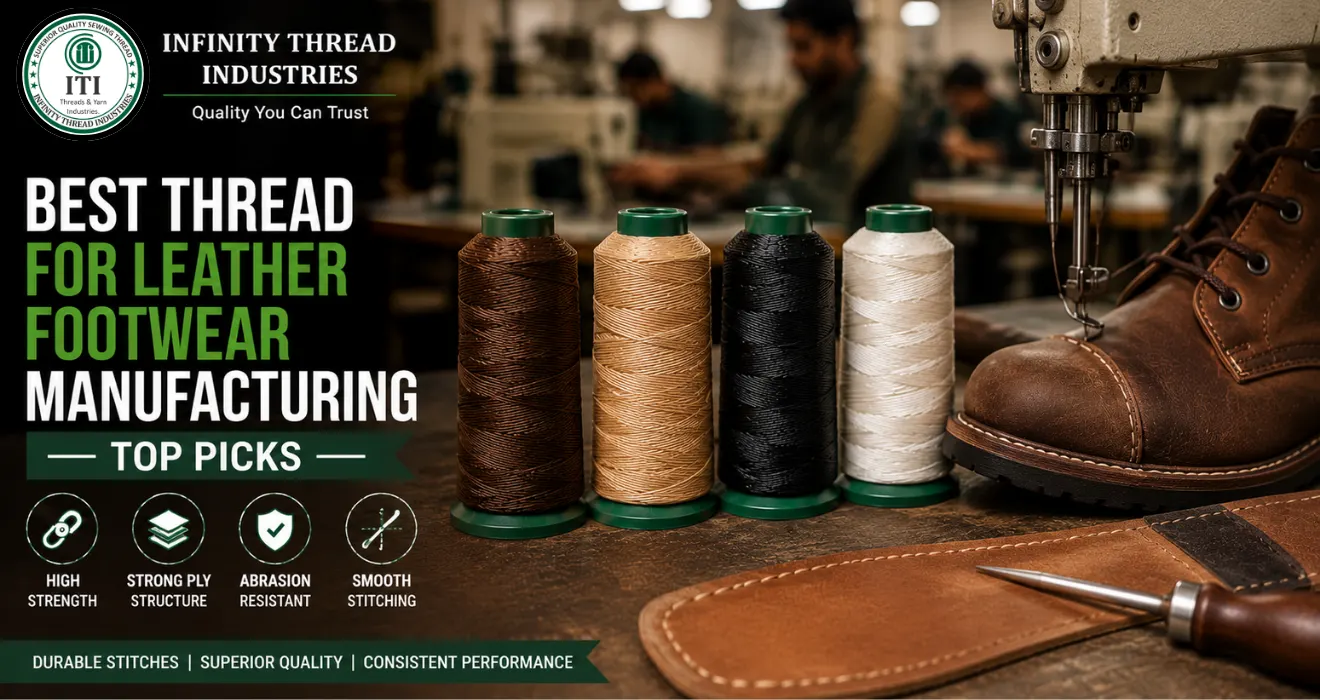
A batch of two thousand pairs. Clean stitching on the line, nothing flagged at final QC. Three months later, the return boxes start showing up, and almost every failure sits in the same spot: the flex crease where the upper bends with the foot.
That’s the pattern we see more than any other when a factory picks the wrong thread for leather footwear manufacturing.
So here’s the direct answer, no build-up. Nylon thread flexes and springs back better, which makes it the safer pick for footwear that bends with every step: uppers, welts, toe boxes. Polyester holds its color and shrugs off UV exposure better, which matters more for work boots and outdoor footwear that sit in the sun all day. Neither wins outright. It comes down to where the seam sits and what it has to survive for the next two years.
And here’s the thing most buyers get backwards: footwear seams don’t fail at the sole first. They fail at the flex point, thousands of times a day, until the thread gives out before the leather does.
The Short Version
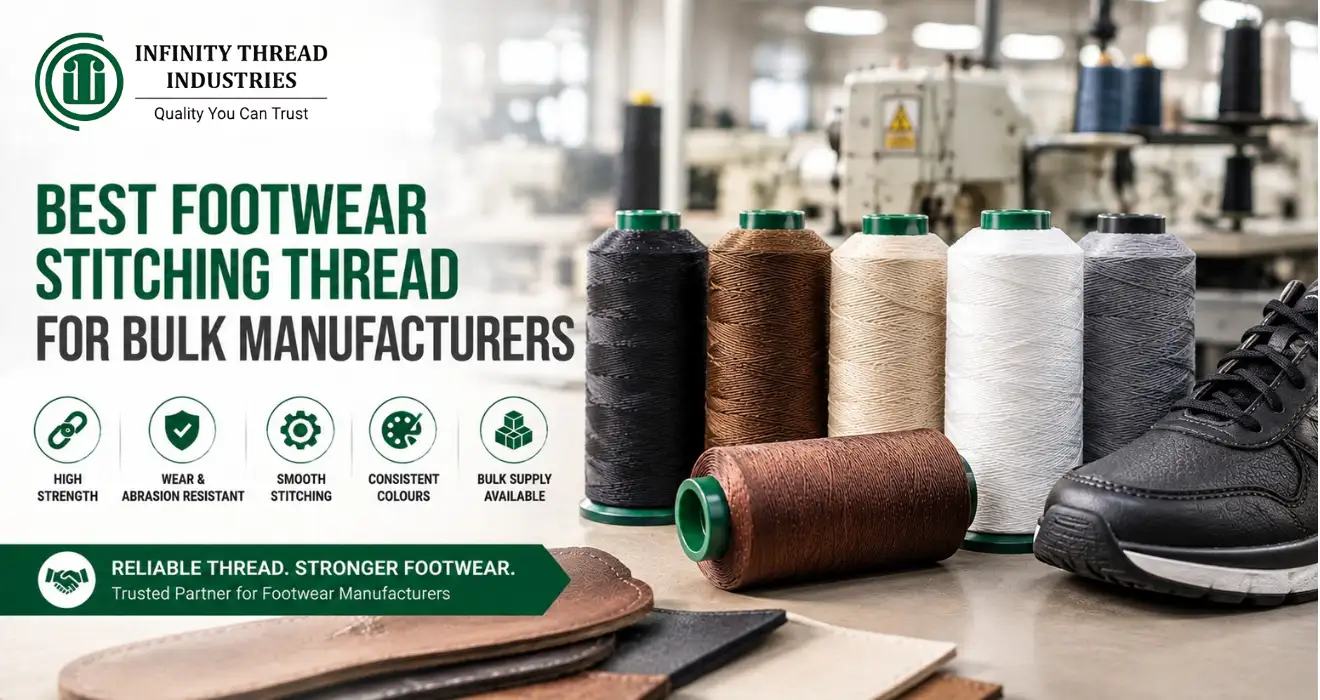
Nylon thread for leather footwear manufacturing wins on flex recovery, which is why it’s the default for sports shoes, sneakers, and boots with heavy bend at the vamp. Polyester wins on color retention and UV stability, which is why it’s the better call for outdoor work boots and safety footwear that live outside for a full shift. Infinity Thread Industries has supplied both grades to footwear and leather goods units from our Surat, Gujarat facility since we expanded into leather stitching thread in 2022.
Most manufacturers we talk to already know this much. What they don’t know is which one actually fits their specific product line, and that’s what the rest of this post walks through.
Most footwear buyers who reach out to us have already had a seam fail. Not before. That’s just how it usually goes. A vamp seam opens up after forty or fifty wears. A welt line starts fraying right at the ball of the foot. Customers send shoes back that are barely broken in.
The frustrating part is that everything else checks out. The sole holds. The leather holds. It’s the thread at the flex point that gives up first, and by the time it shows up as a return, it’s already cost you the customer relationship, not just the pair of shoes.
Flex Resistance Matters More Than Raw Strength for Footwear Thread
Most spec sheets lead with tensile strength, and that’s honestly the wrong number to obsess over first. A shoe seam almost never fails because the thread snapped under one big pull. It fails because the same crease gets bent and released tens of thousands of times before the shoe is even six months old.
Nylon has higher elasticity than polyester, roughly 20 to 30% more stretch before it breaks, and it recovers its shape after each flex cycle instead of staying deformed. Polyester holds its shape and length more consistently over time, which is great for stability but less forgiving where a seam has to keep bending.
Flex resistance vs raw strength: a footwear seam under repeated bending needs elasticity and recovery more than peak breaking strength. Choose your footwear thread based on where the seam sits, not what number sits highest on a spec sheet.
Where Footwear Seams Actually Fail
Three spots account for almost every stitching failure we get asked about: the vamp crease (where the upper bends over the toe), the welt line on constructed footwear, and the heel counter seam on boots. All three take repeated flex stress, not sudden load. That’s exactly where thread elasticity matters more than thread strength.
Nylon Thread for Leather Footwear Manufacturing: Strengths and Limits
Nylon 6 or nylon 66 thread is the default footwear thread recommendation we give when a client’s product bends a lot in normal use. It’s got a higher strength-to-weight ratio than polyester, and its stretch recovery is genuinely better, so it holds up longer at flex points without seam pucker or thread breakage.
It’s not perfect, though, and I’ll say that upfront instead of pretending otherwise. Untreated nylon absorbs more moisture than polyester (2.8% to 8% of its own weight depending on grade) and loses some tensile strength when wet. It also degrades faster under direct UV exposure unless it’s specifically UV-stabilized. So if your footwear line sits outdoors on a loading dock for weeks before shipping, plain nylon isn’t the safest default.
Best-Fit Footwear Categories for Nylon Thread
For nylon thread footwear applications, sports shoes and sneakers are the clearest fit. So are hiking boots and any footwear with a lot of ankle and toe flex built into the design. Nylon also does well on leather bags and belts that share the same repeated-flex problem, which is part of why it’s the same grade many leather goods factories already use.
Polyester Thread for Footwear Manufacturing: Strengths and Limits
For polyester thread shoe manufacturing, the biggest edge is UV and moisture stability. It retains roughly 70 to 80% of its strength after 500 hours of UV exposure testing, compared to standard nylon without UV inhibitors, which can drop below 50% over the same period, according to materials research published by Service Thread. Polyester also absorbs under 0.4% moisture, versus nylon’s 2.8% to 8%, so it holds its dimensions and color far more consistently in humid factory conditions or once the shoe is out in the world.
Where it comes up short is elasticity. Polyester doesn’t stretch and recover the way nylon does, so on a seam that flexes constantly, it can show fatigue and thread breakage sooner, even though it wins on paper for straight-line tensile numbers.
Best-Fit Footwear Categories for Polyester Thread
For polyester thread shoe manufacturing on outdoor lines, work boots, safety footwear, and anything that sits outdoors on a job site or a delivery route is the strongest case for polyester. It’s also the better call for footwear in brighter colors, since polyester holds dye and resists fading far better than nylon over the same UV exposure.
Nylon vs Polyester: A Side-by-Side Look at Shoe Stitching Thread
| Factor | Nylon Thread | Polyester Thread |
| Flex recovery | Excellent, best for repeated bending | Moderate, less elastic |
| UV resistance | Weaker unless stabilized | Strong, retains 70-80% strength after 500 hrs UV |
| Moisture absorption | 2.8-8% of weight | Under 0.4% |
| Color retention | Fades faster outdoors | Holds dye well long-term |
| Best footwear type | Sports shoes, sneakers, hiking boots | Work boots, outdoor and safety footwear |
| Typical ticket range | T-40 to T-90 | T-40 to T-90, denier-matched |
If you’re still not sure which side of that table your product falls on, the fastest way to find out is to run both on your line. Get a footwear thread sample pack and test flex points on your own stitching pattern before you place a bulk order.
📞 Get a Free Sample or Technical Consultation
What Changed When We Expanded Into Leather Footwear Thread
We didn’t always supply footwear manufacturers. Infinity Thread Industries started in 2007 as a small embroidery thread store in Surat’s Ghanshyam Nagar textile market, and for years the business ran mostly on woven sack and bag-closing thread. Leather wasn’t part of the product line at all.
That changed in 2022, when we expanded into leather stitching and mattress sewing threads and started getting inquiries from footwear units directly. The first few orders were rough, honestly. One early client specified nylon across their entire range, including a work-boot line that sat in an open yard between production and dispatch. Three months in, they were seeing color fade and thread brittleness on stock that hadn’t even sold yet. We switched that specific line to high-tenacity polyester and kept nylon on their sneaker range, and the complaints on both sides dropped to close to zero within a season.
That’s the whole lesson, really. It’s not nylon versus polyester as a category. It’s matching the thread to what each specific shoe has to survive.
Today we run that leather and footwear thread supply out of a 15,300 sq. ft. facility in Surat, with a monthly production capacity of 80,000 kg and ISO 9001:2015 certification. That scale is what lets us hold consistent denier and color across a 5,000-pair reorder six months after the first sample approval, which matters more to most manufacturers than either fiber’s spec sheet.
FAQs:
Is nylon or polyester thread stronger for shoes?
It depends what you mean by “stronger.” Nylon has higher elasticity and better flex recovery, while polyester has more consistent tensile strength over time and under load. For footwear specifically, elasticity usually matters more, since most seams fail from repeated bending, not a single hard pull.
What thread is used for sports shoe uppers?
Nylon, in most cases. Sports shoe uppers flex constantly at the toe and ankle, and nylon’s stretch recovery holds up better through that motion than polyester does, especially over the life of a running shoe or trainer.
Does polyester thread fade in sunlight on outdoor footwear?
Not much, at least not compared to nylon. Polyester is inherently more UV-stable, and it typically retains 70 to 80% of its strength after 500 hours of UV exposure. Nylon without UV inhibitors can drop below 50% over the same period.
What ticket number is standard for footwear stitching?
There isn’t one universal ticket number. It varies by seam type, leather weight, and machine setup. T-40 works for finer stitch lines, while T-70 to T-90 suits heavier straps and reinforced seams. Ask for a recommendation based on your exact spec before ordering.
Can thread type affect footwear waterproofing?
Thread alone doesn’t waterproof a shoe. But the wrong thread can create wicking points at the seam, where moisture travels along the stitch line into the shoe. A poorly matched or under-tensioned thread makes this worse, even on leather that’s otherwise treated for water resistance.
Do you supply bonded thread for footwear factories in bulk?
Yes. We supply bonded nylon and bonded polyester thread in bulk to footwear and leather goods factories, matched to denier and ticket number on request.
What’s the cost difference between nylon and polyester footwear thread?
Pricing shifts with denier, ply, and finish, so there’s no flat answer here. As a rough pattern, polyester tends to run slightly cheaper per kg at comparable tenacity, but that gap can flip depending on the specific grade. Request a quote with your exact spec for a real comparison.
Can I test both before committing to a bulk order?
Generally, yes. Sample requests for both nylon and polyester footwear thread are usually accommodated so you can run them on your own line and flex points before placing a volume order.
The Takeaway
Pick your thread for leather footwear manufacturing based on flex-point stress, not the strength number that looks best on a spec sheet. If the seam bends constantly, go nylon. If the shoe lives outdoors under UV and moisture, go polyester. Most product lines actually need both, one grade for the flex zones, another for the panels that just need to hold their shape and color.
We covered the same trade-off in more depth in our guide to polyester vs nylon thread for industrial use, and if bonded construction is on your shortlist, our breakdown of bonded nylon thread for leather goods goes deeper into ticket number selection. For factories deciding between the two on stitched leather specifically, our page on leather stitching thread manufacturing has the full product range, and our high-strength industrial threads line covers the heavier ticket options mentioned above.
Request a Footwear Thread Sample Pack Tell us your company name, phone number, footwear type, and expected order volume, and we’ll send both grades so you can test before you commit. Get in touch to start.

Founder of Digi Segment and HV Digital Marketing
SEO Strategist & Digital Marketing Expert
Hardik Vaghani is a digital marketing professional and SEO strategist based in Surat, Gujarat, India. He is the founder of Digi Segment, a content and insights platform covering SEO, digital marketing, AI tools, and online growth strategies, and the founder of HV Digital Marketing, a results-focused digital marketing agency helping local and service-based businesses rank on Google and generate consistent leads.
With hands-on experience in Search Engine Optimisation, Technical SEO, Google Ads, Meta Ads, and Content Strategy, Hardik has helped businesses across industries including e-commerce, real estate, healthcare, home improvement, and solar companies improve their organic visibility, local search rankings, and lead generation through ethical, white-hat strategies.
He specialises in Core Web Vitals optimisation, on-page SEO, keyword research aligned with search intent, and building scalable content frameworks that rank. At Digi Segment, Hardik shares practical, experience-backed insights, case studies, and step-by-step guides to help marketers, entrepreneurs, and small businesses grow online.
When he is not optimising websites, Hardik is building digital tools, writing SEO-focused content, and working with his agency clients to turn Google visibility into measurable business growth.
Expertise: SEO | Technical SEO | Google Ads | Meta Ads | Content Strategy | Core Web Vitals | WordPress | Digital Marketing | Lead Generation | Local SEO