
What Actually Makes It Different From the Spool at Your Local Shop
A stitched seam popped open on a jumbo bag halfway through loading. That’s how most people find out the thread they were using wasn’t rated for the job. It happens more often than it should, and almost every time, the cause is the same: someone bought “strong thread” instead of industrial sewing thread built for a specific tenacity, ply, and machine speed.
At Infinity Thread Industries, we’ve been manufacturing industrial sewing thread out of our Surat facility since 2007. Nineteen years, one family, and a lot of broken spools along the way taught us exactly where general-purpose thread fails and where real industrial sewing thread starts.
The Short Version
Industrial sewing thread is a high-tenacity polyester or nylon thread engineered for continuous, high-speed machine stitching under load, unlike household or general-purpose thread, which snaps under repeated tension. It’s rated by denier, ply, and tensile strength, not just thickness. If your seams are opening under weight, heat, or friction, you’re probably using the wrong grade.
Why “Strong Thread” Isn’t the Same as Industrial Sewing Thread
Here’s the problem we hear on almost every first call. A garment unit or bag manufacturer has been buying whatever thread the local trader stocks. It works fine for a few months. Then volumes go up, the machine runs faster, and seams start failing at the worst possible time, mid-shipment, mid-season, mid-order.
Regular thread isn’t built for that. It wasn’t tested for tensile load. Nobody checked how it behaves at 4,000 stitches a minute on a high-speed machine. And it definitely wasn’t matched to the fabric or material it’s stitching.
That gap between “thread that sews” and thread engineered to hold under real industrial stress is exactly what separates commercial-grade product from industrial sewing thread.
What Industrial Sewing Thread Actually Is
Industrial sewing thread is manufactured from continuous filament polyester or nylon, spun and twisted to a specific ply count, then bonded and lubricated so it runs smoothly through high-speed industrial machines without shredding.
Three numbers define it, and most buyers have never been told any of them.
Denier and Ply: The Numbers That Actually Matter
Denier measures the weight of the filament, basically how thick the individual strand is. Ply is how many of those strands get twisted together to make the final thread. A 210D/3 thread, for instance, uses 210 denier filament twisted three-ply. Higher denier and higher ply mean more strength, but also a thicker seam, so the right combination depends on the material you’re stitching, not on picking the biggest number available.
Thread Tensile Strength and Why It’s Non-Negotiable
Tensile strength is the load a thread can take before it snaps. According to the ISO 9001:2015 quality management standard, which our facility is certified against, consistency in tensile strength batch to batch is what separates a controlled manufacturing process from guesswork. A thread that tests strong once but varies 15% batch to batch will still fail on the factory floor, even if the spec sheet looks fine.
Polyester vs Nylon Industrial Sewing Thread
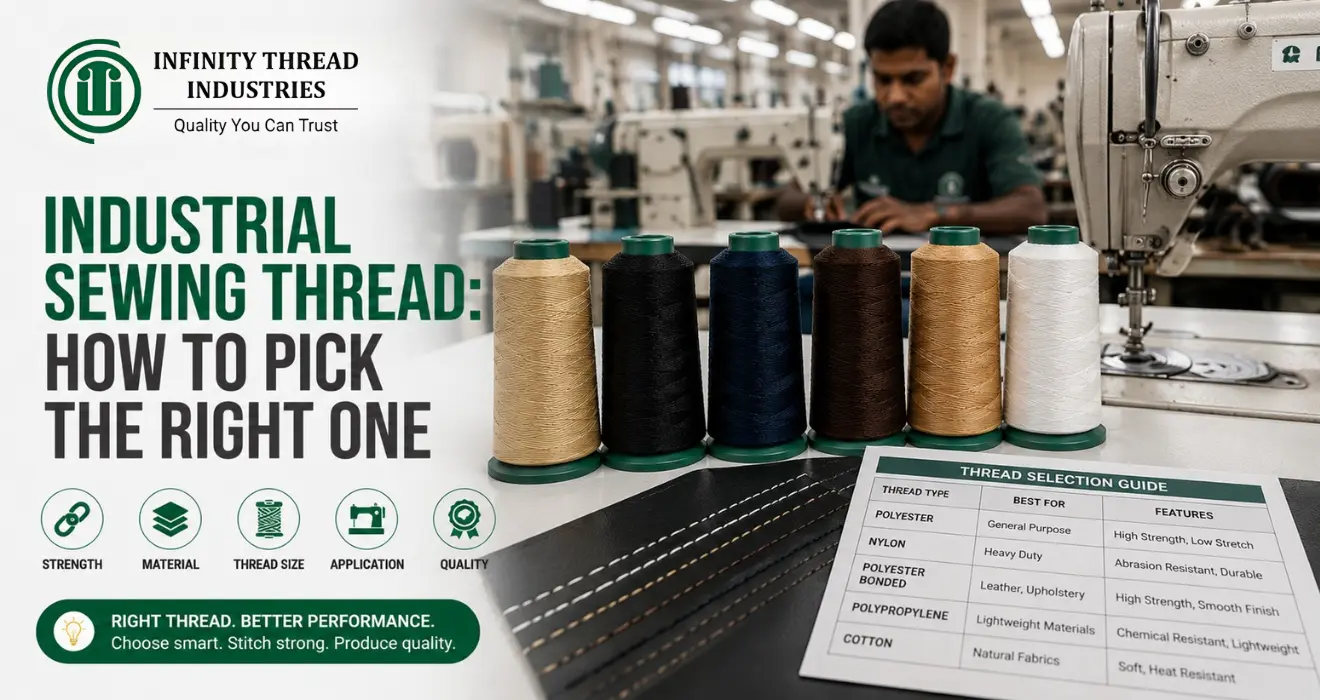
Polyester holds up better against UV exposure, chemicals, and moisture, which is why it dominates outdoor and industrial applications. Nylon has more elasticity and a slightly higher break strength for its weight, so it shows up more in applications needing stretch recovery, like some leather and upholstery work. We cover this in more depth in our breakdown of polyester vs nylon thread for industrial use, but the short version: if the product sits outdoors or near moisture, go polyester. If it needs to flex and recover its shape, nylon usually wins.
📞 Get a Free Sample or Technical Consultation
What Actually Happened When a Bag Manufacturer Switched Suppliers
A woven sack client came to us in 2023 after losing an entire export batch to seam failure. Their previous supplier had been quietly reducing ply count to cut cost, and nobody caught it until 40% of a shipment came back damaged.
We ran their spec against our high strength industrial threads line, matched tenacity to their stitching speed, and rebuilt their order around a consistent 210D/6 bonded polyester. Six months in, their seam failure rate dropped to under 1%. That’s not a dramatic transformation story. It’s what happens when the ply count on the spool matches the number on the spec sheet, every single time.
Where Industrial Sewing Thread Actually Gets Used
This isn’t a one-industry product. The same core thread, adjusted for denier and finish, ends up stitching completely different materials.
Garment and Textile Manufacturing
High-speed garment lines need thread that won’t shred at 4,000+ stitches per minute. Our sewing thread range is built specifically for this, smooth, consistently lubricated, and rated for continuous machine runs without snapping mid-seam.
Leather Goods and Upholstery
Leather punches small holes that thread has to pass through cleanly without fraying. A bonded finish matters more here than raw strength alone. Fray under repeated needle passes is usually a lubrication problem, not a strength problem, and it’s the number one complaint we hear from leather stitchers using the wrong grade.
Woven Sacks, FIBC Bags, and Mattress Stitching
Jumbo bags carry hundreds of kilos of material and get dropped, stacked, and dragged. That’s a completely different load profile than a garment seam. Our mattress threads and woven sack ranges are built around sustained load resistance rather than needle-pass smoothness, because the failure mode they’re protecting against is different.
Industrial Sewing Thread vs Regular Sewing Thread: A Side-by-Side Look
| Factor | Industrial Sewing Thread | Regular Sewing Thread |
|---|---|---|
| Material | Bonded polyester or nylon filament | Cotton or spun polyester blend |
| Tensile Strength | High, tested to a specific load rating | Low to moderate, rarely tested |
| Machine Speed Rating | Built for 3,000-5,000+ stitches/min | Built for domestic or light commercial use |
| Best For | FIBC bags, leather, garments, mattresses | Home sewing, light repairs, crafts |
| Consistency | Batch-controlled under ISO 9001:2015 | Varies widely by manufacturer |
How to Pick the Right Industrial Sewing Thread for Your Machine
Getting this wrong costs real money in downtime and returns. Here’s the process we actually walk clients through.
- Identify the material being stitched, leather, woven fabric, or synthetic sack material behaves differently under the needle.
- Match denier and ply to the load the seam will carry, not just the fabric weight.
- Confirm your machine’s stitch speed rating against the thread’s lubrication and bonding spec.
- Order a test spool before committing to a bulk run. The result is a thread that runs clean on your specific machine instead of one that looks right on a spec sheet.
Skipping step four is, honestly, the mistake we see most. A thread can pass every lab test and still snag on a machine with worn tension discs. Test it on your actual line first.
A Quick Word on Cost
Industrial sewing thread in India generally runs higher per kilo than generic spun thread, and that’s the point. You’re paying for tested tensile strength, consistent ply, and a bonded finish that won’t shred your machine’s tension system. According to industry coverage from Fibre2Fashion, India’s technical textile and industrial thread segment has been growing steadily as manufacturers move away from unbranded suppliers toward certified, spec-consistent producers. Cheaper thread that fails at 60% of a batch costs more than premium thread that holds at 99%. We’ve watched clients learn that the expensive way before switching to us.
Industrial Sewing Thread: Your Questions Answered
Q: What is industrial sewing thread made of?
A: Almost always continuous filament polyester or nylon, twisted to a specific ply and treated with a bonding and lubrication finish so it runs smoothly through high-speed machines without shredding.
Q: How do I choose the right industrial sewing thread for my machine?
A: Start with the material you’re stitching, then match denier and ply to the load the seam needs to carry. Confirm your machine’s stitch speed against the thread’s bonding spec, and always test a sample spool before ordering in bulk.
Q: How much does industrial sewing thread cost in India?
A: It varies by denier, ply, and order volume, but expect to pay a premium over generic thread. Bulk industrial orders from certified manufacturers typically run in a mid-range per-kg bracket that reflects tested tensile consistency, not just raw material cost.
Q: What is the strongest industrial sewing thread?
A: Higher denier, higher ply, bonded polyester or nylon threads carry the highest tensile ratings. But “strongest” only matters if it’s matched to your machine and material. Over-specced thread can be just as much of a problem as under-specced thread.
Q: Is polyester or nylon better for industrial sewing thread?
A: Polyester generally wins for UV, chemical, and moisture resistance, which makes it the default for outdoor and industrial packaging use. Nylon has better elasticity, so it’s often preferred for leather and applications that need stretch recovery.
Q: Why does my industrial sewing thread keep breaking?
A: Usually one of three things: the ply count doesn’t match your seam load, the tension settings on your machine are off for that thread’s diameter, or you’re running an inconsistent batch from a supplier that isn’t quality-controlled. Test a new spool on your actual line before assuming the thread spec is wrong.
Q: What ply is best for heavy-duty industrial sewing?
A: For woven sacks, FIBC bags, and mattress stitching, 3-ply to 6-ply bonded thread is standard, with the exact count depending on the load and stitch length. Garment work usually needs less ply than bag or mattress stitching.
Q: Where can I buy industrial sewing thread in bulk in India in 2026?
A: Look for an ISO-certified manufacturer with in-house production, not just a trading company reselling stock. Infinity Thread Industries manufactures from its own Surat facility with a monthly production capacity of 80,000 kg, so supply consistency isn’t a guessing game.
Go Deeper on Thread Selection
Still weighing your options? A few related reads that go further into specific decisions:
- Polyester vs Nylon Thread: Which Is Better for Industrial Use
- How to Choose the Best Industrial Thread Manufacturer in India
- Sewing Machine Thread Guide: Tips & Tricks
- Top Thread Manufacturers in India
- Learn more about our production standards on our About Us page
Nilesh Devani and the team at Infinity Thread Industries work with garment units, bag manufacturers, and leather stitchers across India on exactly this kind of thread selection. If your seams are failing and you’re not sure why, get in touch and we’ll walk through your spec together.

Founder of Digi Segment and HV Digital Marketing
SEO Strategist & Digital Marketing Expert
Hardik Vaghani is a digital marketing professional and SEO strategist based in Surat, Gujarat, India. He is the founder of Digi Segment, a content and insights platform covering SEO, digital marketing, AI tools, and online growth strategies, and the founder of HV Digital Marketing, a results-focused digital marketing agency helping local and service-based businesses rank on Google and generate consistent leads.
With hands-on experience in Search Engine Optimisation, Technical SEO, Google Ads, Meta Ads, and Content Strategy, Hardik has helped businesses across industries including e-commerce, real estate, healthcare, home improvement, and solar companies improve their organic visibility, local search rankings, and lead generation through ethical, white-hat strategies.
He specialises in Core Web Vitals optimisation, on-page SEO, keyword research aligned with search intent, and building scalable content frameworks that rank. At Digi Segment, Hardik shares practical, experience-backed insights, case studies, and step-by-step guides to help marketers, entrepreneurs, and small businesses grow online.
When he is not optimising websites, Hardik is building digital tools, writing SEO-focused content, and working with his agency clients to turn Google visibility into measurable business growth.
Expertise: SEO | Technical SEO | Google Ads | Meta Ads | Content Strategy | Core Web Vitals | WordPress | Digital Marketing | Lead Generation | Local SEO