
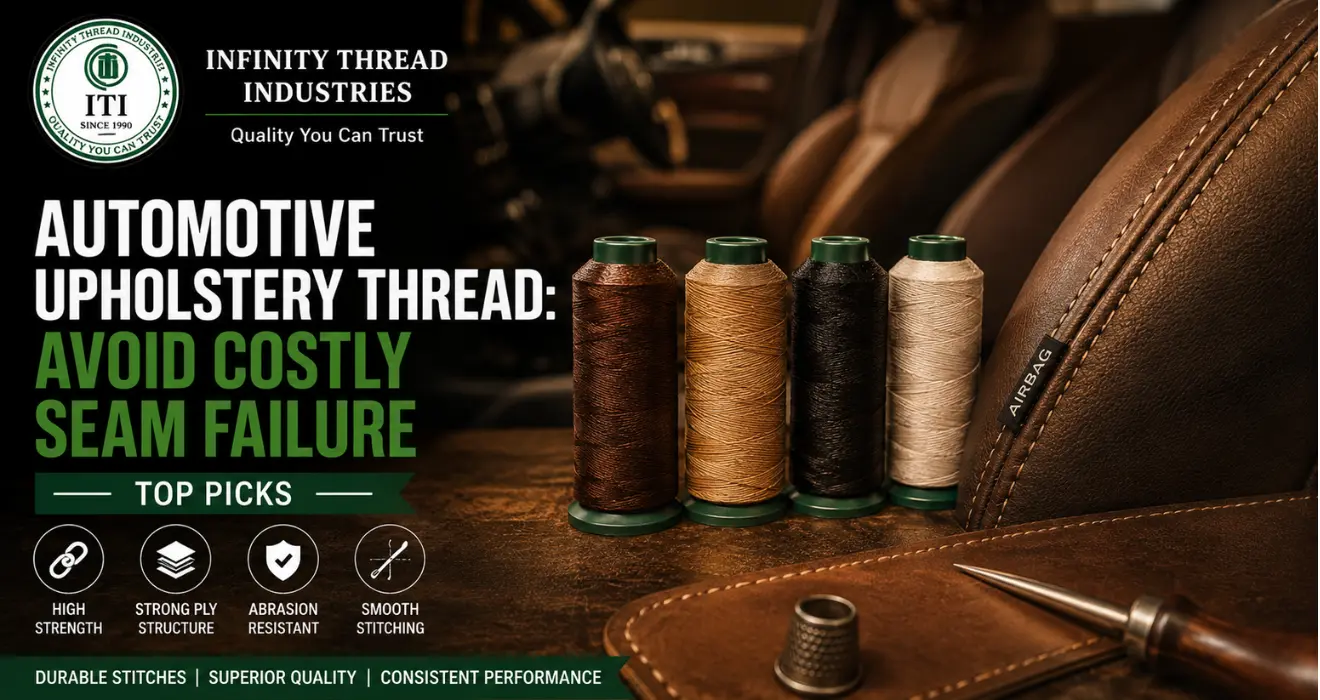
A seat cover stitched perfectly in the factory. Six months later, the same seam is cracking along the bolster, right where the afternoon sun hits it through the windshield. That’s not a strength failure. That’s an automotive upholstery thread that was never rated for what a parked car actually does to it.
At Infinity Thread Industries, we manufacture polyester and nylon threads out of our 15,300 sq. ft. facility in Surat, and automotive stitching is one of the categories where customers come back after a field failure, not before one. Here’s the short version: automotive interior thread needs to survive sustained cabin and dashboard heat, which regularly crosses 60°C in a parked car, plus direct UV exposure through glass that standard sewing thread was never engineered for. Get the thread spec wrong and the seam looks fine at handover. It just doesn’t stay that way.
Here’s the Short Answer
Automotive upholstery thread has to handle two separate stresses at once: continuous heat inside a closed cabin, and ultraviolet light passing through windshield and side glass for years. Standard polyester or nylon sewing thread is built for tensile strength on the sewing floor, not for either of those conditions. If your thread spec doesn’t mention a continuous-use temperature rating or UV stabilization, you’re gambling on how long the seam holds once the car leaves the lot.
Where Seat Cover Stitching Actually Goes Wrong
Most upholstery makers test thread the way they test any sewing thread: tensile strength, seam slippage, needle heat during stitching. None of that predicts what happens after 18 months of parking in the sun.
A study run jointly by researchers at Arizona State University and UC San Diego found that dashboard surfaces in a car parked in direct sun averaged 69°C within one hour, and can climb to 90-95°C on darker interiors in peak summer , with a full simulated shopping-trip cabin temperature reaching about 47°C in the same window. That’s not an outlier day. That’s a fairly ordinary Tuesday afternoon in Surat, Ahmedabad, or Chennai between March and June.
Heat Degradation vs UV Degradation: Different Failure Modes
These are two different mechanisms, and treating them as one is where most specs go wrong.
Heat degradation softens the polymer chain and, in bonded thread, breaks down the adhesive coating that holds plies together. The seam doesn’t snap. It slowly loosens, ply by ply, until stitches start pulling through the fabric under normal seat pressure.
UV degradation is chemical, not thermal. Ultraviolet light breaks molecular bonds in the fiber itself. Research published in the AUTEX Research Journal found that untreated polyester lost close to 44% of its tensile strength after 30 days of continuous UV exposure, with nylon losing even more in the absence of UV stabilizing filters. Thirty lab days isn’t three years of real sun through a windscreen, but it shows the direction fast, and it’s not a small effect.
So you can have a thread that survives a heat chamber test and still fails on color and strength within a year, purely from UV. And you can have a UV-stable thread that still turns brittle if nobody checked its melting point against actual dashboard temperatures. Automotive-grade thread has to clear both bars, not just one.
What to Look For in Automotive-Grade Thread
This is the part most seat cover and interior manufacturers skip, mostly because their existing supplier never asked for it either. If you’re sourcing heat resistant stitching thread for automotive work, three specs matter more than the rest of the datasheet combined.
Melting Point and Continuous-Use Temperature Rating
A thread’s melting point tells you when it fails catastrophically. Its continuous-use rating tells you when it starts degrading well before that. Standard polyester sewing thread typically has a melting point around 250-260°C, which sounds safe against 90°C dashboard heat. But melting point isn’t the number that matters for seams. What matters is how the thread’s tensile strength and elongation behave under sustained lower heat, cycling hot and cool every single day, for years. Ask your supplier for continuous-use data, not just the melt point on the spec sheet. If they can’t produce it, that’s the answer.
UV-Stabilized Polyester vs Standard Polyester
Standard polyester has moderate natural UV resistance, but it isn’t stabilized against sustained solar exposure. UV resistant car seat thread uses stabilizing additives built into the fiber, or a UV-treated bonding coat over the base filament, both of which slow the photo-oxidation that causes fading and brittleness. Industrial thread testing under SAE J2412, the automotive industry’s standard xenon-arc weathering test, is the benchmark most OEM programs actually check against. If your current supplier has never mentioned SAE J2412, ask why.
Comparison Table: Standard vs Automotive-Grade Thread Specs
| Spec | Standard Sewing Thread | Automotive-Grade Thread |
| Continuous-use temperature | Not typically rated | Rated and documented (often 100°C+) |
| UV stabilization | None or minimal | Stabilized fiber or bonded UV coat |
| Test standard | General tensile only | SAE J2412 xenon-arc weathering |
| Bonding | Standard bonded or unbonded | Heat- and UV-stable bonded finish |
| Color retention | Fades under sustained UV | Retains color significantly longer |
| Typical ticket range for seat covers | Varies, unspecified | Tkt 40-70, machine and seam dependent |
Matching Thread to Seat Cover Material
Leather, leatherette, and woven fabric don’t behave the same way under a needle, and the thread has to match the material, not just the climate spec.
Leather is dense and doesn’t flex back after a stitch, so thread with too much stretch causes puckering along the seam line. Leatherette (PU or PVC coated fabric) is more forgiving on flex but can trap heat against the stitching, which is exactly where UV and thermal resistance compound each other. Woven fabric seat covers move the most during use, so seam elasticity matters more than it does on leather.
Thread-to-Needle Pairing for Multi-Layer Upholstery
Most seat cover seams run through three to five layers at once: outer material, foam padding, and backing. That’s a lot of friction generating needle heat, which cooks the thread from the inside before UV or dashboard heat ever touches it. Match ticket size to needle size and stitch speed, not just to the material on top. A thread that’s correctly rated for heat and UV but paired with the wrong needle will still fail, just from a different cause entirely.
If you want the exact continuous-use rating, ticket range, and UV test data for your specific seat cover material, that’s a conversation worth having before the next production run, not after the first field complaint.
What 80,000 kg a Month Taught Us About Automotive Failures
We manufacture close to 80,000 kg of thread every month, and automotive stitching complaints follow a pattern that surprised us the first time we saw it. It’s rarely the thread that shipped last month. It’s the thread that shipped 8 to 14 months earlier, now coming back as a warranty issue once cars have sat through one full summer.
A few years back, one of our upholstery clients switched a seat cover run to a lower-cost standard bonded polyester to cut per-meter cost. The stitching looked identical on the line. Tensile tests passed. Then the complaints started arriving from dealers around the eight-month mark: bolster seams cracking, exactly where sun exposure through the windscreen was heaviest. We ran their returned samples against our standard automotive spec side by side.
The failed thread had lost most of its bonding integrity and a visible amount of tensile strength, consistent with UV and heat cycling rather than any manufacturing defect. Once they moved back to a UV-stabilized, heat-rated thread at the original ticket size, the warranty complaints on that line dropped to close to zero over the following production cycles.
The lesson wasn’t “spend more.” It was that a thread spec sheet without a continuous-use temperature rating and a UV test result is incomplete, no matter how good the tensile numbers look on day one.
FAQ
Q: What temperature can automotive upholstery thread withstand?
A: It depends on the grade. Standard bonded polyester isn’t rated for continuous cabin heat at all. Automotive-grade thread is typically documented for 100°C or higher continuous-use exposure, but the only way to know for sure is to request the continuous-use rating for your specific spec, not just the melting point.
Q: Does polyester thread fade on car seat covers over time?
A: Yes, if it’s standard polyester. UV-stabilized polyester resists fading far better because the stabilizing additives slow the photo-oxidation that causes color loss. Untreated thread can visibly fade within a single hot season of direct sun exposure through glass.
Q: What thread is best for leatherette vs fabric seat covers?
A: There isn’t one universal answer. Thread choice should match the material’s thickness and flex behavior, not just its color or texture. Leatherette needs a thread that handles trapped heat well, while woven fabric needs more give in the stitch to move with the seam.
Q: Can thread cause seam cracking in cold weather too?
A: It can. Thread that turns brittle in cold conditions cracks almost the same way heat-damaged thread does, just from the opposite direction. If your vehicles ship to a wide climate range, ask about cold-flex performance alongside heat and UV data.
Q: Do OEM suppliers require certified thread specs?
A: Many do. Most OEM automotive programs require documented heat and UV test data, often referencing SAE J2412, before approving a thread supplier. It’s worth asking for this before bidding on OEM work rather than after a program rejects your sample.
Q: What ticket number is standard for car seat cover stitching?
A: It varies by seam type and machine setup. Bolster and structural seams often run heavier than decorative topstitching. Rather than guessing, request a ticket size recommendation matched to your fabric layers and machine.
Q: Can you supply thread color-matched to seat cover fabric batches?
A: Yes, custom color matching is available on bulk orders. This is usually arranged alongside the heat and UV spec, not as a separate request, since dye stability under UV matters as much as the initial color match.
Q: What’s the difference between bonded and standard thread for automotive use?
A: Bonded thread has a coating that fuses individual plies together, which usually holds up better under repeated flex and heat cycling than unbonded thread. For automotive seams that flex constantly with seat use, bonded is generally the safer default.
If you’re specifying thread for seat covers, dashboards, or door panel stitching, our high strength industrial threads line covers the tensile side, and our dedicated car seat cover stitching thread range is built specifically around the heat and UV profile covered above. You can see where automotive fits alongside our other lines on the application areas page.
Lab tensile numbers don’t tell you what a seam does after a full summer of parking in direct sun. Real-world testing does. If your current thread spec doesn’t include a UV weathering result, that’s worth fixing before the next production run, not after the warranty calls start.
Request a heat-tested thread sample. Fill in the form below and our team will get back with samples and full test data.
- Company Name
- Phone Number
- Seat Cover Material (Leather / Leatherette / Fabric)
- Order Volume

Founder of Digi Segment and HV Digital Marketing
SEO Strategist & Digital Marketing Expert
Hardik Vaghani is a digital marketing professional and SEO strategist based in Surat, Gujarat, India. He is the founder of Digi Segment, a content and insights platform covering SEO, digital marketing, AI tools, and online growth strategies, and the founder of HV Digital Marketing, a results-focused digital marketing agency helping local and service-based businesses rank on Google and generate consistent leads.
With hands-on experience in Search Engine Optimisation, Technical SEO, Google Ads, Meta Ads, and Content Strategy, Hardik has helped businesses across industries including e-commerce, real estate, healthcare, home improvement, and solar companies improve their organic visibility, local search rankings, and lead generation through ethical, white-hat strategies.
He specialises in Core Web Vitals optimisation, on-page SEO, keyword research aligned with search intent, and building scalable content frameworks that rank. At Digi Segment, Hardik shares practical, experience-backed insights, case studies, and step-by-step guides to help marketers, entrepreneurs, and small businesses grow online.
When he is not optimising websites, Hardik is building digital tools, writing SEO-focused content, and working with his agency clients to turn Google visibility into measurable business growth.
Expertise: SEO | Technical SEO | Google Ads | Meta Ads | Content Strategy | Core Web Vitals | WordPress | Digital Marketing | Lead Generation | Local SEO