
Most FIBC bag failures don’t start with the fabric. They start with the thread.
A torn seam on a 1,000 kg jumbo bag mid-transport isn’t a packaging inconvenience — it’s a workplace safety incident, a production stoppage, and a customer service nightmare rolled into one. And nine times out of ten, when we trace back what actually failed, it’s the wrong thread spec for the application.
This guide is written for FIBC manufacturers, woven sack producers, and procurement managers who want to stop guessing and start buying the right thread the first time.
What is Woven Sack Stitching Thread?
Woven sack stitching thread is a high-tenacity industrial thread engineered specifically for seaming, closing, and reinforcing PP (polypropylene) and HDPE (high-density polyethylene) woven sacks, and FIBC bulk bags.
It’s not the thread you’d find in a garment factory. Not even close.
Standard garment thread is optimised for flexibility, fineness, and appearance. Woven sack thread is built for one thing: holding under extreme mechanical and environmental stress. That means tensile loads measured in kilograms, not grams. UV exposure over weeks of outdoor storage. High-speed stitching machines running continuous production cycles.
The applications span a wide range of industries — agriculture (fertiliser and grain sacks), chemicals, construction (cement and sand bags), and bulk commodity handling. But nowhere is the performance requirement higher than in FIBC jumbo bag manufacturing, where a single seam failure can mean hundreds of kilograms of product on the warehouse floor.
And here’s the thing — not all thread marketed as “industrial” is actually rated for FIBC applications. That distinction matters a lot when you’re specifying for bags with SWL (Safe Working Load) requirements.
Key Properties to Look for in FIBC Bag Thread
There are about a dozen specs manufacturers list on a thread data sheet. Realistically, three of them drive 90% of purchasing decisions for woven sack and FIBC applications.
Tensile Strength & Denier Range (840D to 3000D)
Denier is the weight of 9,000 metres of thread in grams. Higher denier = thicker, heavier thread = more tensile strength.
For everyday woven sack stitching (standard PP bags for 25–50 kg loads), 840D to 1200D high-tenacity polyester is the industry standard. It balances seam strength with smooth machine feeding at high speeds.
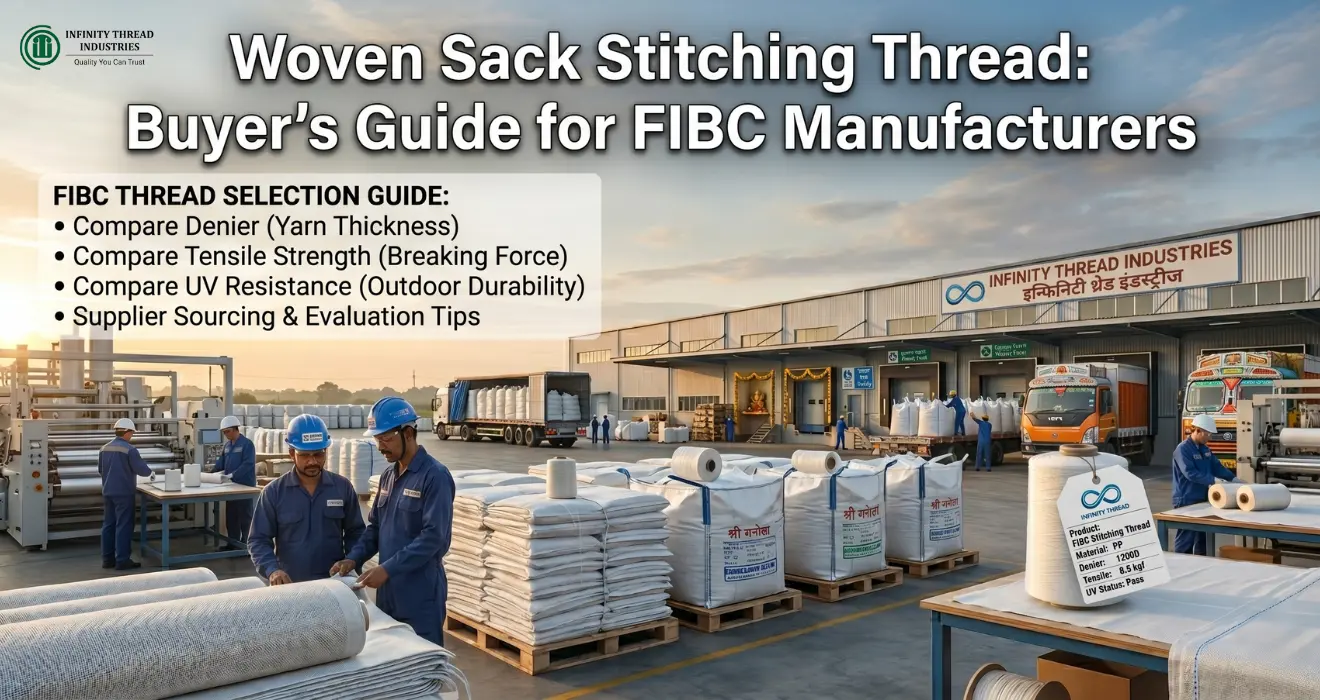
Move into FIBC territory — bags rated for 500 kg, 1,000 kg, or 2,000 kg — and you need to step up. 1000D to 3000D thread is what FIBC fabricators typically run. According to the Flexible Intermediate Bulk Container Association (FIBCA), seam strength testing for Type B and Type C FIBCs must comply with ISO 21898 standards, which specify minimum breaking force thresholds that simply can’t be met with lighter thread.
The ply count matters too. A 1500D/2 thread (two-ply twisted) behaves differently from a single 3000D — the twisted construction distributes stress across the seam more evenly, which reduces the chance of point failure under sudden load.
My recommendation: never spec thread purely on denier. Always cross-reference the breaking strength (in kgf or Newtons) on the supplier’s data sheet. That number is what actually determines whether your seam will hold.
UV Resistance & Moisture Protection
Here’s where a lot of procurement teams make a costly assumption: they buy thread rated for indoor applications and use it outdoors.
UV degradation is real and it’s fast. Untreated polyester thread exposed to direct sunlight for 30–60 days can lose a significant portion of its tensile strength — research from the Technical Textile Institute, Ahmedabad, has documented UV degradation in unprotected PP packaging materials occurring in as little as 400–600 hours of solar exposure. Thread degrades at a similar rate.
UV-resistant thread uses carbon black masterbatch or UV stabiliser additives woven into the filament. This isn’t a coating that wears off — it’s part of the fibre itself. So if your bags will be stored outdoors, transported on flatbeds, or used in agricultural settings with long exposure periods, UV-resistant thread is non-negotiable, not optional.
Moisture resistance is equally important for food-grade sacks (rice, wheat, animal feed) and chemical bags where thread swelling from moisture absorption can affect stitch consistency.
Compatibility with Stitching Machines
This one gets overlooked surprisingly often.
Woven sack stitching machines — portable bag closers, automatic sack stitching lines, and FIBC fabrication setups — have specific thread path geometries and tension requirements. A thread that’s too thick will jam; one that’s too fine will skip stitches under high-speed tension.
Portable bag-closing machines (Union Special 80800, Newlong DS-9C type) typically run best with 840D to 1200D thread on standard sacks. Industrial FIBC sewing setups that run heavier needle sizes (Nm 180–230) can handle 1500D to 3000D.
Always confirm thread compatibility with your machine manufacturer before switching suppliers. This is basic but worth saying — we’ve seen production line downtime caused by nothing more than a denier mismatch that nobody checked before the order arrived.
Woven Sack Thread vs Regular Polyester Thread – What's the Difference?
If you’ve ever tried using standard garment polyester thread on a woven sack line, you already know the answer. But for those who haven’t — here’s a direct comparison.
Property | Regular Polyester Thread | Woven Sack / FIBC Thread |
Denier Range | 40D – 300D | 840D – 3000D |
Tensile Strength | Low–Medium (0.5–3 kgf) | High–Very High (10–40+ kgf) |
UV Resistance | Minimal or none | Available (UV stabilised) |
Moisture Resistance | Low | Medium–High |
Machine Compatibility | Garment/household machines | Industrial bag-closing & FIBC lines |
Construction | Ring-spun or filament | Multi-filament twisted |
SWL Compliance | Not applicable | Required for FIBC use |
Typical Application | Apparel, home textiles | PP/HDPE sacks, FIBC jumbo bags |
The core difference isn’t just about thickness. It’s about how the thread is engineered under load. Regular polyester thread is designed to flex and stretch slightly — that’s what makes it comfortable in a garment. Industrial woven sack thread is designed to resist deformation under sudden tensile stress. That’s the opposite engineering objective.
You can’t substitute one for the other in a heavy packaging application. It’s not a cost-saving option — it’s a failure mode waiting to happen.
How to Choose the Right Thread for Your Production Line
The spec selection process is more straightforward than most buyers make it. Here’s how to think through it.
Step 1: Know your bag's SWL (Safe Working Load).
This is your starting point. The thread needs to support the seam strength required by your bag’s rated load. For standard woven sacks (up to 50 kg), 840D/2 or 1000D/2 thread is typically sufficient. For FIBC bags rated at 500 kg, you’re looking at 1500D to 2000D minimum. Above 1,000 kg SWL, 2500D to 3000D thread is the norm.
Step 2: Check your storage and transport conditions.
Outdoor storage? UV-stabilised thread. Humid environments or coastal transport? Moisture-resistant finish. Indoor, climate-controlled warehouse only? Standard finish will do.
Step 3: Match denier to your machine specifications.
Check your machine’s needle size and thread path spec. Most suppliers should be able to tell you which denier range works for your setup. If they can’t, that’s a red flag.
Step 4: Request samples before bulk ordering.
Any credible supplier will send you a sample spool. Run it through your machine at production speed. Check stitch consistency, thread breakage rate, and the finish on the seam. This 30-minute test saves weeks of production problems.
Step 5: Check certification and quality documentation.
For FIBC threads specifically, ask for test reports showing breaking strength data. ISO 21898 compliance documentation is the benchmark. Suppliers who can’t provide this data aren’t producing to the standard that FIBC manufacturing requires.
One more thing: don’t spec thread based on price alone. The cost difference between adequate thread and the wrong thread is tiny compared to the cost of a production line jam, a failed quality audit, or — worst case — a bag failure in the field.
Check out our FIBC jumbo bag threads and high-strength industrial threads for full specifications on each product in our range.
Why Surat Is India's Hub for Industrial Thread Manufacturing
This doesn’t happen by accident.
Surat has been India’s textile capital for decades — and the same cluster of advantages that made it the country’s synthetic fabric epicentre also made it the natural home for industrial thread manufacturing.
The raw material supply chain is unmatched. High-tenacity polyester yarn and nylon filament are produced within a 100 km radius. That means faster sourcing, lower input costs, and the ability to adjust specifications quickly without long lead times. According to the Textile Association of India, Surat accounts for over 65% of India’s man-made fibre fabric production — the industrial thread sector has grown directly from that base.
The technical workforce is deep. Surat has two generations of workers who understand synthetic fibre processing — from yarn twisting and heat-setting to quality testing. That institutional knowledge is hard to replicate elsewhere.
And the export infrastructure works. Surat manufacturers ship regularly to Southeast Asia, the Middle East, Africa, and Europe. Logistically, the proximity to JNPT (Nhava Sheva) and the Hazira port makes bulk export manageable.
So when you source woven sack stitching thread from a Surat manufacturer, you’re not just buying a product — you’re accessing a supply chain ecosystem that’s been refined over 30+ years.
Infinity Thread Industries – Your Trusted FIBC Thread Supplier
When I first visited thread suppliers in the Surat industrial belt, I noticed the same pattern across several facilities — impressive production capacity on paper, but inconsistent quality control between batches. Denier variation from spool to spool was the most common issue. For garment applications, minor variation doesn’t matter much. For FIBC seam stitching where you’re relying on specific breaking strength values, it absolutely does.
What sets serious industrial thread manufacturers apart is whether they’re testing at the batch level or just at the line setup level. The difference shows up in production — fewer thread breaks, more consistent seam strength, less operator intervention. That’s the operational standard any FIBC manufacturer should be asking about before they place a bulk order.
At Infinity Thread Industries, we’ve been manufacturing industrial threads from Surat since 2010. Our focus has always been on the heavy-duty end of the market — woven sack threads, FIBC threads, and specialised industrial applications where thread failure isn’t just a defect, it’s a safety issue.
Here’s what we actually offer:
- High-tenacity polyester thread from 840D to 3000D, in 2-ply and 3-ply twisted constructions
- UV-stabilised versions for outdoor packaging and agricultural sack applications
- Moisture-resistant finishes for food-grade, chemical, and coastal-use packaging
- Custom colours available on request — standard supply is white
- Smooth multi-filament construction tested for consistent performance on high-speed bag-closing and FIBC fabrication machines
Our manufacturing facility runs 15,300 sq. ft. of dedicated production space with a monthly output of 80,000 kg — which means we can handle both trial orders and large-volume ongoing supply without lead time surprises.
We supply to FIBC manufacturers, PP woven sack producers, and packaging companies across India and for export. If you want to see the thread before you commit, request a free sample — we’ll ship it to your facility.
You can also read more about who we are and how we work before reaching out.
Frequently Asked Questions
For standard woven sacks, 840D to 1200D high-tenacity polyester thread is the industry standard. For FIBC jumbo bags carrying 500–2,000 kg loads, 1000D to 3000D thread is what you need to hit the seam strength required for SWL compliance. Don't spec by denier alone — always check the breaking strength figure (in kgf) on the supplier's data sheet.
Bag closing thread (typically 500/2 to 840/2 construction) is designed for standard bag mouth stitching — sealing filled sacks on a portable or automated bag-closing machine. FIBC jumbo bag thread is a different product entirely. It's engineered for heavier-duty stitching systems where the seam must support loads of several hundred kilograms, with mandatory tensile and SWL compliance testing. The wrong thread on an FIBC application isn't just a quality issue — it's a safety liability.
Yes, if your sacks will spend any meaningful time in direct sunlight. UV degradation weakens polyester thread faster than most buyers expect — significant strength loss can begin within weeks of continuous exposure. UV-stabilised thread uses additives built into the filament (not a surface coating), so the protection doesn't wear off. If you're shipping to customers who will store bags outdoors — agriculture, construction, bulk minerals — specify UV-resistant thread as standard, not as an upgrade.
Yes. Our standard supply is white, which works for most industrial applications. But we do offer custom colour options on request — useful for brand identification, colour-coding different bag specifications, or matching visual sorting systems in your production line. Contact us with your colour requirement and order volume.
MOQ and bulk pricing depend on the specific product, denier, and ply configuration. Contact our sales team directly at info@infinitythreadindustries.in or call +91-76007-10883 for current MOQ details. We work with both mid-scale and large-volume buyers.
Ask for a sample spool and run it through your actual production machine at normal operating speed. Track thread breaks per 1,000 metres, stitch consistency, and seam appearance. For FIBC applications, seam strength testing on a sample sewn piece is worth doing before a large order. Any reputable industrial thread supplier should support this process — if they resist, that tells you something.

Founder of Digi Segment and HV Digital Marketing
SEO Strategist & Digital Marketing Expert
Hardik Vaghani is a digital marketing professional and SEO strategist based in Surat, Gujarat, India. He is the founder of Digi Segment, a content and insights platform covering SEO, digital marketing, AI tools, and online growth strategies, and the founder of HV Digital Marketing, a results-focused digital marketing agency helping local and service-based businesses rank on Google and generate consistent leads.
With hands-on experience in Search Engine Optimisation, Technical SEO, Google Ads, Meta Ads, and Content Strategy, Hardik has helped businesses across industries including e-commerce, real estate, healthcare, home improvement, and solar companies improve their organic visibility, local search rankings, and lead generation through ethical, white-hat strategies.
He specialises in Core Web Vitals optimisation, on-page SEO, keyword research aligned with search intent, and building scalable content frameworks that rank. At Digi Segment, Hardik shares practical, experience-backed insights, case studies, and step-by-step guides to help marketers, entrepreneurs, and small businesses grow online.
When he is not optimising websites, Hardik is building digital tools, writing SEO-focused content, and working with his agency clients to turn Google visibility into measurable business growth.
Expertise: SEO | Technical SEO | Google Ads | Meta Ads | Content Strategy | Core Web Vitals | WordPress | Digital Marketing | Lead Generation | Local SEO