
Most buyers who come to us for agriculture twine start with the same question: “Is this the same stuff we’ve always used, or is it actually different now?”
It’s a fair question. And the honest answer is — it depends on what you were using before. If you’ve been sourcing generic twine from a local distributor without asking about UV rating, denier count, or ply construction, there’s a good chance your field losses are higher than they need to be.
This guide covers what agriculture twine actually is, where it gets used, what specs to look for, and how to order in bulk from a manufacturer in India.
What Is Agriculture Twine and Why It Matters for Farmers
Agriculture twine is any cordage product used specifically in farming and food production — from tying a single tomato plant to a bamboo stake all the way up to machine-fed hay baling on large commercial farms.
But here’s what most buying guides skip over: twine failure in a farming context isn’t just inconvenient. A broken greenhouse trellis line mid-season can mean losing 30–40% of a fruiting crop’s yield. A snapped baling cord during harvest delays everything downstream. The twine is a small cost. The failure is not.
According to the Food and Agriculture Organization (FAO), post-harvest losses in developing economies often exceed 20–30% for perishable produce — and a significant portion of that comes from improper handling and support infrastructure during the growing phase. Quality twine is part of that infrastructure.
So when we say “agriculture twine matters,” we’re not just talking about the cord. We’re talking about what happens to the crop it’s holding up.
Top 6 Uses of Agriculture Twine in Farming
Crop Tying and Plant Support
This is the most common use — and the one with the widest range of requirements. Tying a leafy green to a short bamboo stake is completely different from supporting a heavily fruiting pepper plant for four months in an open field.
For general crop tying, 400D–800D twine with 2–3 ply construction handles most situations. For heavier plants, you want to go higher.
Hay & Straw Baling
Baling twine has to survive being fed through a baling machine at speed, hold a compressed rectangular or round bale together during storage, and then release cleanly when cut. That’s a specific mechanical demand most general twine can’t meet.
Baling applications typically need higher tensile strength — 80 kg or above — and a consistent diameter so the machine feeding mechanism doesn’t jam. This is one area where polypropylene has historically been favoured due to its stiffness, though polyester is gaining ground for premium baling.
Greenhouse Trellising
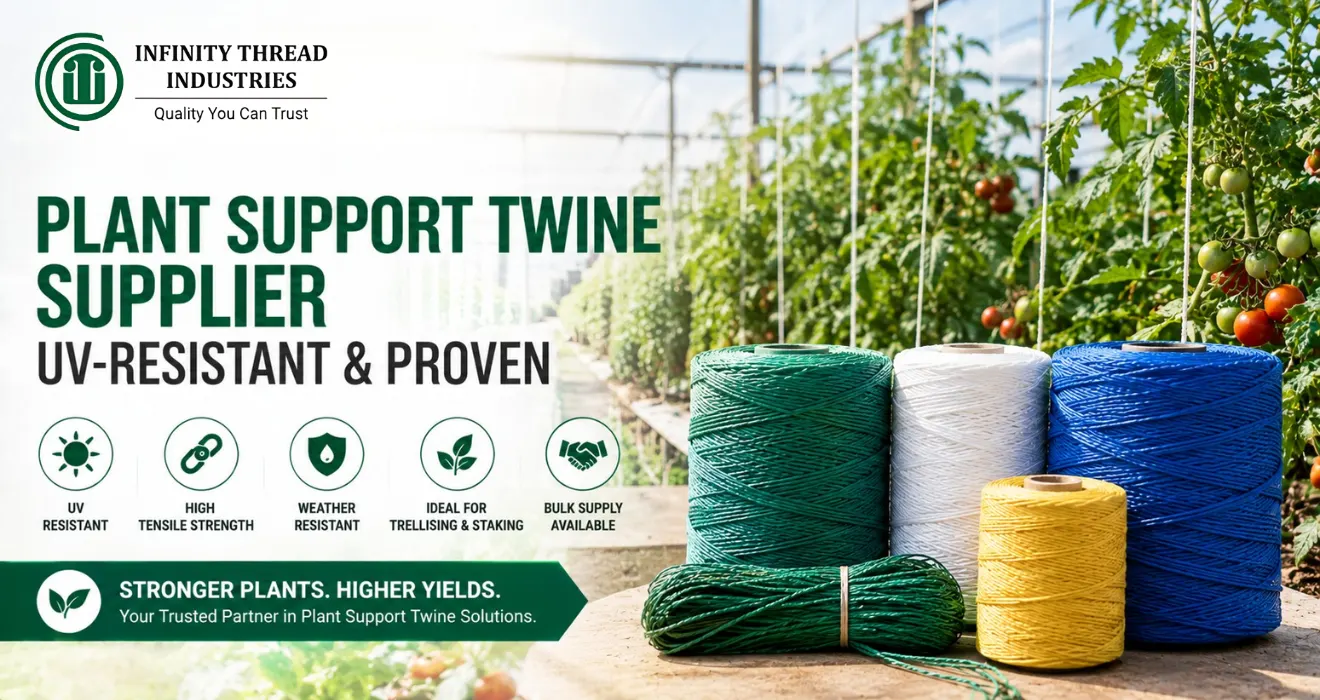
Greenhouse use is where UV stability becomes non-negotiable. A greenhouse trellis line for tomatoes or cucumbers stays under grow lights or diffused sunlight for six to nine months per season. Non-UV-stabilized twine degrades fast — losing up to 50–60% of its tensile strength by month four or five.
UV-stabilized agriculture twine, by contrast, retains up to 85% of its original tensile strength after six months of sun exposure. That’s not a marketing claim — it’s measurable with a standard tensiometer test. For greenhouse operators running multiple cycles per year, this is the difference between replacing twine mid-season or not.
Vineyard and Orchard Support
Vineyards use twine differently. Here, the twine has to flex with the wind movement of the vine, resist moisture from irrigation and rain, and hold for an entire growing season without losing grip on wire trellis systems.
Soft-finish polyester twine works well here — it grips without cutting into vine bark, which matters more than most buyers initially realise. Orchards have similar needs, especially for young tree staking where bark damage from abrasive twine can create disease entry points.
Vegetable Farming (Tomato, Bean, Pepper)
Tomatoes are the benchmark case for high-load agriculture twine. A single mature tomato plant can produce 4–8 kg of fruit, often held up by one or two twine lines. You need twine that’s rated well above that — typically 1500D or higher — because real farm conditions involve wind load, water weight, and the slow accumulation of fruit over weeks.
Beans need lighter, more frequent tying. Peppers fall in between. Most commercial vegetable farms stock two twine weights: a lighter 400D–600D for general tying and a heavier 1500D+ for fruiting crops. That’s a sensible approach.
Packaging Agricultural Produce
Bunching herbs, tying cut flower stems, closing sacks of onions or garlic — this is where twine moves into light packaging. These applications usually don’t need high breaking load, but they do need consistency in diameter (for bunching machines), clean cuts without fraying, and ideally food-safe materials. Biodegradable twine options exist for this end of the market, though polyester is still the dominant choice for most produce packaging in India.
Key Specifications for Agriculture Twine
When you’re ordering in bulk, these are the specs that actually matter:
Specification | What It Means | Recommended Range |
Denier (D) | Thickness / weight of the fibre | 400D (light) to 3000D (heavy baling) |
Ply Count | Number of twisted strands | 2-ply to 6-ply |
Breaking Load | Max load before failure | 15 kg to 80+ kg |
UV Stabilization | Resistance to sun degradation | Required for outdoor use over 3 months |
Roll Length | Metres per supply roll | 500 m to 5,000 m |
Elongation at Break | Stretch before snapping | 15–25% is ideal for most crop tying |
Finish | Surface coating | Soft-finish for plants; standard for baling |
One thing buyers often overlook: elongation. A twine with very low elongation snaps under sudden load — a gust of wind, a heavy cluster of fruit shifting. A small amount of stretch (15–20%) absorbs that load without breaking. Too much stretch and the plant sags. You want the middle.
Polyester vs Polypropylene Twine for Agriculture
This comes up constantly. And the short answer is: polyester performs better in most modern farming applications, but polypropylene still has a place in baling.
Here’s the breakdown:
Property | Polyester | Polypropylene |
UV Resistance | Excellent (especially UV-stabilized) | Moderate (degrades faster) |
Moisture Resistance | High | High |
Tensile Strength | Higher per denier | Lower per denier |
Softness | Softer finish, gentler on plants | Stiffer |
Temperature Tolerance | Good | Lower (softens in heat) |
Cost | Slightly higher | Lower |
Best For | Greenhouse, orchard, vegetable farming | Hay baling, short-duration tying |
We’ve written a detailed breakdown of this comparison in our guide on polyester vs nylon thread for industrial use — many of the properties apply directly to twine selection for agriculture as well.
Honestly? For most farmers buying in bulk for a full season, polyester is worth the modest price difference. The UV performance alone saves you a mid-season restring.
Our Take
When buyers first start asking about agriculture twine specifications, the conversation almost always starts with “what’s the cheapest option.” But after discussing the actual crop type, duration, and conditions, the answer changes most of the time. We’ve had greenhouse operators switch from generic polypropylene to UV-stabilized 1200D polyester and see their mid-season twine breakage rate drop dramatically. It’s not that the cheaper twine was bad — it was the wrong twine for that application. The specs tell you which one to use. Matching denier and UV rating to the actual crop conditions is 80% of the decision.
How to Order Agriculture Twine in Bulk from India
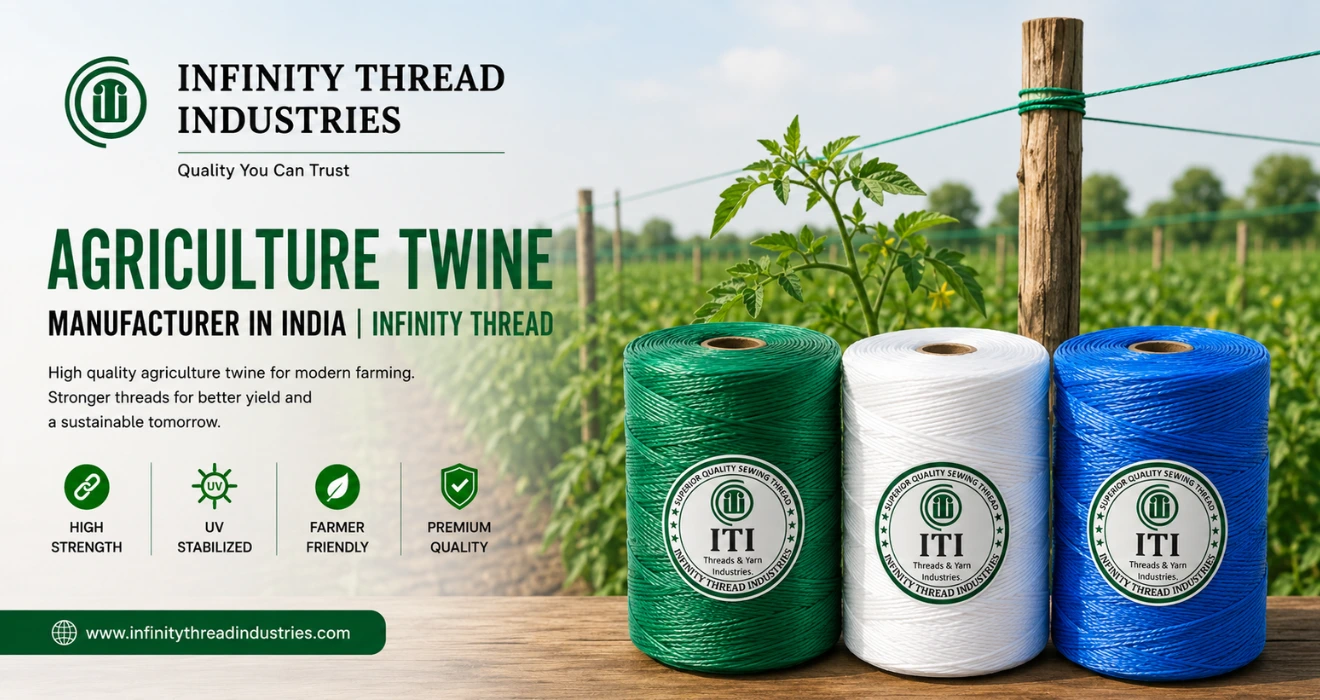
Infinity Thread Industries manufactures agriculture twine at our 80,000 kg/month facility in Surat, Gujarat. Our full range of agriculture twine products covers standard denier options from 400D to 3000D, with UV-stabilized and non-stabilized variants available.
For buyers comparing options across fibre types, our polyester and nylon twine range includes higher-performance variants suited to greenhouse and orchard applications.
For bulk orders, here’s what the process looks like:
- Send your crop type, quantity requirement, and denier preference via our contact form
- We’ll confirm available specifications and roll lengths for your application
- For export orders, we provide documentation support and can supply in pallet quantities
- Custom roll lengths and colour options are available for orders above minimum quantity
We export to buyers in Europe, Africa, and Southeast Asia. Domestic bulk pricing is available for farms and agri-businesses across India, with dispatch from Surat.
Frequently Asked Questions
Quality agriculture twine can support 15–80 kg depending on denier and ply count. For heavy fruiting crops like tomatoes or pumpkins, use higher-denier twine (1500D+) for secure plant support without breakage. For light tying and bunching, 400D–600D is generally sufficient.
Yes — especially for long-duration outdoor use such as greenhouse trellising or open-field farming. UV-stabilized twine retains up to 85% of its tensile strength after 6 months of sun exposure versus 40–50% for non-stabilized twine. If your twine is outside for more than two months, UV stabilization pays for itself in reduced replacement costs alone.
Standard supply rolls range from 500 m to 5,000 m depending on denier. Heavier denier twine naturally fits less per roll at the same spool size. Custom roll lengths are available for large farm operations or baling machine compatibility. Contact our team for current stock specifications.
Yes. Colour-coded twine is popular in greenhouse operations to differentiate plant varieties or track growth stages across rows. We offer custom colour options for bulk orders. Standard colours (natural, green, white) are available off the shelf.
Yes. Infinity Thread Industries exports to multiple international markets. We handle export documentation and supply in bulk pallet quantities. Contact our export team through the enquiry form for freight-on-board pricing and minimum order quantities.
Ply count refers to the number of twisted strands. More ply means higher breaking load and better load distribution — but also more material cost per metre. For most vegetable tying, 2-ply is enough. For baling or supporting heavy fruiting plants, 4-ply or 6-ply gives you the added safety margin.
If you’re sourcing agriculture twine for the first time or looking to switch suppliers for a bulk season order, the specifications in this guide give you a practical checklist before you commit. Wrong denier or missing UV rating are the two most common reasons twine underperforms in the field — both are easy to avoid with the right information upfront.
Get in touch with Infinity Thread Industries to discuss your crop requirements and receive a bulk pricing quote.

Founder of Digi Segment and HV Digital Marketing
SEO Strategist & Digital Marketing Expert
Hardik Vaghani is a digital marketing professional and SEO strategist based in Surat, Gujarat, India. He is the founder of Digi Segment, a content and insights platform covering SEO, digital marketing, AI tools, and online growth strategies, and the founder of HV Digital Marketing, a results-focused digital marketing agency helping local and service-based businesses rank on Google and generate consistent leads.
With hands-on experience in Search Engine Optimisation, Technical SEO, Google Ads, Meta Ads, and Content Strategy, Hardik has helped businesses across industries including e-commerce, real estate, healthcare, home improvement, and solar companies improve their organic visibility, local search rankings, and lead generation through ethical, white-hat strategies.
He specialises in Core Web Vitals optimisation, on-page SEO, keyword research aligned with search intent, and building scalable content frameworks that rank. At Digi Segment, Hardik shares practical, experience-backed insights, case studies, and step-by-step guides to help marketers, entrepreneurs, and small businesses grow online.
When he is not optimising websites, Hardik is building digital tools, writing SEO-focused content, and working with his agency clients to turn Google visibility into measurable business growth.
Expertise: SEO | Technical SEO | Google Ads | Meta Ads | Content Strategy | Core Web Vitals | WordPress | Digital Marketing | Lead Generation | Local SEO