
A wallet that splits at the seam after eight months on the shelf isn’t a leather problem. Nine times out of ten, it’s a thread problem.
That’s the call we get most often at Infinity Thread Industries. A bag unit or a footwear manufacturer switches their leather supplier, keeps the same thread, and suddenly seams that used to last two years start failing in two months. Leather changed. The thread didn’t catch up.
Bonded nylon thread is the fix most leather manufacturers in India reach for once they hit this wall. We’ve been supplying it to leather, bag, and accessories units since we expanded into leather sewing threads in 2022, running out of our ISO 9001:2015-certified facility in Surat, Gujarat. This post walks through what bonded nylon thread actually is, where it beats regular nylon and bonded polyester, and how to pick the right ticket number for your product line.
Here’s the problem most leather units run into before they switch: stitching lines that fray within weeks, needle heat that melts cheap thread mid-run, and returns from customers whose bag seam gave way at the handle. None of that is a leather-grade issue. It’s almost always the thread that was never built for leather in the first place.
What Makes Bonded Nylon Thread Different from Regular Nylon Thread?
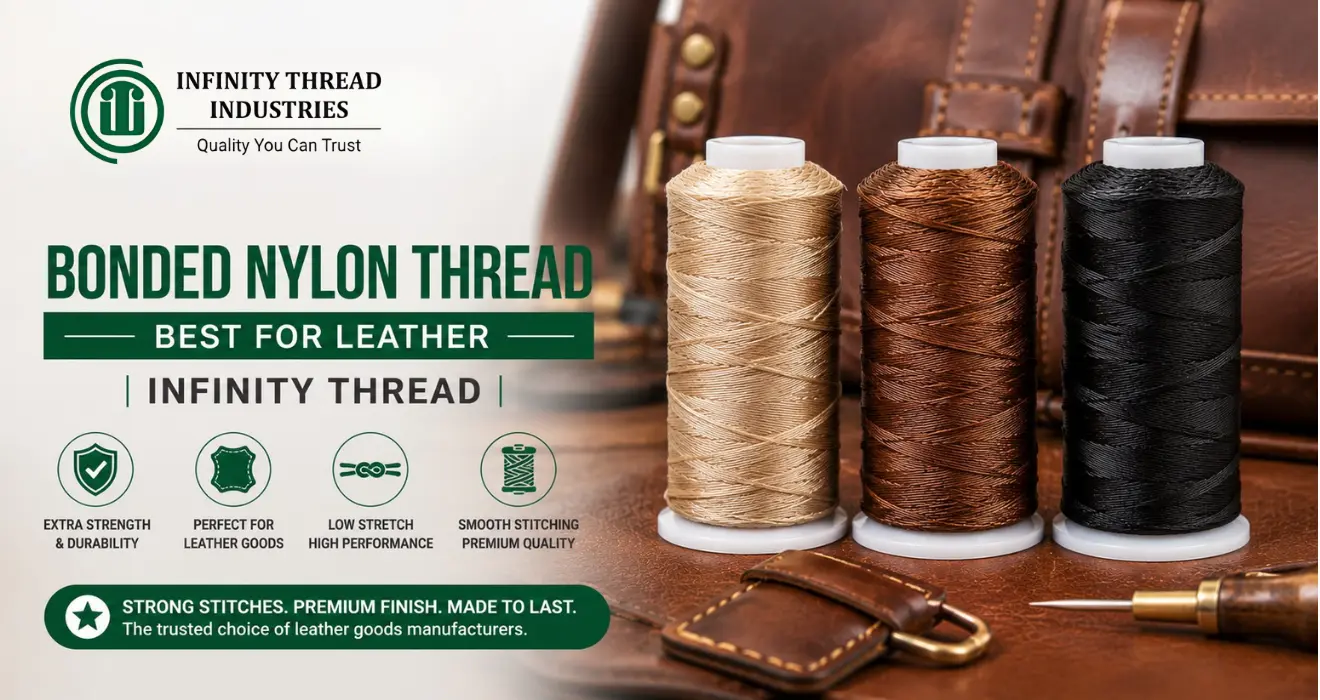
Bonded nylon thread is regular nylon yarn that’s been run through a resin-bonding process heat and a special coating fuse the individual filaments into a single, smooth strand instead of a loosely twisted bundle. It’s used wherever a seam takes repeated friction: leather goods, webbing, lifting belts, heavy bags.
Regular twisted nylon, by contrast, is just plies of filament twisted together with no fusing. Under tension which is exactly what leather stitching applies, seam after seam those plies start to separate. You get fuzzing, then fraying, then a snapped thread mid-shift.
So what does that actually mean on the factory floor? It means a bonded thread holds its shape as the needle punches through stiff leather thousands of times an hour, while non-bonded thread slowly comes apart at the surface. The bonding isn’t cosmetic. It’s the difference between a thread that survives the sewing process and one that just survives the spool.
Why Leather Stitching Demands a Completely Different Thread Category
Leather isn’t fabric. It’s dense, uneven in thickness, and stiff enough that the needle generates real friction and heat with every stitch. Cotton thread chars. Standard nylon thread fuzzes up and breaks. Neither holds a seam line on a leather bag that’s going to be opened, closed, and carried for years.
And here’s the thing leather goods exports from India aren’t a small category anymore. According to the Council for Leather Exports, India’s leather and footwear exports grew 25% in FY 2024-25 to touch roughly USD 5.7 billion, and the council expects that to cross USD 6.5 billion in FY 2025-26. Leather goods specifically bags, wallets, belts, gloves make up close to 27% of that export basket. That’s a lot of seams that can’t afford to fail at a customs inspection or a buyer’s quality check.
Most leather manufacturers don’t think about thread until a batch comes back. We’d rather you think about it before that happens. Seam strength on leather depends on three things working together: the thread’s tensile strength, how smoothly it passes through a stiff, dense material without overheating, and how well it resists abrasion against the rough edges leather creates as it flexes. Regular thread categories were never engineered to do all three at once. Bonded nylon was.
The 5 Core Benefits of Bonded Nylon Thread for Leather Applications
We’ll be honest not every leather product needs bonded nylon. A decorative stitch on a thin leather patch can get away with less. But for anything load-bearing handles, straps, belt loops, footwear uppers these five benefits are what separate a seam that lasts from one that doesn’t.
Abrasion Resistance Why It Saves Your Stitching Lines
Leather rubs against itself, against zippers, against the inside of bags and shoes, constantly. Every rub is a tiny abrasion event on the visible stitching line. Non-bonded thread starts fuzzing within weeks under that kind of repeated friction. Bonded nylon’s resin coating acts like a protective shell around the fibre, so the abrasion happens to the coating first, not the structural strands underneath.
The result: stitching lines on bonded nylon-stitched leather goods routinely outlast the leather’s own surface wear. We’ve had buyers tell us the thread was the last thing to show age on a bag, well after the leather itself had developed a patina.
Smooth Needle Passage How It Extends Machine Life
Here’s a benefit nobody talks about until they’ve burned out three needles in a shift. Bonded nylon’s smooth, fused surface generates far less friction passing through the eye of the needle and through dense leather than a rough, non-bonded thread does. Less friction means less heat. Less heat means fewer melted thread breaks and fewer needle replacements.
For a unit running multi-needle industrial machines for eight or ten hours a day, that’s not a minor convenience. It’s the difference between a smooth production run and a line that keeps stopping for thread snaps and needle changes.
The other three benefits stack on top of these two. Seam strength comes from the fused filament structure holding tension evenly instead of one ply taking the load. Moisture resistance comes from the same bonding process water doesn’t wick into a sealed strand the way it does into loose twisted fibre. And colour stability holds up because the resin coating locks dye into the strand rather than letting it bleed out under friction and handling.
Bonded Nylon vs Bonded Polyester for Leather A Head-to-Head Comparison
This is the question we get asked second-most, right after “what ticket number do I need.” Both are bonded, both work on leather but they’re not interchangeable for every product.
| Property | Bonded Nylon | Bonded Polyester |
| Elasticity | Higher flexes with leather as it stretches | Lower stiffer, holds shape under load |
| Moisture resistance | Good, not waterproof | Excellent, better for wet/outdoor use |
| UV resistance | Moderate can yellow over long sun exposure | Strong holds colour outdoors |
| Best for | Bags, wallets, belts, footwear uppers, indoor goods | Marine leather goods, outdoor luggage, automotive leather |
| Typical ticket range we supply | T-40 to T-90 | T-70 to T-135 |
In my experience, most domestic leather bag and wallet manufacturers default to bonded nylon, and they’re usually right to. It’s got a bit more give, which matters when leather flexes at a fold line or a handle joint. But if you’re making outdoor leather luggage or marine accessories that sit in sun and water for months, bonded polyester is the better call full stop. We tell clients this even when it means selling them less of the nylon thread, because a seam failure six months later costs us the relationship either way.
Industries That Rely on Bonded Nylon Thread in India
Leather goods is the headline use case, but it’s not the only one we ship bonded nylon for. Here’s where it shows up across our order book:
- Leather bags, handbags, and backpacks handle stitching, gusset seams, strap attachments
- Wallets, belts, and small leather goods finer ticket numbers, tighter stitch density
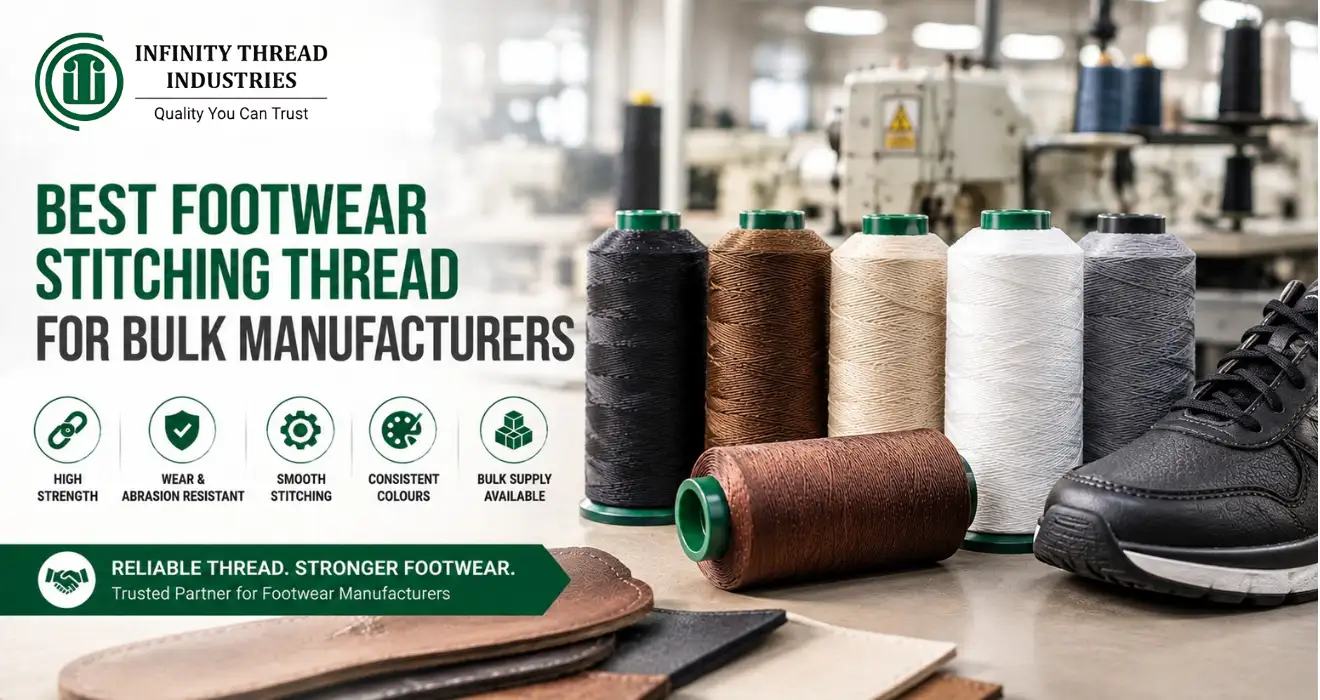
- Footwear uppers leather sneakers, formal shoes, sandals where seam visibility matters
- Leather automotive upholstery seat panels, steering wheel covers, door trims
- Leather accessories and travel goods laptop sleeves, passport holders, watch straps
Most of this demand traces back to India’s position as the world’s fourth-largest exporter of leather goods, with manufacturing clusters in Kanpur, Chennai, Agra, and Kolkata feeding both export orders and the growing domestic premium leather market. We supply units across several of these clusters from our Surat facility, which runs a monthly production capacity of 80,000 kg.
How to Order Bonded Nylon Thread from Infinity Thread Industries
Picking the right bonded nylon thread isn’t complicated once you know what to measure. Here’s the process we walk every new leather client through:
How to Select the Right Bonded Nylon Thread for Leather Manufacturing
- Determine the leather thickness in mm thicker leather needs a higher ticket number to carry the load.
- Decide on the seam type: saddle stitch, lock stitch, or chain stitch. Each puts a slightly different strain pattern on the thread.
- Select the ticket number: T-40 for fine work, T-70 for medium-weight bags and goods, T-90 for heavy-duty straps and handles.
- Match the thread colour to your product’s colour card we carry standard shades and do custom colour matching for bulk runs.
- Test the thread on a sample piece before you commit your full production line to it.
- Call Infinity Thread Industries. We’ll send sample spools so you can test before placing a bulk order.
That last step matters more than people expect. We won’t talk you into a bulk order before you’ve run it on your own machine, on your own leather, at your own stitch tension. Too many thread suppliers skip that step. We’d rather lose a quick sale than a long-term client.
Get a Sample Before You Commit to Bulk Order
We say this to every new buyer, and we’ll say it here too: don’t place a bulk order on a thread you haven’t run through your own machine. Leather thickness varies, machine tension settings vary, and what works on one production line can behave differently on another.
Infinity Thread Industries ships sample spools of bonded nylon thread knotless, well-lubricated, and quality-tested before they leave our facility so you can validate seam strength and abrasion performance on your actual product before placing a bulk order. It costs us a bit more upfront. It saves both of us a returned shipment later.
Frequently Asked Questions
What is the difference between bonded and non-bonded nylon thread?
Bonded nylon thread is coated with a resin that fuses the fibres together, giving it higher abrasion resistance, smoother needle penetration, and better seam strength. Non-bonded thread can fray over time under the same stress, since its plies aren’t fused.
Which ticket number (thread size) is best for leather bags and wallets?
For leather bags, T-70 to T-90 bonded nylon is standard. For wallets and thinner leather goods, T-40 to T-60 usually works better. Our team at Infinity Thread Industries can recommend the right ticket number once we know your leather thickness.
Is bonded nylon thread waterproof?
The bonding process gives bonded nylon excellent moisture resistance, but it isn’t 100% waterproof. For marine or heavy outdoor leather goods, bonded polyester is the better choice it holds up better against UV and sustained water exposure.
Can bonded nylon thread be used on regular industrial sewing machines?
Yes. Bonded nylon thread is engineered to run on standard industrial sewing machines without modification. Its smooth, bonded surface reduces friction at the needle, which cuts down on thread breakage during long production runs.
What colours are available in bonded nylon thread?
Infinity Thread Industries stocks bonded nylon thread in a wide range of standard colours and offers custom colour matching for bulk orders. Reach out to our team for the current colour card and minimum order quantities.
📞 Get a Free Sample or Technical Consultation

Founder of Digi Segment and HV Digital Marketing
SEO Strategist & Digital Marketing Expert
Hardik Vaghani is a digital marketing professional and SEO strategist based in Surat, Gujarat, India. He is the founder of Digi Segment, a content and insights platform covering SEO, digital marketing, AI tools, and online growth strategies, and the founder of HV Digital Marketing, a results-focused digital marketing agency helping local and service-based businesses rank on Google and generate consistent leads.
With hands-on experience in Search Engine Optimisation, Technical SEO, Google Ads, Meta Ads, and Content Strategy, Hardik has helped businesses across industries including e-commerce, real estate, healthcare, home improvement, and solar companies improve their organic visibility, local search rankings, and lead generation through ethical, white-hat strategies.
He specialises in Core Web Vitals optimisation, on-page SEO, keyword research aligned with search intent, and building scalable content frameworks that rank. At Digi Segment, Hardik shares practical, experience-backed insights, case studies, and step-by-step guides to help marketers, entrepreneurs, and small businesses grow online.
When he is not optimising websites, Hardik is building digital tools, writing SEO-focused content, and working with his agency clients to turn Google visibility into measurable business growth.
Expertise: SEO | Technical SEO | Google Ads | Meta Ads | Content Strategy | Core Web Vitals | WordPress | Digital Marketing | Lead Generation | Local SEO