
How the Right Mason Twine Can Make or Break Your Construction Project
A foundation that’s off by even 10mm doesn’t show up on day one. It shows up six months later, when a wall won’t sit flush, a door frame won’t square up, or a contractor is back on site explaining to a client why the layout needs correcting after the slab’s already poured.
Nine times out of ten, when we trace that kind of error back to its source, it isn’t the mason’s eye or the engineer’s drawing. It’s the string they pulled the line with.
What Is Mason Twine and How Do Contractors Use It Every Day?
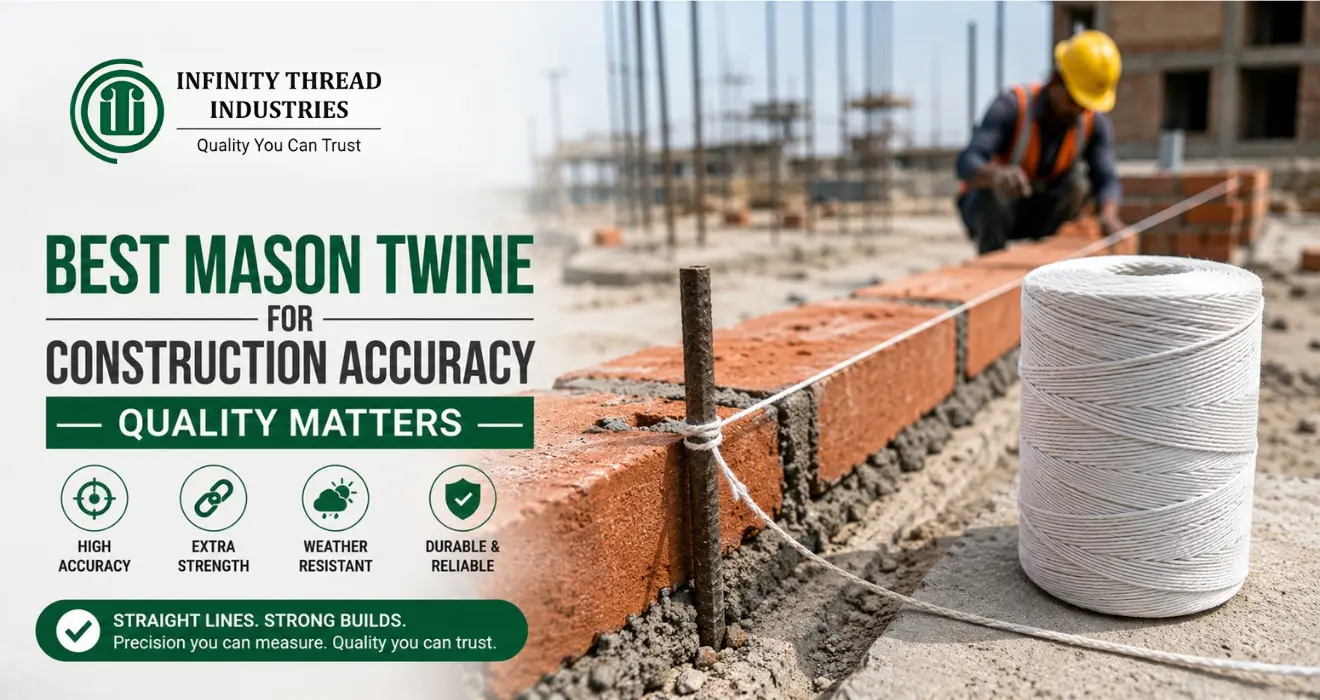
Mason twine sometimes called mason line or masonry string is a strong, thin cord used to mark a perfectly straight reference line on a construction site. It’s tied off between batter boards at the corners of a footprint, pulled taut, and used as the guide for everything that follows: foundation edges, wall alignment, brick courses, and column layout.
Walk any active site and you’ll see it doing quiet, unglamorous work strung across a freshly dug trench, running along a half-built brick wall, marking where the next course needs to sit. It’s not a power tool. It doesn’t show up in the equipment budget. But almost nothing on a site gets built straight without it.
Most contractors use two main types: twisted nylon for general layout work, and braided nylon or polyester for jobs that need extra knot resistance and a longer working life across multiple projects.
The Problem with Low-Quality Mason Line on Construction Sites
Here’s where most of the rework conversations start. A site buys whatever mason twine is cheapest at the local hardware shop, and for the first week, it works fine. Then one of three things happens.
The line sags. PP (polypropylene) twine stretches under tension, especially across longer runs, and that stretch doesn’t recover. A line that read perfectly straight on Monday is bowing by half a centimetre by Thursday and nobody re-checks it, because nobody expects string to move.
The colour fades. Standard white or dull twine disappears against dust, concrete, and bright daylight. Workers misjudge the line, or worse, accidentally cut or snap it because they didn’t see it.
And the line snaps. Low-grade twine frays at the knot points after repeated tensioning and untying exactly the kind of handling mason twine gets, multiple times a day, across a multi-week project.
Any one of these costs time. All three together cost days and on a job where the client is watching the calendar as closely as the budget, that’s the difference between a contractor who gets the next contract and one who doesn’t.
Key Properties That Separate Good Mason Twine from Bad
Good mason twine isn’t fancier. It’s just engineered to not do the three things above.
| Property | Low-Quality Mason Twine | Quality Mason Twine (Infinity Thread) |
|---|---|---|
| Elongation under tension | Stretches, loses line accuracy | Low-elongation polyester, holds true |
| UV exposure | Weakens and degrades within weeks outdoors | UV-stabilized, holds strength across the project |
| Visibility | Fades against dust and daylight | Fluorescent orange/yellow options, clearly visible |
| Knot durability | Frays at repeated tie-off points | Braided construction resists fraying at knots |
Tensile Strength Why Your Line Should Not Sag
A mason line under tension is doing one job: staying perfectly straight between two fixed points, no matter how long the run is. Cheap twine has high elongation, which is engineering language for “it stretches and doesn’t bounce back.” Pull it taut today, and by the time a mason is three courses into a brick wall next week, the line has crept. The wall follows the line. The error compounds with every course laid against it.
Low-elongation polyester mason line resists that creep. It holds the tension you set on day one through to the day the layout work is done which is the entire point of using a reference line in the first place.
UV Stability Critical for Outdoor Construction in India
Indian construction sites don’t get the luxury of mild weather. Mason twine left strung across a foundation in Gujarat or Rajasthan in summer takes direct UV exposure for weeks, sometimes months, on a longer project timeline. Standard, non-stabilized nylon or PP twine loses strength under that kind of sun exposure faster than most site supervisors realise it can look fine and still be far weaker than it was on day one.
UV-stabilized mason twine is built specifically to resist that degradation, which matters most on the projects where the line stays up the longest: large foundations, multi-phase builds, and anything that runs through the hottest months.
Visibility Fluorescent vs Standard Colours on Site
A line nobody can see is a line somebody will trip over, cut, or accidentally knock loose. On dusty, low-light, or crowded sites which describes most active construction sites in India fluorescent orange and fluorescent yellow mason twine stand out clearly against concrete, soil, and scaffolding in a way standard white or grey line simply doesn’t.
It’s a small detail. But it’s the kind of small detail that keeps a layout line intact through a full day of foot traffic and material movement around it.
How a Surat Contractor Saved 3 Days Using Our Mason Line
The scenario below is a representative one drawn from patterns we see repeatedly with contractor clients not a single named, verified case study. We’re flagging that openly rather than dressing it up as something it isn’t.
A mid-sized residential contractor working on a multi-unit plot near Surat had been losing time to a problem they couldn’t immediately diagnose: foundation corners that looked square on layout day were measuring slightly off by the time the footing was poured. Two corrections, two delays, and a supervisor convinced his measuring tape was the issue.
It wasn’t the tape. It was the twine a low-cost twisted PP line that had been creeping under tension across the longer runs on the plot, just enough to throw the diagonal checks off by a few centimetres each time.
Switching to a low-elongation braided mason line solved it in one pass. The line held its position from the morning it was tied to the afternoon the footing was checked and approved no re-measuring, no second layout pass. On a project where each layout correction was costing roughly a day of crew time, holding the line accurately on the first attempt across the remaining plots saved an estimated three days against the original schedule.
It’s a small fix. It’s also exactly the kind of fix that doesn’t get noticed until it’s not a problem anymore.
Why Civil Engineers Are Specifying Mason Twine by Brand Now
A few years ago, mason twine wasn’t something anyone specified by name. It was string buy it locally, use it, move on. That’s changing, and it’s worth understanding why.
India’s construction market is in the middle of a sustained build-out. Industry analysis from Mordor Intelligence puts the Indian construction market at roughly USD 0.79 trillion in 2026, on track to grow at a compound annual rate of nearly 6.9% through 2031. Highway awards, metro expansion, and industrial corridor construction are all running at a pace that leaves very little room in project schedules for avoidable rework.
When schedules tighten and projects get bigger, the small line items that used to be an afterthought including mason twine start getting written into procurement specs. Civil engineers managing multi-crore projects don’t want a layout error six months into a build because someone bought the cheapest string available that week. Specifying a known, low-elongation, UV-stable mason line by brand removes one more variable from a project that already has enough of them.
We’ve watched this shift happen directly in our own order book more site engineers and project managers calling ahead of a tender to confirm specs, rather than a site supervisor calling after a problem.
How to Use Mason Twine for Accurate Building Layout
Good mason twine only delivers accuracy if it’s used correctly. Here’s the process we walk contractors through:
- Set batter boards at each corner of the building footprint, making sure they’re level.
- Tie mason twine between the batter boards at the exact building line position you need.
- Use a line level to confirm the twine is perfectly horizontal before you mark anything off it.
- Check your diagonals. Equal diagonals confirm a true right-angle layout this is the step most layout errors get caught at, if they’re caught at all.
- Keep the twine taut throughout. Even a small amount of sag introduces measurement errors that compound as work progresses.
- Use a premium, low-elongation mason line like ours for zero-stretch accuracy across the full duration of the layout work.
Step four is the one we’d flag if you only remember one. Most layout errors that make it all the way to a poured footing were sitting there in the diagonal check, waiting to be caught and weren’t.
Bulk Mason Twine Supply for Contractors and Construction Companies
Infinity Thread Industries supplies mason twine in twisted and braided nylon and polyester constructions, in standard and fluorescent colours, from our ISO 9001:2015-certified manufacturing facility in Surat, Gujarat. We work with individual contractors on smaller residential plots and with construction companies running multiple sites at once, supplying standard spool sizes as well as custom bulk configurations.
If you’re managing procurement across several active sites, the math is simple: one batch of low-elongation, UV-stable mason line costs a little more upfront than the cheapest option at a local shop. One avoidable layout correction costs a lot more than that difference, in crew time alone.
FAQs
Q: What is the best mason twine thickness for foundation layout?
A: 1.5mm to 2mm braided mason line works best for foundation and column layout. It maintains tension without stretching and stays clearly visible over long distances.
Q: How much mason twine do I need for a typical residential project?
A: For a standard 1,000 sq ft residential plot, you’ll typically need 150–250 metres of mason line. Larger commercial projects need significantly more. We supply in bulk rolls contact us for project-specific pricing.
Q: Does mason twine stretch over time?
A: Low-quality PP twine stretches and loses accuracy. Our mason twine is made with low-elongation polyester that holds its line even under tension, keeping your layout accurate throughout the project.
Q: What colour mason twine is easiest to see on a construction site?
A: Fluorescent orange or yellow is the most visible option, especially in low-light or dusty site conditions. We offer mason line in multiple colours, including standard and fluorescent variants.
Q: Can I buy mason twine in custom spool sizes?
A: Yes. We supply mason twine in standard 100m, 200m, and 500m spools, as well as custom bulk configurations for large contractors. Call +91-96878 93487 to discuss your requirement.
📞 Get a Free Sample or Technical Consultation

Founder of Digi Segment and HV Digital Marketing
SEO Strategist & Digital Marketing Expert
Hardik Vaghani is a digital marketing professional and SEO strategist based in Surat, Gujarat, India. He is the founder of Digi Segment, a content and insights platform covering SEO, digital marketing, AI tools, and online growth strategies, and the founder of HV Digital Marketing, a results-focused digital marketing agency helping local and service-based businesses rank on Google and generate consistent leads.
With hands-on experience in Search Engine Optimisation, Technical SEO, Google Ads, Meta Ads, and Content Strategy, Hardik has helped businesses across industries including e-commerce, real estate, healthcare, home improvement, and solar companies improve their organic visibility, local search rankings, and lead generation through ethical, white-hat strategies.
He specialises in Core Web Vitals optimisation, on-page SEO, keyword research aligned with search intent, and building scalable content frameworks that rank. At Digi Segment, Hardik shares practical, experience-backed insights, case studies, and step-by-step guides to help marketers, entrepreneurs, and small businesses grow online.
When he is not optimising websites, Hardik is building digital tools, writing SEO-focused content, and working with his agency clients to turn Google visibility into measurable business growth.
Expertise: SEO | Technical SEO | Google Ads | Meta Ads | Content Strategy | Core Web Vitals | WordPress | Digital Marketing | Lead Generation | Local SEO