
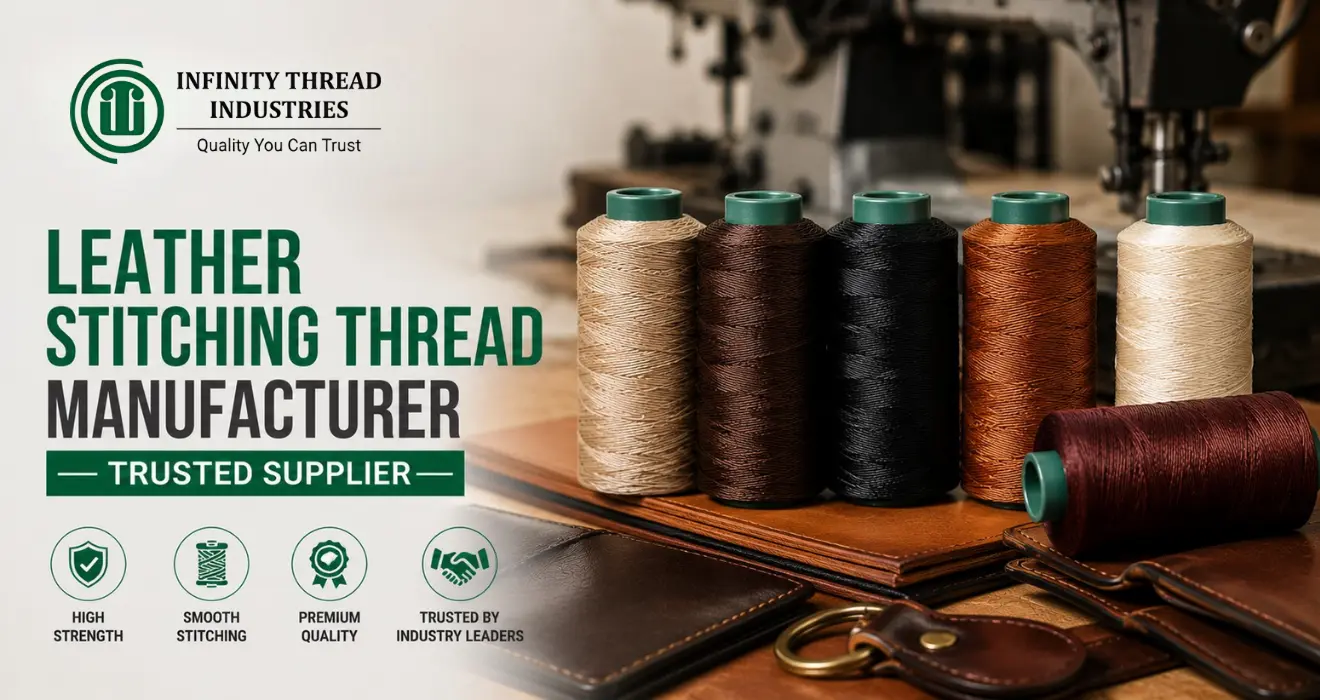
A batch of 4,000 leather wallets, stitched, boxed, ready to ship. Then a customer opens one and the seam has already popped. That single failure traces back to one thing almost every time: the thread. Picking the right leather stitching thread manufacturer is not a small line item on a purchase order. It decides whether your stitching holds for years or unravels in a shopping bag.
Infinity Thread Industries has been manufacturing polyester and nylon threads out of Surat, Gujarat, since 2007, and added dedicated leather stitching thread to its product line in 2022. This guide covers what actually separates a reliable leather stitching thread manufacturer from one that just prints “industrial grade” on the label, based on what we’ve seen supplying stitching solutions to leather goods units across India.
The Short Version
A good leather stitching thread manufacturer controls three things well: tensile strength, consistent lubrication, and colorfastness. Polyester and bonded nylon dominate machine leather stitching because they resist abrasion from the needle and don’t rot with moisture the way cotton does. If a supplier can’t share tensile data or a batch-to-batch consistency report, keep looking.
Why Stitching Fails Long Before the Leather Does
Most leather goods manufacturers don’t think about thread until something goes wrong. A wallet returns with a blown seam. A bag strap separates after three months of daily use. The leather itself is usually fine. It’s the thread that gave out first.
This happens for a few repeatable reasons. Cheap thread has inconsistent tex or denier along its length, so it thins out at random points and snaps under tension. Poor lubrication makes the needle run hot, which can literally melt weaker synthetic threads mid-stitch. And low colorfastness means a black thread bleeds faintly onto tan leather the first time it gets damp.
None of this shows up in a sample swatch. It shows up three weeks into a production run, when 200 units are already stitched.
What to Look for in a Leather Stitching Thread Manufacturer
Tensile Strength and Bond Type
Leather stitching puts thread under real strain, especially at seams, straps, and handle attachments. Bonded nylon and high-tenacity polyester are the two materials that hold up. Bonded thread has a resin coating fused onto the fiber, which raises abrasion resistance and stops the thread from fraying as it repeatedly passes through the needle eye and leather layers.
Definition-First: Tensile strength is the amount of pulling force a thread can take before it breaks. It’s measured in grams or kilograms of force. It matters most on load-bearing seams like bag straps, belts, and shoe uppers, where the stitch takes weight every single day.
Lubrication and Heat Resistance
High-speed sewing machines generate friction, and friction generates heat. A leather stitching thread manufacturer that skips proper lubrication is handing you a thread that softens, sticks, or snaps the moment machine speed goes up. Well-lubricated thread runs cooler and glides through dense leather without dragging.
Colorfastness and Finish
Leather goods are a visual product. A thread that looks fine in the box but fades or bleeds after the first rain is a return waiting to happen. Reliable manufacturers test dye batches against wash and rub standards before the thread ever leaves the factory.
Certification and Batch Consistency
Ask for ISO certification and batch test records, not just a sales pitch. We run our leather stitching thread manufacturing under ISO 9001:2015, and every batch goes through quality testing before it’s packed. That’s the difference between a supplier who talks about consistency and one who can actually document it.
Polyester vs Bonded Nylon: Which Wins for Leather?
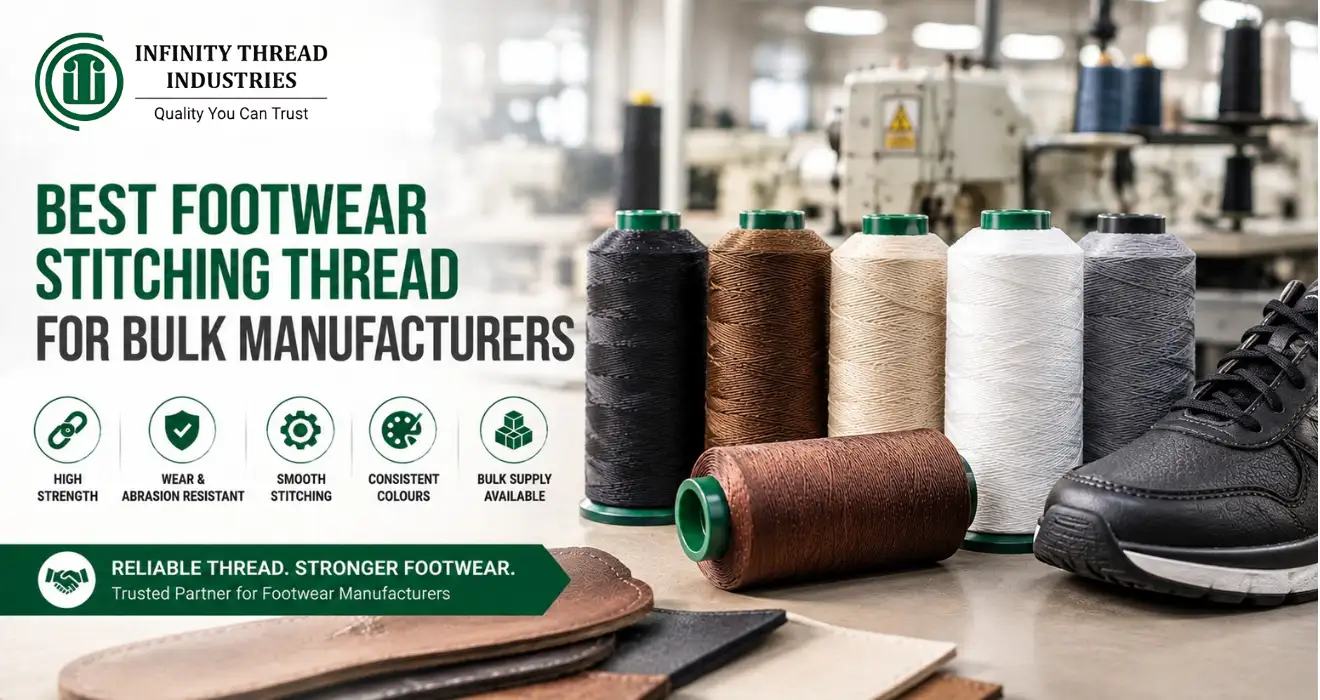
This is the question we get most from new leather goods clients, and honestly, there isn’t one right answer. Polyester holds color better and resists UV fading, which makes it the safer pick for leather goods that sit in shop windows or travel outdoors, like belts and bags. Bonded nylon has slightly more stretch and shock absorption, which suits footwear and heavy saddlery where the seam flexes constantly.
We’ve written a longer breakdown comparing the two in our guide to polyester vs nylon thread, if you want the technical side of it.
Comparison: Polyester vs bonded nylon for leather stitching: UV resistance goes to polyester, flex and shock absorption goes to nylon, and both outperform cotton on abrasion resistance and shelf life.
How Infinity Thread Industries Builds Stitching Thread for Leather Goods
Our facility in Surat runs on a 15,300 sq. ft. floor with a monthly production capacity of 80,000 kg, which is what lets us hold delivery timelines even during festival-season order spikes. Every leather stitching thread we ship is knotless, quality tested, and available in a wide color range so it can be colour-matched to the leather rather than the other way round.
We didn’t start out making leather thread. The business began in 2007 as an embroidery thread shop, moved into denim twisting by 2010, and only added leather and mattress sewing threads to the range in 2022 once demand from garment and leather units in Gujarat made it clear there was a gap. You can read the full story on our about us page.
For heavier leather applications like bag handles or work-boot uppers, we also supply from our high strength industrial threads range, which shares the same tensile testing process.
📞 Get a Free Sample or Technical Consultation
What Actually Happened When We Added Leather Thread to the Line
In 2022, when Infinity Thread Industries first pushed a bonded nylon thread into a leather bag manufacturer’s production line, the early runs weren’t smooth. The thread performed fine on cotton-backed samples but skipped stitches on thicker vegetable-tanned leather. It took switching to a heavier tex count and adjusting the lubrication ratio before the machines stopped skipping.
That client is still ordering monthly, three years later. The lesson stuck with us: leather isn’t one material, it’s dozens of thicknesses and finishes, and thread that works on one won’t automatically work on another. Now we ask about leather type and machine speed before quoting any leather stitching thread order, not after.
What the Data Says About Demand for Leather Thread in India
India’s leather, leather products, and footwear exports reached roughly $4.75 billion in FY2025-26, according to DGCI&S export data reported by APLF. That’s a huge base of stitching demand sitting behind every belt, bag, and boot leaving the country. The Council for Leather Exports, formed in 1984, remains the apex trade body for the sector and reports that the industry employs about 4.42 million people in India, with leather goods production spread across states including Tamil Nadu, Uttar Pradesh, and Maharashtra.
Every one of those production lines needs a thread supplier who won’t cause a line stoppage. That demand is exactly why we expanded into this category in the first place.
Comparison at a Glance
| Thread Type | Best For | Abrasion Resistance | Colorfastness | Typical Use |
|---|---|---|---|---|
| High-Tenacity Polyester | Belts, bags, outdoor leather goods | High | Excellent | Fashion leather goods |
| Bonded Nylon | Footwear, saddlery, heavy seams | Very High | Good | Flex-heavy applications |
| Cotton (legacy) | Light, decorative stitching only | Low | Fades with washing | Rarely used commercially now |
Frequently Asked Questions
Q: What is leather stitching thread made of?
A: Most commercial leather stitching thread today is polyester or bonded nylon, not cotton. Cotton was standard decades ago, but it rots with moisture and frays fast. Polyester and nylon resist abrasion, hold color, and survive the heat generated by high-speed industrial machines.
Q: How do I choose a leather stitching thread manufacturer?
A: Start with tensile strength data and batch consistency records, not just a sample card. Ask whether the manufacturer is ISO certified, request a small trial run on your actual leather (not a generic swatch), and check delivery timelines against your production schedule before committing to a bulk order.
Q: Is bonded nylon or polyester better for leather stitching?
A: It depends on the application. Polyester resists UV fading better, so it suits bags and belts that see sunlight. Bonded nylon flexes more without snapping, which makes it the stronger pick for footwear and saddlery where the stitch bends constantly.
Q: Why does my leather stitching thread keep breaking?
A: Usually it’s one of three things: the tex count is too light for the leather thickness, the lubrication is uneven so friction builds up at the needle, or the tension setting on the machine is fighting the thread’s actual strength rating. Check tension first. It’s the cheapest fix.
Q: What thread thickness works best for leather goods?
A: There’s no single number. Light leather goods like wallets typically run on 40s to 20s tex thread, while heavier applications like bag straps or footwear uppers need a thicker, high-tenacity count. A manufacturer who asks about your leather weight before quoting is doing it right.
Q: How much does leather stitching thread cost in India?
A: Pricing for leather stitching thread varies by tex count, material, and order volume, and shifts with raw material costs. Bulk industrial buyers get meaningfully better per-kg rates than small retail spools. It’s worth getting a direct quote rather than going off a generic price list, since specs change the number fast.
Q: Does leather stitching thread need to be colour-matched exactly?
A: For visible stitching, yes, close matching matters for finish quality. A manufacturer offering a wide colour range, tested for colorfastness, saves you from thread bleeding onto lighter leather after the first exposure to moisture.
Q: Where can I buy leather stitching thread in bulk in India?
A: Bulk buyers usually go direct to a manufacturer rather than a retail supplier, since factory pricing and custom specs (tex, twist, color) only come from the source. Infinity Thread Industries supplies bulk leather stitching thread out of Surat, Gujarat, to leather goods units across India.
Get Stitching Thread That Actually Holds
If your current supplier can’t answer a straight question about tensile strength or batch consistency, that’s your answer already. Choosing a leather stitching thread supplier on price alone is how seams fail later. We’ve also covered related buying questions in our guides to choosing the best industrial thread manufacturer in India and the top thread manufacturers in India, if you want to compare wider than just leather.
For leather goods units in Gujarat and beyond, Nilesh Devani and the team at Infinity Thread Industries handle exactly this kind of order. Reach out through our contact page with your leather type and machine speed, and we’ll recommend a thread spec instead of just selling you whatever’s in stock.

Founder of Digi Segment and HV Digital Marketing
SEO Strategist & Digital Marketing Expert
Hardik Vaghani is a digital marketing professional and SEO strategist based in Surat, Gujarat, India. He is the founder of Digi Segment, a content and insights platform covering SEO, digital marketing, AI tools, and online growth strategies, and the founder of HV Digital Marketing, a results-focused digital marketing agency helping local and service-based businesses rank on Google and generate consistent leads.
With hands-on experience in Search Engine Optimisation, Technical SEO, Google Ads, Meta Ads, and Content Strategy, Hardik has helped businesses across industries including e-commerce, real estate, healthcare, home improvement, and solar companies improve their organic visibility, local search rankings, and lead generation through ethical, white-hat strategies.
He specialises in Core Web Vitals optimisation, on-page SEO, keyword research aligned with search intent, and building scalable content frameworks that rank. At Digi Segment, Hardik shares practical, experience-backed insights, case studies, and step-by-step guides to help marketers, entrepreneurs, and small businesses grow online.
When he is not optimising websites, Hardik is building digital tools, writing SEO-focused content, and working with his agency clients to turn Google visibility into measurable business growth.
Expertise: SEO | Technical SEO | Google Ads | Meta Ads | Content Strategy | Core Web Vitals | WordPress | Digital Marketing | Lead Generation | Local SEO