
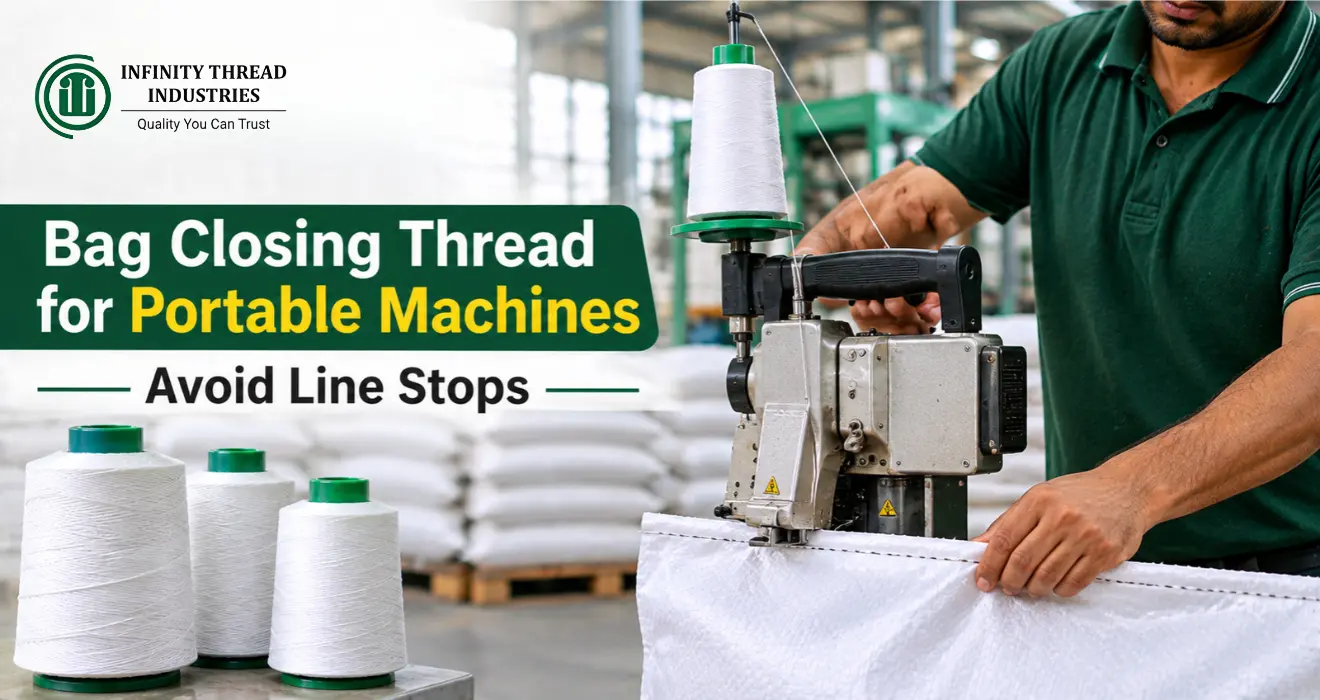
A portable closer runs one cone without a hiccup. Then the operator loads the replacement cone and the machine stops twice in ten minutes. Same size label. Same sack. Same operator.
That gap is why bag closing thread for portable machines can’t be approved on a size label alone. The label gives thickness. It says nothing about cone fit, unwind direction or how the thread forms a stitch on your sack material.
Below is a sample approval checklist you can run before committing to a larger purchase. When you’re ready, send your machine and sack details to us at Infinity Thread Industries and we’ll work from those.
The Short Version
Portable bag closer thread has to match three things: the machine (model, stitch type, needle system), the sack material and the cone (fit, unwind direction, feed path). Approve it with a recorded trial on your own line. If the log shows no stops at the cone change and even stitch formation across one sack batch, you have grounds for a bulk order.
Why a Matching Size Label Isn’t Enough
You send a purchase request that says “same as last time, 840/2, lower rate per kg.” The new lot arrives. Some operators say it feeds differently. Others see no difference. Nobody wrote down which machine, which sack batch or which cone.
Now you’re arguing from memory.
That’s the real problem, and it isn’t always the bag closing thread. It’s the missing record. A bulk order approved without one gives you nothing to hold a complaint against. And on a filling line, a stopped closer holds up every bag behind it.
For general sack thread selection, our guides on woven sack stitching thread and thread denier for woven sack packaging cover denier and seam strength. This post stays on one narrower question: will the thread run on your portable machine?
What Bag Closing Thread Must Match on a Portable Machine
Start with the machine, not the bag closing thread. A sack closing thread that suits one closer can fight another, because the stitch, the needle and the thread path change with the model.
Check them in this order: machine model, stitch type, needle system, sack material. Only then talk about size.
Stitch Type and Needle System
Take two real machines from American-Newlong. The NP-7A is a single-thread chain stitch closer with a DNx1 #25 needle, an 8.5 mm fixed stitch length and a listed speed of 1,700 to 1,900 stitches per minute, according to the AllBrands listing for the NP-7A.
At the low end that’s about 28 stitches every second. A lump or weak spot in the bag closer thread shows up fast at that rate.
The NP-3II is a different animal. Feed & Grain’s directory entry for the NP-3II describes a double thread chain stitch. Two threads means two positions to approve, not one.
Your machine may be neither. That’s the point. Open the manual, find the model, the needle system and the bag closing thread it names, and write all three on the approval record before anything else.
Sack material goes on the record too. The NP-7A listing says it closes paper, cotton, jute, burlap and synthetic fabric bags. One closer, very different sacks. So run the trial on the sack you’ll actually close, not a spare one from the store.
Cone Dimensions and Thread Delivery
When a machine runs one cone and stalls on the next, look at cone fit first.
Record the cone height, base diameter and core diameter in millimetres. Note the unwind direction. Trace how the thread runs from the cone through the guides to the needle, then photograph the cone seated on the holder and the feed path from a second angle.
The AllBrands NP-7A page carries a photo note that the thread must pass through a small guide hole. That’s exactly the detail a photograph catches and a size label never will.
A bag stitching cone that sits differently on the holder shows up in a side-by-side photo. Without the photo, you’re back to arguing from memory.
Want to start from a defined range? The Woven Sack & FIBC Jumbo Bag Thread page lists bag closing thread in 500/2, 600/2, 840/2 and 840 single, made from 100% high-tenacity polyester. Send us a specification or ask for a sample, and we’ll confirm sample availability, charges and quantity for your machine.
📞 Get a Free Sample or Technical Consultation
How to Run a Bag Closer Thread Trial
A trial is only worth doing if you can repeat it. So lock the variables before the first sack.
- Photograph the machine ID plate, the needle and the tension setting.
- Pull one sack batch and use it for every sample.
- Run your current bag closing thread first as the baseline, with the same operator.
- Run each sample on the same machine, at the same settings, with the same operator.
- Let every cone run to empty, then change to the next cone.
- Log every stop and every odd stitch as it happens.
The result is a log you can show a supplier, a supervisor or a purchasing manager.
Don’t change two things at once. If you swap the thread and adjust tension in the same run, you’ve learned nothing about either. And here’s a hard opinion: a trial that never reaches the cone change is unfinished. That’s the exact moment from the opening scenario.
Check Starts, Stops and Stitch Formation
Watch four things.
Starts: does the seam begin cleanly, or does the first stitch skip? Stops: note each break and where it happened, at the needle, between the guides or at the cone. Feed: does the thread pay out evenly, or does it surge? Closure: look at the finished seam from both sides, and photograph anything uneven.
Count breaks per cone, not per shift. A cone is a unit you can compare.
Keep the same log for every sample. If sample A stops once per cone and sample B never stops, that’s a finding about portable bag closing thread you can act on. If both stop at the same spot, the thread probably isn’t the variable.
If breaks cluster at one spot, check the needle, tension and feed path before blaming the bag closer thread. The maker lists a DNx1 #25 needle for the NP-7A, so a wrong or worn needle is a quick thing to rule out.
A Sample Approval Record
One page, filled in on the line:
- Machine ID: model and serial or plant number
- Sample lot: the number on the cone carton
- Operator: name or initials
- Trial length: bags closed, or cones run to empty
- Decision: approve, reject or retest, with the reason in one line
Machine and Thread Compatibility Table
Copy this layout. The first two rows carry published machine facts. Every trial column is yours to fill.
| Machine model | Sack material | Cone format | Trial observation | Approval status |
|---|---|---|---|---|
| American-Newlong NP-7A (single thread chain stitch, DNx1 #25 needle) | Record material and batch | Record height, base and core in mm | Breaks per cone, result at the cone change | Pending |
| American-Newlong NP-3II (double thread chain stitch) | Record material and batch | Record both cones, needle thread and second thread | Breaks per cone, where they occurred | Pending |
| Your machine | Record material and batch | Record height, base and core in mm | Breaks per cone, stitch appearance | Pending |
Trial Notes From a Customer Machine
Everything above is a method. Here’s what it looks like on a real line.
[ADD REAL TRIAL NOTES: machine model, sack material and batch, thread size and lot, trial length, number and location of breaks, date, and confirmation that the customer gave permission for the photographs]
[ADD REAL PHOTOGRAPHS: cone seated on the holder, feed path, finished seam, each with a one-line caption]
One honest limit goes with whatever result sits here. A trial on one machine says nothing certain about another. Different model, different needle system, different sack, different result. Treat any trial, including yours, as evidence for that machine only.
What to Include in a Bulk Purchase Enquiry
Send everything about your bag closing thread requirement in one message. One complete enquiry saves the back-and-forth.
- Size: the size and ply on your current cones, or the label if that’s all you have
- Packing: the cone format and carton style you want
- Monthly demand: in kilograms or cones
- Delivery location: city and state, or the port for export
- Machine and sack: the model, plus a sack sample or a description
We make bulk bag closing thread in Surat. Not sure which range fits your line? Our full product range and application areas show where our threads are used.
Bulk bag closing thread pricing depends on material, construction, finish, pack size, quantity and freight. Ask for an itemised offer, with thread, packing and freight on separate lines, so you compare like with like. A lower rate per kilogram isn’t a lower cost per bag closed.
Portable Bag Closer Thread: Questions Buyers Ask
Q: What is portable bag closing thread?
A: It’s the thread that handheld or portable sack closing machines use to sew the top of a filled bag. The machine manual and the sack’s construction decide which thread suits. Some portable closers run one thread, others run two.
Q: Can one bag closing thread run on every bag closer?
A: No, and assuming it can is risky. A single-thread machine and a double-thread machine need different setups. Confirm the needle system, feed arrangement and cone fit, then run a sample on the machine itself.
Q: Which bag closing thread size should I order?
A: Send your current thread label, your machine model and details of the sack. We’ll propose a replacement from the range, which is listed as 500/2, 600/2, 840/2 and 840 single. You approve it on your line, not on paper.
Q: Why does bag closer thread break near the needle?
A: Check the needle, tension and feed path before you blame the thread. A wrong or worn needle, tension set too high or a snag in the guides can all break thread right at the needle. Write down where each break happens before you change products.
Q: Should I compare cone weight or usable length?
A: Compare the agreed specification and the usable quantity. Gross cone weight includes packaging, and that distorts the comparison.
Q: Can I request a trial quantity?
A: Yes. Ask us to confirm sample availability, charges and quantity for your specification, and say which machine and sack the sample is for.
Q: What determines bulk bag closing thread pricing?
A: Material, construction, finish, pack size, quantity and freight. Request an itemised offer so each of those is visible on its own line.

Founder of Digi Segment and HV Digital Marketing
SEO Strategist & Digital Marketing Expert
Hardik Vaghani is a digital marketing professional and SEO strategist based in Surat, Gujarat, India. He is the founder of Digi Segment, a content and insights platform covering SEO, digital marketing, AI tools, and online growth strategies, and the founder of HV Digital Marketing, a results-focused digital marketing agency helping local and service-based businesses rank on Google and generate consistent leads.
With hands-on experience in Search Engine Optimisation, Technical SEO, Google Ads, Meta Ads, and Content Strategy, Hardik has helped businesses across industries including e-commerce, real estate, healthcare, home improvement, and solar companies improve their organic visibility, local search rankings, and lead generation through ethical, white-hat strategies.
He specialises in Core Web Vitals optimisation, on-page SEO, keyword research aligned with search intent, and building scalable content frameworks that rank. At Digi Segment, Hardik shares practical, experience-backed insights, case studies, and step-by-step guides to help marketers, entrepreneurs, and small businesses grow online.
When he is not optimising websites, Hardik is building digital tools, writing SEO-focused content, and working with his agency clients to turn Google visibility into measurable business growth.
Expertise: SEO | Technical SEO | Google Ads | Meta Ads | Content Strategy | Core Web Vitals | WordPress | Digital Marketing | Lead Generation | Local SEO