
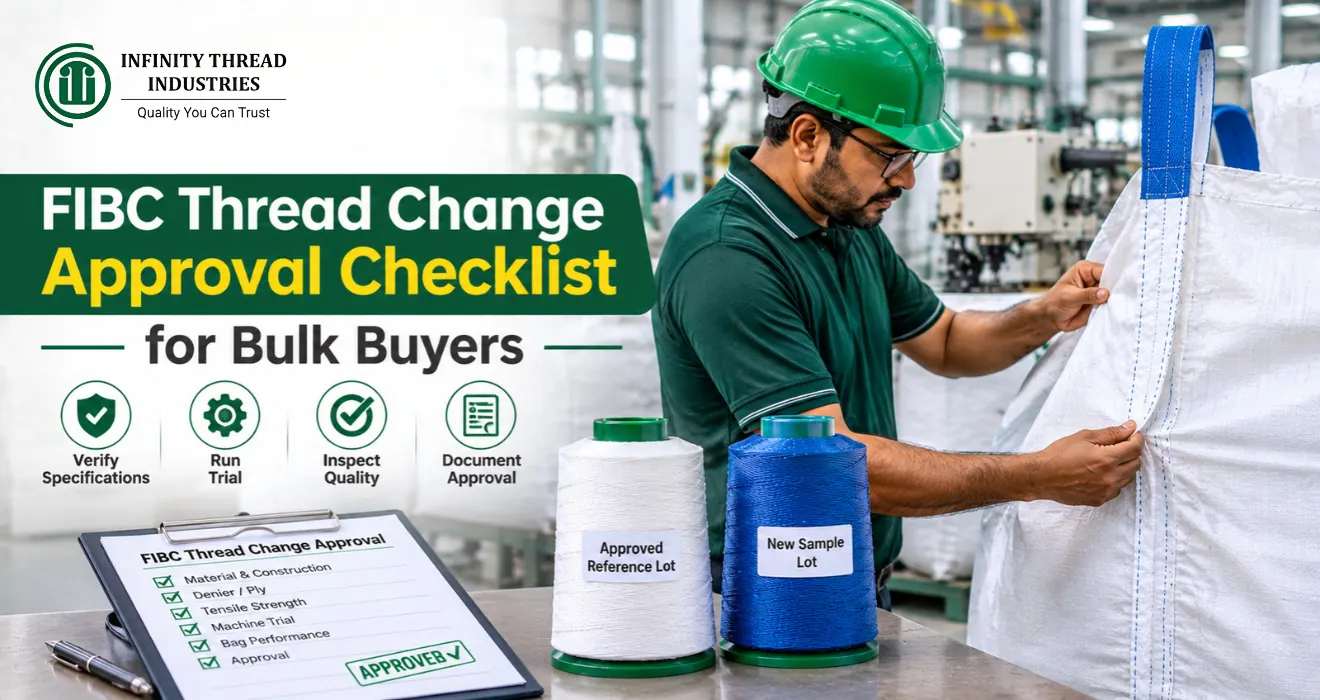
Your current thread supplier can’t cover next quarter’s volume. Purchasing wants a second source, a sample cone arrives, and it looks exactly like the old one. That’s how an unrecorded change slips into a repeat order. FIBC thread change approval is the habit that stops it.
We’re Infinity Thread Industries, a family-owned thread manufacturer in Surat, and we’ve made woven sack and FIBC jumbo bag thread since 2017. This checklist is for the quality manager or buyer who has to handle thread change approval without losing repeatability. Run any supplier through it, us included.
The Short Version
FIBC thread change approval needs three things: a written specification for the new thread, a controlled production trial on your own machines, and validation of the finished bag under the requirements that apply to it. A thread label or a single breaking force figure can’t establish a finished bag rating. The finished bag design and its validation do.
If you need a second supplier, treat the new thread as a change to a qualified process, not a like-for-like swap. We’re a candidate supplier, and your quality team should review our sample and batch documents the way it would review anyone’s.
Why FIBC thread change approval trips up repeat orders
A repeat order runs on a specification. The specification names a thread, a denier and a colour. It rarely names the lot, the finish, the packing or the machine settings the first approval happened on. So when a second supplier appears, thread change approval has nothing to compare against.
That gap has a name in quality systems. If your plant works to ISO 9001:2015, clause 8.5.6 asks you to review and control changes to production so they don’t cause unintended consequences, as NQA’s guide to clause 8 explains. A new thread source is a change to production. Handling it as a purchasing swap skips the review that FIBC thread change approval exists to provide.
We already cover how strength testing works in our guide to FIBC jumbo bag thread strength testing. This post starts one step later: what you do when the supplier changes.
So is a sample cone enough? No. A cone shows that a supplier can wind thread. It tells you very little about how that thread runs on your needles, at your speed, in your seams.
Define the FIBC thread change before sampling
Write the change down before anyone ships a cone. One page is enough, as long as it’s specific. Record four things:
- Material and construction. Fibre, ply, twist and denier. Our woven sack and FIBC jumbo bag thread page lists woven sack stitching thread from 840 to 3000 denier and a 1000/2 thread for FIBC stitching, so name the exact product you mean.
- Finish. Lubrication or coating, UV treatment and colour. White is standard on that page, with custom colours on request.
- Packaging. Cone or spool type, net weight and carton labelling.
- Intended bag design. Bag type, seam type, stitch pattern, machine and needle.
Denier alone won’t settle thread change approval. Our guide to thread denier for woven sack packaging covers denier and tenacity in more depth, and the two travel together.
Keep the current approved reference
Don’t let the old thread leave the building. Seal an unused cone from the approved lot, tag it with the specification revision it belongs to, and file the matching documents beside it.
Why bother? Six months from now, when a seam question comes back, you’ll want to compare the new thread with what was approved, not with what someone remembers. Without the reference cone, thread change approval turns into guesswork. You can’t tell whether the thread changed or the machine did.
Build a jumbo bag thread approval record
One record per change. It links four things: the sample lot, the machine trial, the seam observations and the buyer’s approval. Miss one link and the approval is an opinion, not a record.
Here’s the order we’d follow:
- Log the sample lot ID and the date it arrived.
- Run the trial on a production machine, not a spare one, and note the machine, needle, speed and shift.
- Record seam observations: skipped stitches, thread breaks per run, puckering and lint build-up.
- Repeat the same observations on the reference cone, on the same setup.
- Record the decision, who made it and the revision date.
The result is a jumbo bag thread approval record that someone outside your team can read and follow.
Separate thread data from finished bag qualification
Keep two files. Thread data says what the thread is: construction, finish and the supplier’s strength figures. Finished bag qualification says how the bag performs with that thread in its seams. The second belongs to whoever makes the bag, which is why FIBC thread change approval on the thread side never replaces bag validation.
ISO 21898:2024 sets materials, construction, design, type test and marking requirements for FIBCs meant for non-dangerous solid materials in powder, granular or paste form, according to ISO’s catalogue entry. It’s a standard for the bag. It doesn’t approve a cone of thread.
Stay inside that scope. If your bags carry dangerous goods, ISO 21898:2024 isn’t the document that applies, so your quality team needs to confirm what does for your product and market.
So when someone calls a thread “stronger”, ask two questions. Stronger by which test? And has the finished bag been validated with it? Breaking force is one input. Bag design and the applicable validation set the rating. Thread change approval only keeps the thread side honest.
The change control sign-off
List who signs a FIBC thread change and what they sign for.
- Purchasing: the supplier terms, the specification revision issued, and the delivery documents requested.
- Production: the trial results and machine observations.
- Quality: review of the thread data, the call on what finished bag validation applies, and final release.
Put a revision date next to every name. A signature with no date can’t be matched to a specification revision later. NQA’s clause 8 guidance lists change requests, approvals and records that changes were reviewed before implementation as what auditors expect to see, which makes a fair template for this page.
📞 Get a Free Sample or Technical Consultation
Approval workflow at a glance
Here’s the whole thread change approval workflow on one page.
| Step | Evidence required | Responsible team | Revision | Release status |
|---|---|---|---|---|
| 1 | Current approved reference cone and specification | Quality | Rev ___ | Open |
| 2 | Written definition of the proposed thread: material, construction, finish, packaging | Purchasing with supplier | Rev ___ | Open |
| 3 | Sample lot ID and receipt record | Purchasing | Rev ___ | Open |
| 4 | Machine trial record and seam observations | Production | Rev ___ | Open |
| 5 | Finished bag validation under the applicable requirements | Bag manufacturer’s quality team | Rev ___ | Open |
| 6 | Dated buyer approval | Quality and purchasing | Rev ___ | Open |
| 7 | Lot documents with every delivery | Purchasing with supplier | Rev ___ | Open |
Mark each row Open, Approved or Rejected, and copy the revision number from your specification.
Got a specification and a trial line ready? Send us the specification and ask for a sample of our woven sack and FIBC jumbo bag thread to start your FIBC thread change approval.
Protect repeat orders with batch traceability
Approval happens once. Traceability keeps thread change approval true on the fiftieth delivery.
Agree before the first order what travels with every shipment: the lot identification on the cone or carton label, the specification revision the lot was made to, and the test documents linked to that lot. Ask for them with every delivery, not just the first one.
Our product page says each batch is tested for tensile strength, elongation and friction resistance. Ask for that report by lot number. Then read it against your specification.
Then define what triggers re-approval. A new raw material source, a change of finish, a different packing format or a move to another plant should each reopen the FIBC thread change record. Ask your supplier to tell you in writing before any of those happen.
Our woven sack stitching thread buyer’s guide covers how thread choice shows up in seams. And if you run several bag types, list the intended use for each one. Our application area page shows the industries our threads go into.
Questions Buyers Ask About Approving a New Thread
Q: What is FIBC thread change approval?
A: It’s a documented review done before a new or second-source thread goes into production. The review covers the thread’s specification, a controlled trial on your machines and the effect on the bag design, and it ends with a dated sign-off.
Q: Does stronger thread prove a higher bag rating?
A: No. Breaking force on the thread is one input. The bag’s rating comes from its design, its seams and the validation run under the applicable requirements. A different thread can also change how a seam forms on your machine, so the trial still matters.
Q: Can we complete FIBC thread change approval from a sample cone alone?
A: Not safely. A sample is an input to your process, nothing more. Your quality team decides what production trial and finished product validation the change needs before release.
Q: Which standard covers FIBCs?
A: ISO 21898:2024 covers FIBCs for non-dangerous goods. Confirm the applicable requirements for your actual product and market before you sign off a FIBC thread change, since dangerous goods and other regions can bring different ones.
Q: What lot details should we request from a supplier?
A: Ask for the lot identification, the specification revision the lot was made to and any test documents linked to that batch. Get them with every delivery, not only the first.
Q: Can a thread supplier guarantee our bag certification?
A: No, and treat any promise like that with caution. Thread supply doesn’t establish certification of your finished bag. Agree in writing who is responsible for what.
Q: What information helps a supplier quote a FIBC thread change?
A: Send the approved thread specification, the bag application, your forecast volume, the documentation you need and the delivery location.

Founder of Digi Segment and HV Digital Marketing
SEO Strategist & Digital Marketing Expert
Hardik Vaghani is a digital marketing professional and SEO strategist based in Surat, Gujarat, India. He is the founder of Digi Segment, a content and insights platform covering SEO, digital marketing, AI tools, and online growth strategies, and the founder of HV Digital Marketing, a results-focused digital marketing agency helping local and service-based businesses rank on Google and generate consistent leads.
With hands-on experience in Search Engine Optimisation, Technical SEO, Google Ads, Meta Ads, and Content Strategy, Hardik has helped businesses across industries including e-commerce, real estate, healthcare, home improvement, and solar companies improve their organic visibility, local search rankings, and lead generation through ethical, white-hat strategies.
He specialises in Core Web Vitals optimisation, on-page SEO, keyword research aligned with search intent, and building scalable content frameworks that rank. At Digi Segment, Hardik shares practical, experience-backed insights, case studies, and step-by-step guides to help marketers, entrepreneurs, and small businesses grow online.
When he is not optimising websites, Hardik is building digital tools, writing SEO-focused content, and working with his agency clients to turn Google visibility into measurable business growth.
Expertise: SEO | Technical SEO | Google Ads | Meta Ads | Content Strategy | Core Web Vitals | WordPress | Digital Marketing | Lead Generation | Local SEO