
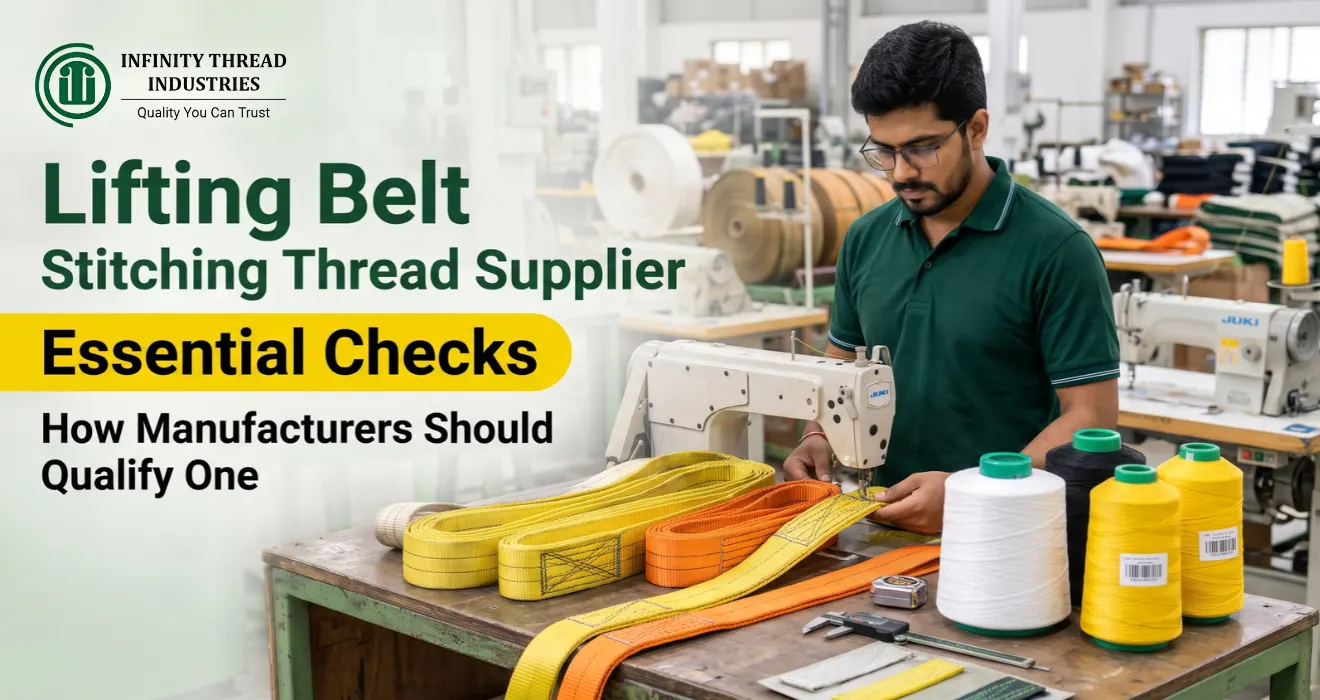
Your usual thread source is late, or the price moved, or one lot ran differently from the last. Purchasing now has a shortlist and a deadline. That’s when a lifting belt stitching thread supplier gets approved on a sample cone and a rate per kg, because those are the two things everyone can see.
Neither one tells you whether the thread belongs in a finished lifting belt. We’re Infinity Thread Industries, a family-owned thread manufacturer in Surat, in business since 2007, and we’d rather you review us against your own specification than against our brochure. This guide shows how to run that review so purchasing, engineering and quality sign off together.
The Short Version
A lifting belt thread supplier should be assessed against your approved drawing and material requirement. Thread size can’t tell you what a finished belt will carry, and neither can a product photograph. Keep three steps apart (document review, manufacturing trial, finished product validation) and keep the final approval with the people responsible for the belt’s design.
Why a Sample Cone Isn’t a Qualification
Say you’re a webbing manufacturer and one supply line has turned unreliable. You ask three lifting belt thread suppliers for samples. Two send cones within a week. The third asks for your specification first.
It’s tempting to read that as slow. It’s actually the right question. A cone in your hand proves the thread exists. It doesn’t show that the thread matches the revision your engineers approved, or that the next lot will match this one.
Define the Lifting Belt Stitching Thread Specification Before You Ask for a Quote
Start from a drawing and material requirement that your own team owns. Not ours. Not a competitor’s data sheet. If your engineers haven’t frozen the thread requirement, a quote has nothing to be based on.
A workable thread specification usually names:
- the fibre (polyester or nylon)
- the construction and count
- the finish and colour
- the packaging format and cone size
- the documents that must ship with each lot
Any lifting belt stitching thread supplier you approach should quote against this list, not against its own catalogue.
For reference, our lifting belt stitching thread entry on our high strength industrial threads page lists sizes from 1000/3 to 3000/3, and the page describes the range as 100% high-tenacity polyester or nylon in a multi-ply twisted construction. Those figures describe the thread. They don’t describe your belt. Nobody should work backwards from a count like 3000/3 to a working load. That number lives in your design and validation records.
Standards sharpen the point. The published scope of EN 1492-1 covers sewn flat woven webbing slings in polyamide, polyester and polypropylene, with webbing widths from 25 mm to 450 mm. Whether that standard applies to your belt is a call for your qualified engineers. For purchasing, the point is narrower: if a standard sits in your approval file, the supplier’s paperwork has to be written against it.
Identify Documentation and Traceability Needs
Ask for three things in writing before the first order. Lot identifiers on every cone or carton. The properties the supplier agrees to deliver. And whatever supporting records exist for those properties. Then decide who checks them when the goods arrive.
Why bother? Because the people downstream will ask. HSE guidance notes that slings need to be uniquely identifiable under UK LOLER rules, and its LOLER overview says lifting equipment must be suitably marked and fit for purpose. Those are UK rules, so check what your own market and customers require. The pattern holds anywhere, though. If a finished belt has to be traced, the lot you bought from your lifting belt thread supplier should be traceable too.
Is that overkill for something as small as thread? Ask yourself how you’d answer if a customer wanted to know which lot went into a returned belt.
Have an approved specification already? Send it with the application and your forecast volume through our contact page. We’ll confirm sample terms with you first. A sample from any lifting belt thread supplier doesn’t replace the review below.
Qualify a Webbing Thread Supplier Through Controlled Review
Here’s the order that keeps everyone honest when you qualify a webbing thread supplier:
- Document review. Compare the supplier’s paperwork against your specification, line by line.
- Manufacturing trial. Run the thread on your machines, under your process controls, and record what happens.
- Finished product validation. Test the finished belt the way your qualified engineers require, then release.
The result is an approval based on evidence rather than on a cone.
Each step answers a different question. The first asks whether the webbing thread supplier understood what you asked for. The second asks whether the thread runs in your process. The third asks whether the finished product still meets your requirements. Skipping one doesn’t save time. It moves the question into the field, where it costs more.
One more thing. A thread test result, however good, is an input. It doesn’t certify a belt. BSI’s catalogue entry for BS EN 1492-1 frames the standard’s technical requirements around use that follows the manufacturer’s instructions and specifications. The belt maker owns that chain, thread included.
Keep Design Approval With the Responsible Manufacturer
Here’s my position. Purchasing shouldn’t approve a thread substitution alone. A lifting belt thread supplier’s sales team shouldn’t either, ours included. We make thread. We don’t design or validate your belts, and a sample from us isn’t a verdict on one.
So route it properly. The change goes through your change control process. Qualified personnel set the standards and the acceptance requirements. Quality confirms the records. Purchasing then handles price and delivery once the technical side has cleared.
A Controlled Supplier Approval Record
One page is enough, as long as it’s controlled. It should hold:
- the specification revision the approval refers to
- the evidence reviewed, with document names and dates
- the name of the person who authorised release, and the date
If a lot behaves differently six months on, that page tells you what was approved, on what evidence, and by whom.
📞 Get a Free Sample or Technical Consultation
Supplier Qualification Matrix (Template)
Copy this lifting belt thread supplier matrix into your approval file. It holds no load capacity and no stitch design data, by intent.
| Required document | Evidence received | Reviewer | Status |
|---|---|---|---|
| Approved thread specification, with revision | Document name, revision, date | Engineering | Open / Approved / Rejected |
| Lot identification scheme | Sample lot label or written scheme | Quality | Open / Approved / Rejected |
| Agreed thread properties | Supplier’s written property list | Engineering | Open / Approved / Rejected |
| Supporting test records | Records the supplier can share | Quality | Open / Approved / Rejected |
| Manufacturing trial record | Your own trial notes | Production | Open / Approved / Rejected |
| Finished product validation | Your own validation report | Responsible engineer | Open / Approved / Rejected |
| Change notification agreement | Agreed written terms | Purchasing and Quality | Open / Approved / Rejected |
| Quality system certificate | Certificate copy with its scope | Quality | Open / Approved / Rejected |
Our About Us page lists ISO 9001:2015. Ask any lifting belt stitching thread supplier, us included, for the certificate copy and its scope. A logo on a website isn’t evidence.
Build the Commercial Quote Around the Approved Specification
Price comes last, on purpose. A rate per kg for “similar” thread is a rate for a different product. Ask every lifting belt thread supplier to quote against the same specification revision, and to write that revision on the quote.
Then agree the practical items in writing:
- packaging format and cone details
- forecast quantities and the call-off pattern
- delivery terms and lead time
- how and when the supplier will tell you about any change to raw material, process or packing
That last item gets forgotten. A silent change is the quickest way for an approved lifting belt thread supplier to stop being one.
Capacity belongs in the conversation too. Our About page lists 80,000 kg a month from a 15,300 sq. ft. facility. When you weigh any lifting belt thread supplier on capacity, the figure matters less than how it maps to your forecast, which is why we ask for forecast volume alongside the specification.
Questions to Put to Every Lifting Belt Thread Supplier
Keep the list short and identical for each one. Which specification revision is this quote based on? How are lots identified? Which records can you share? How will you tell us about a change? A webbing thread supplier who answers all four in writing has already saved you a meeting.
If you’re still comparing options more broadly, our guide to choosing an industrial thread manufacturer in India covers the wider checks. For how thread test data is handled in another load-bearing product, see FIBC jumbo bag thread strength testing. The fibre choice itself stays with your engineers, but our comparison of polyester vs nylon thread explains how the two materials differ. And if you want to see where else we supply, the application area page lists them.
What We Don’t Put in a Quote
We don’t publish working loads for lifting belts, and we don’t recommend stitch patterns. Both depend on a design we haven’t seen and a validation we haven’t run. If any lifting belt thread supplier offers either without seeing your drawing, treat that as a reason to slow down.
Questions Buyers Ask Before Sending a Specification
Can thread size decide how much a lifting belt can carry?
No. A finished lifting product depends on its complete design, how it’s made and the validation it passes. Thread count is one input among many.
What should a lifting belt thread quote be based on?
Your approved thread specification, at a named revision, plus the documents you need shipped with each lot. A quote against “similar” thread can’t be compared with one against yours.
How do I compare one lifting belt stitching thread supplier with another?
Put them on the same footing. Give each lifting belt thread supplier the same specification revision, the same documentation list and the same forecast, then set the answers side by side in your matrix.
Can purchasing approve a thread substitution alone?
Not safely. Follow your change control process and bring in the responsible technical and quality people first. Purchasing joins in on price and delivery after that.
What records support repeat supply of lifting belt thread?
Four are worth agreeing up front: lot identification, specification revision, any test data available, and how changes will be notified.
Does testing one thread lot certify a lifting belt?
No. Thread test data feeds your product qualification process. The belt gets qualified as a finished product.
Should a procurement article recommend a stitch pattern?
This one doesn’t. Stitch design and validation belong with qualified specialists who have your drawing in front of them.
How do I request a supplier review from Infinity Thread Industries?
Send your approved specification, the application, the documentation you need and your forecast volume through the contact page. We’ll come back with sample terms.

Founder of Digi Segment and HV Digital Marketing
SEO Strategist & Digital Marketing Expert
Hardik Vaghani is a digital marketing professional and SEO strategist based in Surat, Gujarat, India. He is the founder of Digi Segment, a content and insights platform covering SEO, digital marketing, AI tools, and online growth strategies, and the founder of HV Digital Marketing, a results-focused digital marketing agency helping local and service-based businesses rank on Google and generate consistent leads.
With hands-on experience in Search Engine Optimisation, Technical SEO, Google Ads, Meta Ads, and Content Strategy, Hardik has helped businesses across industries including e-commerce, real estate, healthcare, home improvement, and solar companies improve their organic visibility, local search rankings, and lead generation through ethical, white-hat strategies.
He specialises in Core Web Vitals optimisation, on-page SEO, keyword research aligned with search intent, and building scalable content frameworks that rank. At Digi Segment, Hardik shares practical, experience-backed insights, case studies, and step-by-step guides to help marketers, entrepreneurs, and small businesses grow online.
When he is not optimising websites, Hardik is building digital tools, writing SEO-focused content, and working with his agency clients to turn Google visibility into measurable business growth.
Expertise: SEO | Technical SEO | Google Ads | Meta Ads | Content Strategy | Core Web Vitals | WordPress | Digital Marketing | Lead Generation | Local SEO