
You changed the filter media in March. By May, seams on the finished elements are opening, and the filter fabric thread on the cone is the one you’ve always run. Nobody on the floor can explain it. Sound familiar?
Filter fabric sewing thread has to match three things together: the fabric, the seam design and the real service environment. A general industrial thread isn’t automatically a high-temperature or chemical-resistant grade. We make polyester and nylon thread at Infinity Thread Industries, a family-owned business in Surat that began in 2007. This guide gives you the specification and trial worksheet we’d use to decide whether a proposed grade suits your application.
The Short Version
Choose filter fabric thread by testing it on your own fabric, with your own seam design, against service conditions you’ve written down. A sewing trial shows how the thread runs and how the seam forms. It doesn’t prove service life. So write the acceptance criteria first, and collect the temperature and chemical evidence before the first cone is loaded. That’s the whole method for filter fabric sewing thread. The rest is detail.
Why a Seam Opens When Nothing Looks Different
Blaming the filter seam thread alone is usually a mistake. A seam is a system: fabric, needle, stitch, tension, and the environment the finished filter sits in. Change the media and you’ve changed the system, even if the label on the cone hasn’t moved.
And a failed seam doesn’t always mean a failed thread. Sometimes the thread is intact and the fabric around it has given way. More on that in the trial section.
Define the Filter Fabric Sewing Thread Requirements First
Grades come second. A grade can’t be judged until you know what it’s being asked to survive, so write down three things before anyone mentions a part number. The general buying advice sits in our industrial sewing thread guide. This guide covers filter fabric sewing thread specifically.
- Fabric construction. Woven, needle felt or knitted. Fibre type, weight, finish or coating, and the batch you’ll test on.
- Seam location. Side seam, bottom seam, top cuff or pocket seam. Each carries a different load and a different exposure.
- Operating environment. Temperature, chemicals, moisture, cleaning method and how long the filter stays in service.
Why this much detail? Because filters aren’t gentle places to work. One European thread maker says industrial filters meet chemicals, oil, moisture and gases as hot as 250 °C, and its filter sewing thread sheet lists separate threads in polyester, polypropylene, polyacrylic, aramid and PTFE.
The sheet’s own starting point is that the thread must be tailored to the filter in use. A polyester filter thread suits some jobs and fails others. No grade is universal.
Our high strength industrial threads page lists filter fabrics among the uses, next to FIBC bags, geotextiles, car seats and tarpaulins. The threads there are polyester or nylon, in deniers from 150D to 3000D. That’s a starting list for filter fabric thread. It isn’t an approval for your filter. The application area page shows the other industries we supply.
State Chemical and Temperature Exposure Precisely
“High heat” and “some acid” aren’t specifications. Give numbers, and give paper:
- Named chemicals, with concentration, and whether exposure is wet or dry
- Continuous temperature, peak temperature and how long the peak lasts
- Cleaning method and how often it runs
- The fabric maker’s data sheet for the exact material
- Any finish limits, such as whether silicone is acceptable in your process
Then comes the part many enquiries skip: evidence. For your exact fabric and exposure, we’d ask for the data you already hold and review the proposed grade against it. We won’t quote a temperature or chemical limit that hasn’t been documented for your conditions. You shouldn’t accept one from any supplier either. With filter stitching thread, an undocumented limit is a guess.
If your conditions point to a fibre outside our polyester and nylon range, the review should say so plainly. Stretching a grade to fit is how the March-to-May problem starts. Still weighing the two base fibres? Our polyester vs nylon thread comparison looks at both for industrial use.
Evaluate Filter Seam Thread on the Real Assembly
A bench strip proves little about filter fabric sewing thread. Sew the real assembly: the actual fabric batch, the actual seam type, on the machine that will run production. Then record what you see in the room, not only what a lab reports later.
Document three things during the filter seam thread run:
- Feed. Does the fabric travel evenly, or does it creep, pucker or stretch?
- Seam appearance. Stitch formation, tension balance, needle holes, and any cut or fused fabric edges.
- Required performance checks. Whatever your filter specification or the thread manufacturer requires for this grade and seam. Run exactly that.
Our view: an industrial thread trial with no pass or fail line written beforehand isn’t a trial. It’s a demonstration. Demonstrations always look fine. Real filters don’t.
📞 Get a Free Sample or Technical Consultation
Read the Failed Seam Before You Blame the Cone
So does a clean run mean the thread is approved? No. Equally, a failed seam doesn’t point at the thread by default. ASTM’s D1683 test method for sewn seams measures seam strength with force across the seam, and it separates failure of the fabric, failure of the thread and slippage of the seam. Use the same split on your own samples:
| What you see | What it often points to | What to check next |
|---|---|---|
| Thread snapped at the stitch | Thread load, tension or abrasion at the needle | Tension, thread path, needle condition |
| Fabric torn along the needle holes | Stitches too dense, or a damaged needle weakening the fabric | Stitch density, needle size and condition |
| Seam pulled open, thread intact | Slippage: fabric yarns pulling out of the seam | Seam allowance, fabric construction, stitch type |
D1683 is written for woven fabrics. For felt or knitted media, agree a method with your technical team first.
The standard also states that it doesn’t predict how a seam wears in service. We wrote about the same pattern on coated cloth in our post on seam leaks in PVC coated fabric: the fabric gets blamed, and the seam is where it fails.
Control the Comparison
Comparing a proposed grade with your current filter fabric thread? Change one thing. Freeze the rest and write the settings on the sheet:
- Fabric batch, ideally the same roll
- Needle type and size, and when it was last changed
- Stitch type and stitch density
- Machine, speed and thread tension
- Operator or shift
Why so strict? Because a new needle, a different roll and a tighter tension each change the result. If three things moved, you can’t say which one mattered. Strength testing on bulk bags follows the same logic, and our post on FIBC jumbo bag thread strength testing shows how we set the load before the test.
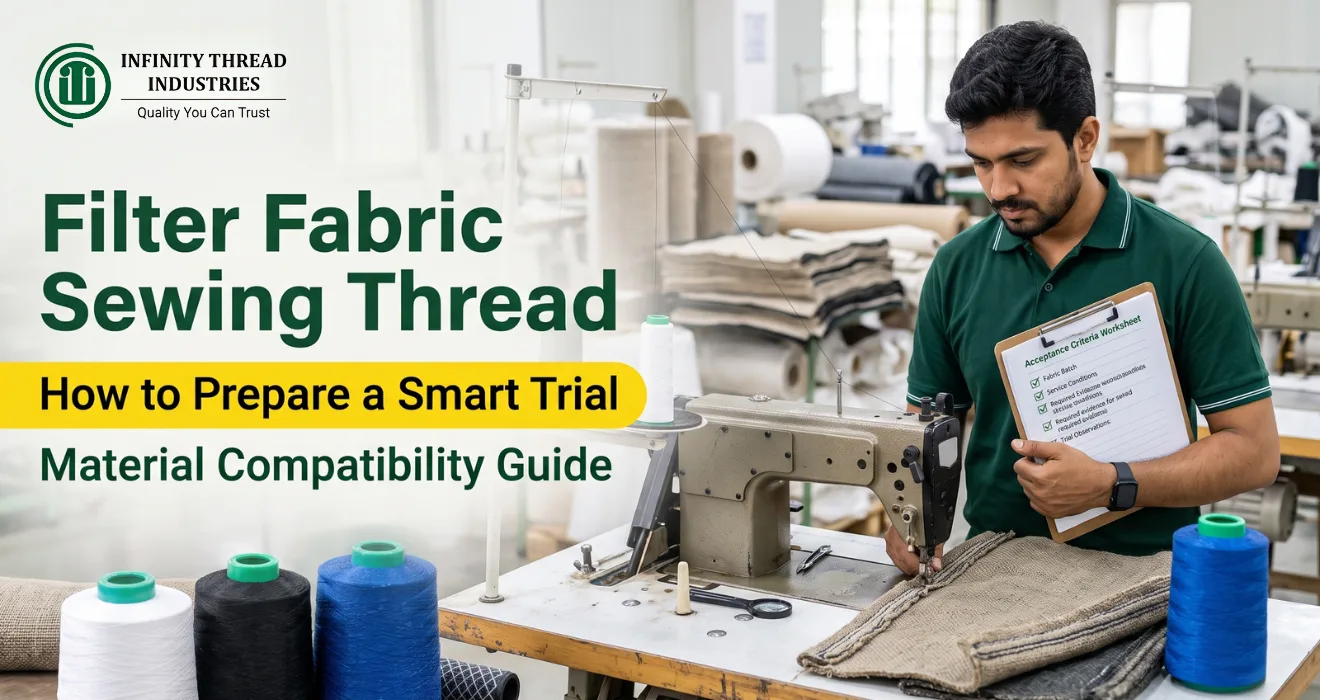
An Acceptance Criteria Worksheet
Keep four things apart: what’s confirmed, how you’ll check it, what you saw and what you decided. Blend them and a “looks fine” note turns into an approval. Fill in the first two columns before you sew anything.
| Item | Confirmed requirement | Test method | Result | Decision |
|---|---|---|---|---|
| Fabric | Construction, finish and batch number recorded | Fabric data sheet and roll label | Record observed result | Approve / reject / more evidence |
| Service condition | Chemicals, temperatures and cleaning cycle stated, with source | Buyer data and fabric-maker evidence for the exact material | Record observed result | Approve / reject / more evidence |
| Required evidence | Evidence list agreed before the trial | Grade-specific review of the proposed thread | Record observed result | Approve / reject / more evidence |
| Trial observation | Feed, seam appearance and breaks logged | Same fabric batch, needle, stitch and machine settings | Record observed result | Approve / reject / more evidence |
| Approval decision | One named person signs | Completed sheet reviewed by the technical team | Record observed result | Approve / reject / more evidence |
Already have a fabric and a seam in mind? Request a filter fabric thread application review by sending a sample or specification. Sample terms are confirmed once we’ve seen your details.
What a Signed-Off Review Should Show
We won’t publish a filter fabric sewing thread result here that nobody has signed. So this section shows the method, and the slot below is for a real review. The method runs in six steps:
- Record fabric, seam and exposure data from the buyer’s own documents.
- List the evidence the proposed filter seam thread needs.
- Sew the real assembly with every setting logged.
- Note feed, seam appearance and any breaks.
- Run the checks the specification requires.
- Have the technical team sign: approve, reject or more evidence.
This worksheet won’t replace the filter maker’s own qualification tests. It’s there so nothing is missing when those begin.
Send a Complete Technical Enquiry
A thin enquiry gets a thin answer. Send what you have, and we’ll ask for the rest instead of guessing:
- A drawing or a clear photograph of the seam
- The approved specification for the fabric and the finished filter
- Fabric information: construction, finish and batch
- The filter fabric sewing thread you run today, with its grade and supplier
- Operating conditions, with supporting documents
- Machine details: type, needle and speed
- Forecast demand, as a monthly thread requirement
If the filter is one part of a larger stitching job, the full thread and twine range shows what else we make.
Filter Fabric Thread Questions Buyers Ask
Q: What thread is suitable for filter fabric?
A: Filter fabric thread depends on three things: the fabric, the seam design and the service conditions. One filter may suit polyester while another needs polypropylene, polyacrylic, aramid or PTFE, which is how one European maker lists its range. Ask for a grade-specific review against your exact conditions.
Q: Is polyester suitable for every filter?
A: No. A polyester filter thread has limits, and some environments need specialist materials, usually where temperature or chemical exposure is severe. Confirm the exact operating conditions before choosing any fibre, and ask for the evidence in writing.
Q: Can sewing trials prove service life?
A: Not on their own. A sewing trial shows processing behaviour: how the thread runs and how the seam forms. Service performance needs the application-specific evaluation the manufacturer requires, and ASTM D1683 itself says its seam test doesn’t predict how a seam wears in use.
Q: Why can a seam fail with unbroken thread?
A: Because the thread isn’t the only part carrying the load. Fabric damage, stitch formation or seam design can each open a seam while the thread stays intact. Examine the complete assembly, including needle holes and fabric edges, before you blame the cone.
Q: What details should the supplier receive?
A: Fabric information, seam design, operating conditions, machine details and the approved filter seam thread specification. A seam photograph or drawing speeds things up. So does a monthly demand figure.
Q: Can I request custom packing?
A: Ask for it in the enquiry. Packing options are confirmed for the chosen grade and trial quantity, so say which cone or spool format your machines take.
Q: How is bulk pricing calculated?
A: Against five confirmed inputs: construction, finish, quantity, packaging and delivery terms. Until those are fixed, no honest per-kg figure exists. Request a quote for your filter fabric thread once the specification is settled.

Founder of Digi Segment and HV Digital Marketing
SEO Strategist & Digital Marketing Expert
Hardik Vaghani is a digital marketing professional and SEO strategist based in Surat, Gujarat, India. He is the founder of Digi Segment, a content and insights platform covering SEO, digital marketing, AI tools, and online growth strategies, and the founder of HV Digital Marketing, a results-focused digital marketing agency helping local and service-based businesses rank on Google and generate consistent leads.
With hands-on experience in Search Engine Optimisation, Technical SEO, Google Ads, Meta Ads, and Content Strategy, Hardik has helped businesses across industries including e-commerce, real estate, healthcare, home improvement, and solar companies improve their organic visibility, local search rankings, and lead generation through ethical, white-hat strategies.
He specialises in Core Web Vitals optimisation, on-page SEO, keyword research aligned with search intent, and building scalable content frameworks that rank. At Digi Segment, Hardik shares practical, experience-backed insights, case studies, and step-by-step guides to help marketers, entrepreneurs, and small businesses grow online.
When he is not optimising websites, Hardik is building digital tools, writing SEO-focused content, and working with his agency clients to turn Google visibility into measurable business growth.
Expertise: SEO | Technical SEO | Google Ads | Meta Ads | Content Strategy | Core Web Vitals | WordPress | Digital Marketing | Lead Generation | Local SEO